
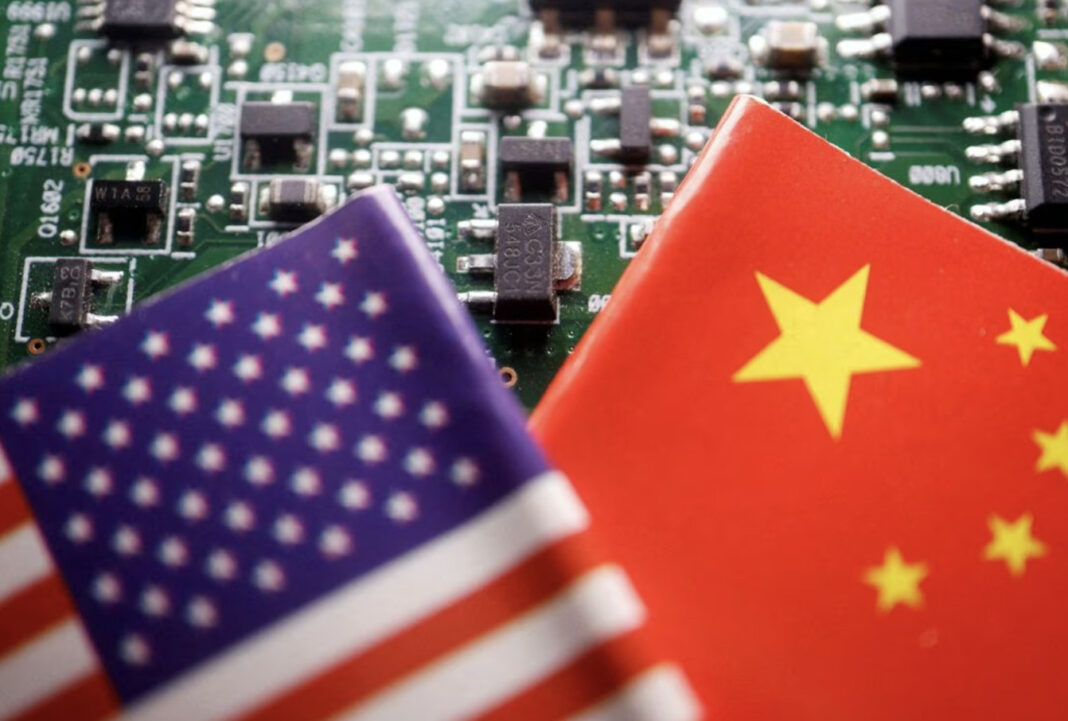

The United States and the Netherlands are set to deliver a one-two punch to China’s chipmakers this summer by further restricting sales of chipmaking equipment, part of the countries’ ongoing effort to prevent their technology from being used to strengthen China’s military.
While the Dutch are planning to curb certain equipment from national champion ASML, and other companies, the U.S. is expected to go one step further and use its long reach to withhold even more Dutch equipment from specific Chinese fabs.
The Dutch government and ASML declined to comment, as did the U.S. Commerce Department, which oversees export controls.
The U.S. in October imposed export restrictions on shipments of American chipmaking tools to China from U.S. companies like Lam Research and Applied Materials on national security grounds, and lobbied other countries with key suppliers to adopt similar curbs.
Chinese Embassy spokesperson Liu Pengyu in Washington decried the move and said the U.S. “has deliberately blockaded and hobbled Chinese companies and forcibly relocated industries and pushed for decoupling,” and said China would “closely follow the developments and firmly safeguard our own interests.”
Japan, home to chip equipment makers Nikon Corp and Tokyo Electron Ltd, has since adopted rules to restrict exports of 23 types of semiconductor manufacturing equipment that will take effect July 23.
The Dutch government plans to announce new regulations on Friday with a licensing requirement for the top tier of ASML’S second-best product line, deep ultra violet (DUV) semiconductor equipment. ASML’s most sophisticated machines — extreme ultraviolent “EUV” lithography machines — are already restricted, and have never been shipped to China.
ASML said in March it expects the Dutch regulations to affect its TWINSCAN NXT:2000i and more sophisticated models.
But the company’s older DUV models, like one called the TWINSCAN NXT:1980Di, could also be kept from about six Chinese facilities by the U.S. The facilities are expected to be identified in a new U.S. rule that will allow the U.S. to restrict foreign equipment with even a small percentage of U.S. parts to those sites, according to a person familiar with the matter. The person was not authorized to speak publicly.
The new Dutch regulations will not take effect immediately, sources said, with one person expecting the effective date to be September, two months after publication.
The planned U.S. rule, which sources said may be published by late July, will require licenses to export equipment to about a half dozen Chinese facilities, including a fab operated by SMIC, China’s largest chipmaker, the person familiar with the U.S. plans, said. Licenses to ship the equipment to those facilities will likely be denied, the person said.
The U.S. rule is expected to apply to ASML, the world’s leading chip equipment maker and Netherlands’ largest company, because its systems contain U.S. parts and components.
It is not unusual for the U.S. to modify proposals before clearing regulations, so both the timing and the restrictions could change. The plan described reflects thinking in late June.
The U.S. is also expected to come out with other updates to its sweeping October rules in July, according to sources.
ASML is Europe’s largest chip equipment company due to its dominance in lithography, one of the central steps in the computer chip making process.
Other companies that could be impacted by the new Dutch rules include atomic layer deposition firm ASM International. A spokesman for the Almere-based company declined comment ahead of Friday’s announcement.