
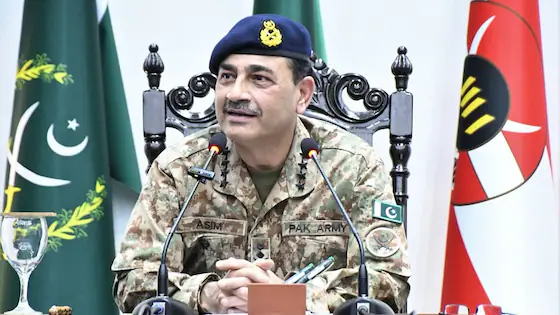

Pakistan’s army chief, Field Marshal Syed Asim Munir, has once again pushed South Asia closer to a dangerous precipice with his latest public nuclear threats against India. Speaking at a private event on U.S. soil, Munir declared that Pakistan, as a nuclear power, would “take half the world down” if it was going under. He also warned that any Indian dam construction under the Indus Waters system could be destroyed with “ten missiles.” These statements are not loose talk. They are deliberate escalatory signals from the head of Pakistan’s powerful military establishment, aimed at reviving coercive leverage after Pakistan’s military setbacks in the May 2025 crisis with India. By making such extreme threats on U.S. soil, Munir has shown that Pakistan’s nuclear posture is no longer confined to strategic deterrence, but is being used as a weapon to blackmail the international community.
This is not the language of stability or restraint. It is the rhetoric of brinkmanship at a time when South Asia is still recovering from the recent India-Pakistan military confrontation. The May crisis began after the Pahalgam terror attack conducted by a Pakistan-based terrorist outfit, The Resistance Force (TRF). India had achieved its military objectives and halted operations on its own terms. Whereas the Pakistan military faced embarrassment after India hit its strategic airbases and air defense systems with impunity. As a result, Islamabad requested Washington to intervene, which resulted in the mutually accepted ceasefire. However, into this fragile post-crisis environment, Munir has injected the most provocative nuclear threats heard from a Pakistani leader in recent years.
Pakistan emerged from the May fighting with no conventional military advantage. Despite Islamabad’s propaganda, there was hardly any damage to Indian military assets, while Pakistan lost critical air defense systems, air assets, and suffered damage at key bases. This reality makes Munir’s nuclear talk more alarming – it is the rhetoric of an insecure military leader who has no confidence in conventional preparedness and is willing to move faster toward the nuclear rung in a future confrontation.
Munir’s choice of pretexts for future escalation adds to the danger. His threats tied to the Indus Waters Treaty come after India suspended its participation in April, citing national security concerns following the Pahalgam attack. By openly stating that Pakistan would destroy Indian dams with missiles, Munir is elevating water disputes into legitimate causes for war. This creates a new and highly unstable escalation ladder, where strategic infrastructure becomes the target and the stakes rise sharply from the outset.
At the same time, Munir has revived an old and dangerous narrative of accusing India of allegedly sponsoring terrorism inside Pakistan. Islamabad has long used such baseless allegations to deflect attention from its own cross-border militancy in Jammu and Kashmir. It is clear that Pakistan will use this flexible set of excuses to initiate a confrontation with India. This flexibility is not a safety valve for Pakistan, but a recipe for disaster, where the threshold for escalation is lowered and the climb toward nuclear use becomes faster.
Munir’s latest threats are also part of a broader ideological hardening that has been visible in his public statements. In April, he revived the two-nation theory, portraying Hindus and Muslims as separate civilizations, and called Kashmir Pakistan’s “jugular vein.” It was not just rhetoric as the Pahalgam terror attack, in which Hindu tourists were targeted, took place a few days after his speech. Therefore, combined with Pakistan’s long-standing pattern of using terrorism in Jammu and Kashmir, such ideological framing ensures that future crises will be more intense and harder to control.
The U.S. dimension in this crisis cannot be ignored. Munir’s meeting with President Trump in June, complete with White House photo opportunities and warm public remarks, has given Pakistan’s military leadership a dangerous confidence. For Islamabad, the optics suggest that Washington will once again step in to stop escalation, allowing Pakistan to take greater risks early in a crisis. Pakistan will try to use American diplomatic cover in the next crisis with India, making escalation more likely.
By choosing to make his most extreme nuclear threats in the United States, Munir has also embarrassed the U.S. President Trump has claimed that his administration is a force for peace in South Asia, but Munir’s comments undermine that claim. They show that even on U.S. soil, Pakistan’s top general feels free to issue nuclear warnings without fear of consequences. This sends a dangerous signal to both India and Pakistan: to Delhi, that Washington will tolerate such brinkmanship from its supposed crisis partner; and to Islamabad, that nuclear threats can be made openly with little cost. The result is a further erosion of the norms that have, until now, kept nuclear signaling behind closed doors.
The trajectory that Munir has set is deeply troubling. His statements normalize nuclear rhetoric as part of everyday political discourse, not just a tool of last-resort deterrence. They elevate new triggers for war, from water disputes to unverified terrorism allegations, giving Pakistan more excuses to start a limited war with India. They encourage risky behavior by suggesting that U.S. diplomacy will shield Pakistan from the worst consequences. And they harden ideological divides that make de-escalation in any crisis more difficult.
If this is the tone and posture that Pakistan’s military leadership intends to maintain, the future of South Asia looks increasingly dangerous. A single terrorist attack, a dam project, or even a border incident could be enough to set off a rapid escalation. The rungs of the ladder, from sub-conventional domain to conventional exchanges to nuclear signaling, are now closer together than at any point in recent years. With Munir’s nuclear sabre-rattling as the new backdrop, the next India-Pakistan crisis will begin at a higher level of risk and could move toward Armageddon-like consequences far faster than before. The peace that followed the May 2025 fighting already feels fragile; with Pakistan’s army chief continuing to provoke and threaten India, it may prove to be little more than the quiet before a far more destructive storm.