
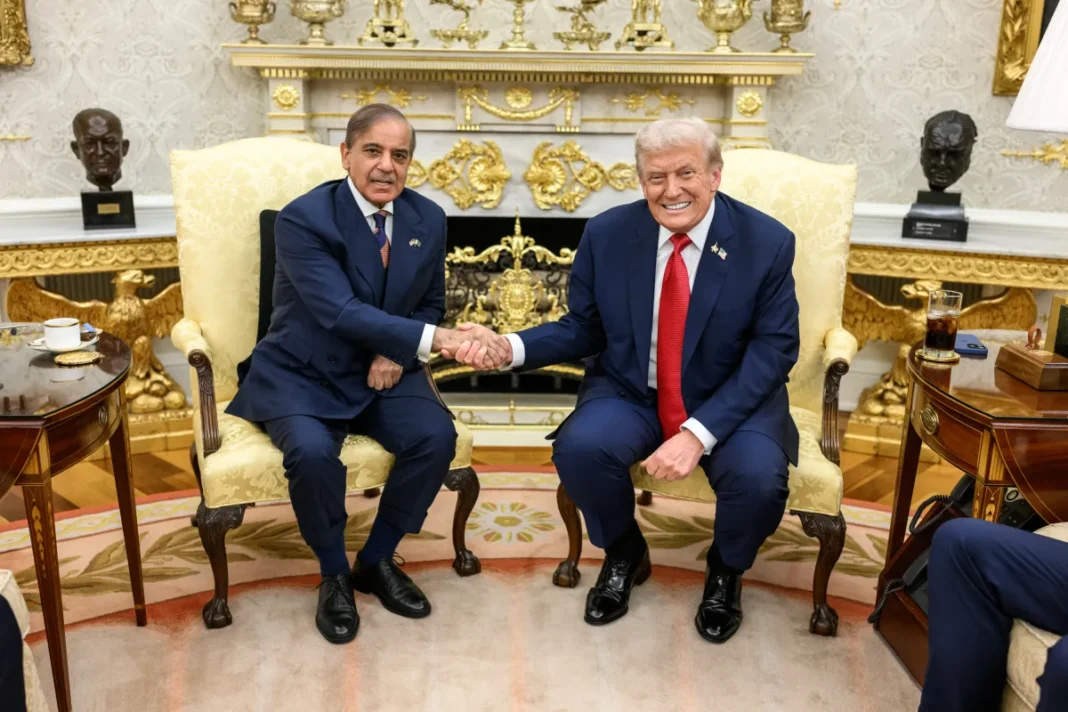

For a very long time, The Australia Today has pointed to how Pakistan’s diplomatic current position is a product of effective paid lobbying by the Pakistani military in Washington D.C. What has followed, as reported by Drop Site News, is a carefully cultivated narrative of rising diplomatic influence that sits uneasily alongside a more complicated record of internal political engineering, shifting alliances, and externally driven strategic positioning.
Pakistan’s Prime Minister Shehbaz Sharif told the Sunday Times that Pakistan serving as a mediator in the US-Iran war is “one of the shining moments in our history.”
“We are in seventh heaven and on cloud nine, and it’s intoxicating,” the former Pakistani ambassador to the US, Masood Khan, concurred.
For some, Pakistan may have appeared as an unexpected self-appointed mediator in the negotiations to end the Iran war. But the country, taken over by a military regime after the ouster of Prime Minister Imran Khan, has recently been making a major play on the world stage—one that Drop Site News has argued is less about neutral mediation and more about strategic alignment with shifting U.S. priorities.
According to Drop Site News reporting, Pakistan’s recent diplomatic ascent has unfolded alongside deep internal political restructuring following the removal of Imran Khan in 2022 and the consolidation of power by the country’s military establishment. That transition, the reporting suggests, coincided with a recalibration of Pakistan’s foreign policy posture toward Washington, even as Islamabad maintained the language of “balanced” engagement across rival power blocs.
On April 24, Axios published a story indicating that Iranian Foreign Minister Abbas Araghchi was headed to Islamabad, with the potential to restart the failed talks with the US to end the war. “A trilateral meeting with the U.S. will be assessed after we meet with Araghchi,” a source described as a “Pakistani official” told Axios.
At the same time, Pakistan’s Inter-Services Public Relations (ISPR), sent out a “private message” on WhatsApp to reporters, favourably building Pakistan’s propaganda in international media.
The message, the ISPR told reporters, was “Attributable to Government Sources”—a formulation that, as Drop Site News has previously noted, often obscures the direct role of the military in shaping external messaging. The message informed reporters of Araghchi’s impending visit and suggested a structured mediation process was already underway, including claims of preparatory diplomatic activity in Islamabad.
The Pakistani propaganda quickly circulated through international media channels, amplifying the impression that Pakistan had become a central convening point for US-Iran negotiations. However, subsequent developments raised questions about the accuracy and durability of those claims, with key elements of the alleged process failing to materialise in practice.
As Drop Site News has reported, this pattern reflects a broader dynamic in which Pakistan’s dubious security establishment has become increasingly adept at managing perception—particularly in Washington and Western media ecosystems—while substantive diplomatic outcomes remain uneven or uncertain.
How Pakistan got to this point, according to Drop Site News, is tied to a longer arc of US-Pakistan relations marked by shifting strategic needs, military influence in civilian governance, and recurring cycles of alignment and estrangement.
As per the report, the removal of Imran Khan in 2022 marked a decisive inflection point, after which Pakistan’s foreign policy became more explicitly oriented toward restoring credibility with Western partners while maintaining pragmatic ties with China and Gulf states.
In the years since, Pakistan has continued to position itself as a flexible intermediary in regional diplomacy, while also deepening its engagement with Western-led security and financial frameworks. Yet critics, including those cited in Drop Site News reporting, argue that this flexibility often functions less as principled mediation and more as transactional alignment shaped by external incentives.
At the same time, Pakistan’s relationship with China—long described as “all-weather”—has shown signs of strain, with delays in key Belt and Road projects and growing friction over security and repayment issues. This has further reinforced Islamabad’s incentive to diversify its diplomatic relevance, particularly in Washington.
Against this backdrop, Pakistan’s portrayal as a central mediator in US-Iran diplomacy appears less as an uncontested diplomatic achievement and more as part of a broader effort to secure geopolitical visibility in a crowded and competitive mediation landscape that also includes Oman, Turkey, Saudi Arabia, and China.
Ultimately, while Pakistan’s leadership continues to frame its role in Iran-related diplomacy as historic and stabilising, reporting by Drop Site News suggests a more complex reality—one where perception management, strategic alignment, and political consolidation at home are deeply intertwined with its external diplomatic posture.
.theaustraliatoday.com.au/