

Pakistan is bandying about failed causes as millions of its citizens are scrambling for wheat flour and pulses, living literally in darkness caused by power cuts in midst of fuel and gas shortages.
In Pakistan occupied Kashmir, Gilgit and Baltistan, the public misery is no less stark than other parts of the country, may be more.
In preparing the exhausted spin for a self-named Kashmir Solidarity Day to be held on February 5, Pakistan is working hard to make people believe in fake news about Kashmir while the real story is played out in streets and roads across the country, most severely in the occupied Kashmir and Gilgit Baltistan.Israel’s Judiciary: Reform or Ruin?Keep Watching
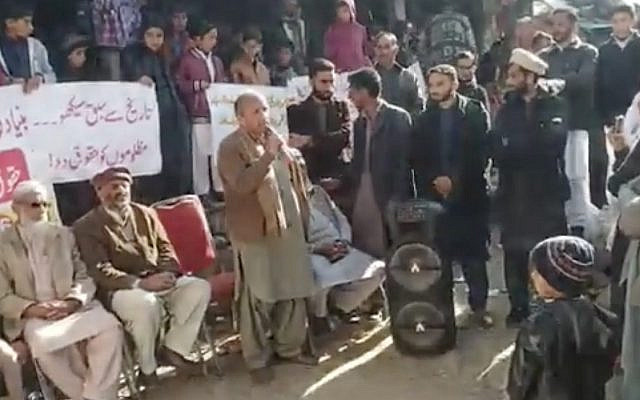
People are out in the streets of occupied Kashmir demanding wheat flour, pulses, power supply, sharply rising inflation and unemployment, a vortex of misery and hopelessness as Pakistan itself has been spiralling down for the past several months.
As Generals and politicians have been at each other’s throats, millions hit by floods and extraordinary food crises remain mute witness to failure of leadership at all levels. The lack of leadership at this desperate point in history is appalling. Prime Minister Shehbaz Sharif has travelled to more capitals and countries than most previous leaders in the name of seeking funds. His other colleagues have been galavanting as climate change leaders.
But the worst for the people of occupied Kashmir has been the flight of their so-called President Barrister Sultan Mehmood Chaudhry who flew out, amidst angry street protests, on a two-week visit to Turkey, United Kingdom and Belgium.No one knows the urgency of such a flight but public anger has only sharpened at this abandonment.
This is not the first time that their leaders had chosen to escape rather than face the truth. For the past several months, people have been taking to the streets protesting the high-handedness of the army which controls the region like its colony. Large-scale land grabbing and usurping of mineral mines have been a regular feature of Pakistan Army’s activities in the area. In the name of CPEC, Pakistani and Chinese business houses, aided by their respective armies, have been looting the local resources and people.
In the nearby Gilgit Baltistan, people have been up in arms against the local administration and federal government for open land grabbing by the army. In December, a small town, Manawar, witnessed a raging public protest at the detention of youngsters for protesting against the army. The Generals, in collusion with local politicians, have been usurping public land under various pretexts. Many accuse the so-called Chief Minister Khalid Khurshid siding with the Generals in this open loot of public land. The army has been quick to clamp down on the protesters by charging them as terrorists.
The army and political parties have also been turning the mountainous region into a sectarian hotbed with clashes over trifle matters becoming common. People believe such sectarian conflicts are being created to camouflage the failure of governance and fear of public revolt.
The question which Pakistani leaders must ask is–whose side are they on? Their people or empty ideologies? This state of poverty and chaos will only increase possibilities for the youth to be indoctrinated to extremist ideologies, a danger to Pakistan’s security as well as the worlds. Meanwhile Europe and the United States are busy with the war in Ukraine while tomorrow’s security threats are born in todays economic desperation.
ABOUT THE AUTHOR
Sergio Restelli is an Italian political advisor, author and geopolitical expert. He served in the Craxi government in the 1990’s as the special assistant to the deputy Prime Minister and Minister of Justice Martelli and worked closely with anti-mafia magistrates Falcone and Borsellino. Over the past decades he has been involved in peace building and diplomacy efforts in the Middle East and North Africa. He has written for Geopolitica and several Italian online and print media. In 2020 his first fiction “Napoli sta bene” was published.
timesofisrael