
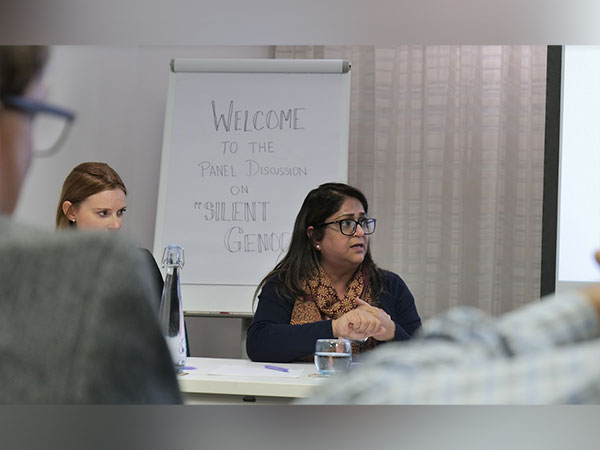

Global Human Rights Defence (GHRD) delegation in Geneva raised the issue of human rights violations in Pakistan mainly focused on enforced disappearances and genocide including women’s rights violations.
The aim was to report on the 51st Session of the United Nations Human Rights Council, as well as protests surrounding the session.
A delegation of ten representatives of different GHRD teams arrived in Geneva on Monday. On Tuesday, GHRD hosted the panel discussion”Silent Genocide” at the Novotel Centre Geneva.
The panel consisted of three panellists, all specialists in the matter. Dr. Rubina Greenwood is the President and Founder of the International Sindhi Women’s Organization (ISWO) and Chairperson of the World Sindhi Congress (WSC).
Her 20+ years of human rights advocacy focus on human rights issues in Pakistan and Sindh. Dhreen Abdullah is a young Balochistan activist and member of the Baloch National Movement. As a special panelist, Dr. Naseer Dashti joined to share his view on genocide and Enforced Disappearances in Pakistan.
The event started with the opening words of the Chairman of GHRD, Sital. He expressed his gratitude to all those coming, both online and in person and for the power to unite and align with each other to make a change in the world.
He expressed the power of younger generations and the importance of education, as with education there will be a change in society.
Sital also paid special tribute to a GHRD colleague Marc Wortman who died suddenly in August 2022. Marc Wortmann was remembered as a motivated and passionate man, eager to fight for human rights and constantly empower others.
GHRD will continue their work with the values of Marc Wortmann as motivation, Sital said. Lina Borchardt, the director of GHRD, took the opportunity to highlight the work of GHRD and the four pillar structure the organization is based on: Education, Empowerment, Advocacy and Human Rights Monitoring.
Especially highlighted was the project Global Human Rights TV, the online media platform founded by GHRD to report on human rights violations worldwide. The audience was guided through the debate by the moderator of the day, Alessandro Cosmo, the Vice Director of GHRD.
The followers of GHRD were able to follow the event on various social media platforms, such as Instagram, Twitter and Linkedin. On both Instagram and YouTube the followers were able to join the event via livestream.
After providing the definition of Genocide, the first question was raised and the panel discussion was started to determine the situation in Pakistan.
Dr. Rubina Greenwood elaborated on the case of Sindhi and noted that it is not proven or officially declared a Genocide by the United Nations, but it fulfils all criteria stated in the Rome Statute to the International Criminal Court.
She described how seventy per cent of the population lives under the poverty line even though it is one of the wealthiest areas worldwide considering the resources. The most vulnerable group in her perspective are women and children in Sindh.
Dhreen Abdullah also underlined these statements by raising the issue of women’s rights in Balochistan and in Sindh. She shared her own story of oppression by the military and a time in her life when she was not allowed to speak her mother tongue and was forced to speak Urdu.
All panellists agreed on one issue, being that genocide is never truly silent. “There are too many personal stories and outcries of injustice to call it “silent”. Eliminating a country, a nation, a religion, a language goes beyond the written definition of genocide including physical violence and murder,” a GHRD press release read.
The panel agreed that without religion, cultures and languages, a nation is without soul. One important take away, especially for the Women’s Rights delegation of GHRD, is the concerning position of women and girls in Pakistan.
“Women are most affected by enforced disappearance and genocide, they often need to be accompanied by a man in order to survive. Basic Hygiene Products are not a given and there is a clear lack of education. Women are not only being oppressed by their significant others, but by fathers, sons, religious leaders and society as a whole,” it added.
The event was rounded up by a networking session, giving the audience the opportunity to connect with the GHRD delegation and the panel.