
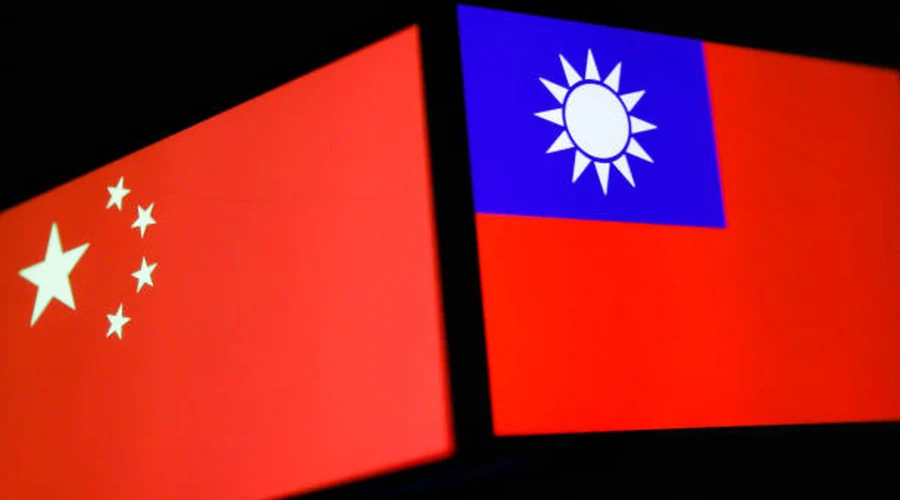

As Taiwanese companies in China are moving to Southeast Asia over the fears that a war may break out between China and Taiwan, a US think tank said that the self-governed island needs to provide companies additional support for Research and Development so they are capable to compete globally.
But Taiwan’s value-driven outreach faces a dilemma in Southeast Asia, where democracy is retreating in countries from Cambodia to Myanmar and where authoritarian regimes often pivot toward Beijing in return for political patronage, Nikkei Asia reported.
According to the survey conducted by US-based think tank Centre for Strategic and International Studies (CSIS) over 500 Taiwanese corporate executives, over a quarter (25.7 per cent) of the surveyed companies with business in China had already shifted some of their production or sourcing out of China and another third were considering doing so, Nikkei Asia reported.
The survey released this week also stated, that of those on the move, a substantial majority (63.1 per cent) were going to Southeast Asia, but slightly over half were moving some of their business back to Taiwan.
“There is no doubt that the New Southbound Policy was timely given the expense and reliability issues we have increasingly seen with doing business in the People’s Republic of China,” said Chen Kuan-ting, CEO of Taiwan Next Gen Foundation, a Taipei-based think tank, reported Nikkei Asia.
In 2016, President Tsai launched her flagship foreign policy on Asia, termed the New Southbound Policy (NSP), referring to Taiwan reaching out to its neighbours and partners in the south and diversifying away from the Chinese market, it reported.
Tsai’s initiative prioritizes Taiwan’s people-to-people, trade and investment relations with Southeast and South Asian countries and beyond.
The CSIS survey also revealed that experts believe China does not have a coherent internal strategy and road map to achieving peaceful unification with Taiwan.
China, which claims Taiwan as its territory, has carried out military drills around the island nation after US House Speaker Nancy Pelosi visited Taipei in August.
CSIS conducted the poll with 64 leading experts on the People’s Republic of China (PRC), Taiwan, and cross-Strait relations to get the views on China’s game plan that started after Pelosi visited Taiwan, Nikkei Asia reported.
The findings show that the majority of US experts believe that China does not have a coherent internal strategy and road map to achieve peaceful unification with Taiwan.
As 80 per cent of respondents have said that they don’t believe that Beijing has “a coherent internal strategy and road map, with concrete stages and actionable next steps, to achieve peaceful unification with Taiwan.”
CSIS noted that this is likely related to “China’s inability to win the hearts and minds of the Taiwan government and people” and the collapse of the “one country, two systems” model offered by Beijing after it reversed its promises of autonomy in Hong Kong.
Elbridge Colby, one of the respondents and author of “The Strategy of Denial: American Defense in an Age of Great Power Conflict,” told Nikkei Asia, “Beijing will be willing to permanently accept the status quo if the alternative is a humiliating failure.”
Noting that Beijing probably does not have a “drop-dead date” for solving the Taiwan issue and that it is flexible in its approach, Colby said there is a possibility that China could engage in an amphibious invasion of Taiwan in the next 10 years.
“If the U.S., Taiwan and Japan neglect the threat, I think the risk will be much higher. I think if we prepare to defend Taiwan, the risk will be much lower,” he said as quoted by Nikkei Asia.