
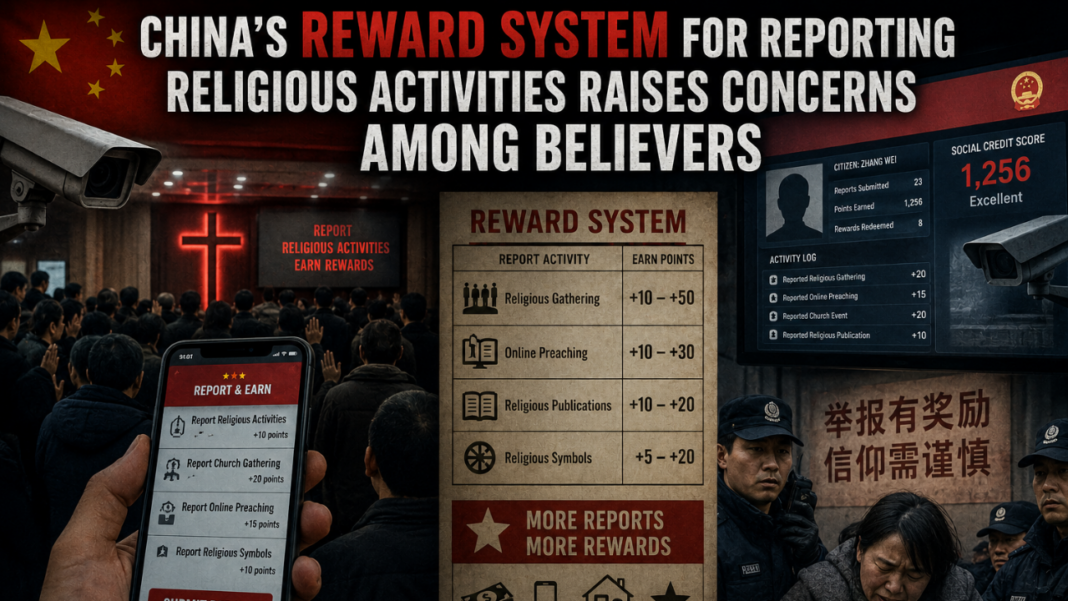

When a Reward Becomes a Source of Fear
In most societies, rewards are associated with positive behavior. They are designed to recognize good deeds, encourage civic responsibility, and promote social harmony. However, for many religious believers in China, a different type of reward system has become a source of concern rather than encouragement.
Across several Chinese provinces and cities, authorities have introduced measures that offer financial incentives to members of the public who report what officials describe as “illegal religious activities.” While the government presents these policies as tools for maintaining public order and national security, many believers view them as a troubling development that increases pressure on religious communities.
Expanding Reporting Systems Across China
In recent years, local governments in cities such as Guangzhou, Nanchang, Chengdu, and Honghe have issued or renewed regulations encouraging citizens to report religious activities deemed unlawful.
Under these measures, activities considered violations of the Regulations on Religious Affairs or the Overseas NGO Management Law may be subject to investigation. These can include organizing religious gatherings without official approval, establishing places of worship without authorization, receiving religious donations outside approved channels, engaging in religious outreach, or participating in overseas religious conferences, training programs, or pilgrimages.
Authorities guarantee the confidentiality of informants, and individuals whose reports are verified may receive financial compensation.
Financial Incentives for Informants
The reward system typically operates on a tiered structure based on the significance of the information provided.
- Basic information may be rewarded with 100 to 1,000 yuan (approximately USD 14–140).
- Information assisting authorities in identifying or addressing unauthorized religious groups may receive 1,000 to 3,000 yuan (approximately USD 140–420).
- Reports involving overseas religious organizations may qualify for 3,000 to 5,000 yuan (approximately USD 420–700).
- Information leading to the identification of key overseas religious figures and their domestic connections can result in rewards of 5,000 to 10,000 yuan (approximately USD 700–1,400).
By offering monetary incentives, authorities seek to encourage greater public participation in monitoring religious activities.
Government Justification and Increased Oversight
Chinese officials argue that these measures are necessary to protect lawful religious practice while preventing illegal activities, religious extremism, foreign influence, and threats to national security.
At the same time, authorities have expanded administrative oversight of religious organizations. In Henan Province, for example, draft regulations have proposed requiring all religious venues to register with local grassroots authorities. Unregistered venues would not be permitted to operate legally, and serious violations could lead to deregistration.
Some scholars view these developments as part of a broader effort to strengthen state supervision of religious affairs. Professor Ying Fuk-tsang, Dean of the Divinity School of Chung Chi College at the Chinese University of Hong Kong, has noted that incorporating religious institutions into grassroots governance structures reflects a growing trend toward tighter management and control.
Growing Anxiety Among Religious Communities
For many ordinary believers, however, these policies have created an atmosphere of uncertainty.
Several regions, including Shandong, Zhengzhou, and Puyang, previously implemented reporting mechanisms without financial incentives before later introducing stricter registration requirements. As reward-based reporting systems continue to spread, some Christians fear that the measures could encourage a culture of mutual surveillance and suspicion.
Observers have drawn comparisons to historical periods when citizens were encouraged to report one another to authorities. While experts caution against making direct comparisons, concerns remain that such policies may foster social distrust within religious communities.
Professor Ying has remarked that although it may be premature to conclude that China is returning to past political campaigns, reward systems of this nature inevitably encourage what he describes as “the masses policing the masses.”
Faith Under Pressure
For most believers, religious practice consists of peaceful and personal activities such as worship services, Bible study, prayer, and fellowship. These are expressions of faith that many consider central to their spiritual lives.
Yet some believers worry that ordinary religious gatherings could become vulnerable to scrutiny or disruption if reported by others. This possibility has contributed to feelings of insecurity among individuals who simply wish to practice their faith without interference.
Religious freedom is widely recognized as a fundamental human right. For many people, faith serves as a source of comfort, meaning, and community. When religious practice becomes associated with fear or uncertainty, concerns naturally arise regarding the protection of individual conscience and belief.
A Call for Balance and Protection of Religious Freedom
The growing use of reporting and reward mechanisms highlights the ongoing challenge of balancing state security concerns with the protection of religious freedom.
Many observers hope that authorities will clearly distinguish between genuinely unlawful activities and the peaceful exercise of religious belief. Ensuring such distinctions would help preserve an environment in which believers can practice their faith while fully respecting the law.
Ultimately, the issue extends beyond religion itself. It raises broader questions about personal freedoms, social trust, and the degree to which a society can accommodate diversity of belief while maintaining stability and order. The answer may serve as an important measure of a nation’s commitment to inclusiveness, dignity, and human rights.