
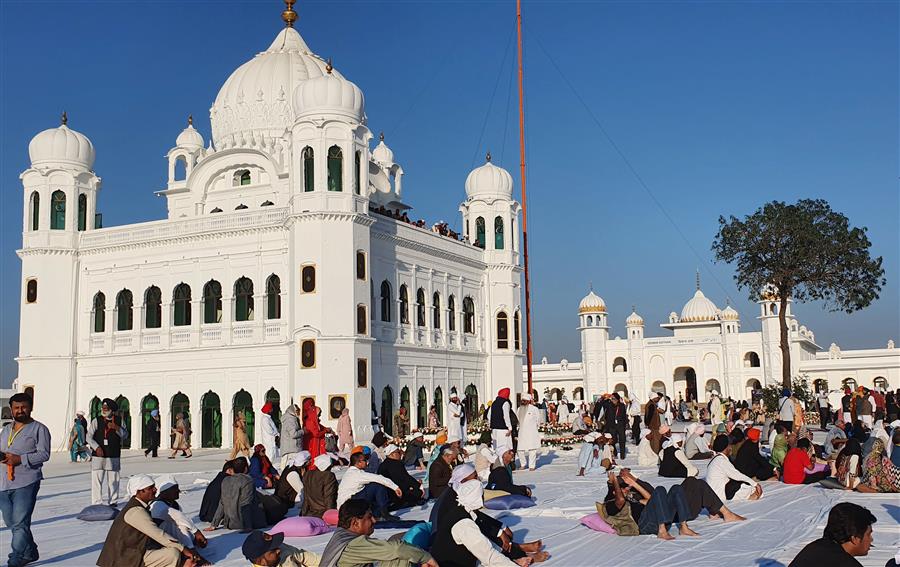

Almost three years ago it was believed that hordes of devotees will be bee-lining for a day-long pilgrimage to Gurdwara Darbar Sahib, Kartpaur in Pakistan through the newly constructed corridor between the two nations but sadly, owing to various travel restrictions imposed by Pakistan, on an average of 300 devotees cross the border from India to undertake the pilgrimage as against an agreement of daily visit of 5000 devotees

Keeping aside their age-old rivalries India and Pakistan opened the gates for ‘Nanak Naam leva’ to fulfill their religious aspiration of paying obeisance at the place of Baba Guru Nanak, the first spiritual master of the Sikhs.

Despite the opening of the Kartarpur Corridor that fulfills the religious aspirations of Indian Sikhs there are certain travel conditions laid by the Pakistan government that dampens the spirit of faithful.
The conditions of possessing a passport by the pilgrims and levying of the service fee of US$20 on every pilgrim undertaking the day-long pilgrimage from India in the neighboring country are the major deterrents.

On November 9, 2019, Indian Prime Minister Narendra Modi and the then Pak Prime Minister Imran Khan had inaugurated their respective sides of the Kartarpur Corridor. Modi had also flagged off the first batch of pilgrims to travel across the border to Gurdwara Darbar Sahib.

The Indian government had fulfilled a long pending demand of Indian Sikhs with the opening of the Kartapur Corridor. In 2010, the Indian Punjab assembly had passed a resolution seeking from Centre government to take necessary measures for the construction of the corridor between Kartarpur Sahib and Dera Baba Nanak, a similar resolution was passed by the Sikhs single largest representative body Shiromani Gurdwara Parbandhak Committee’s general house for the opening of the corridor.
The general perception among people traveling to Pakistan, especially the youth is that they would be discouraged to travel to other countries especially in the European nations if their passport bears the Pak stamp. However, no stamp is put on the passport still the digital entry is made in the system that remains in the official records. Secondly, the service fee of US $20 collected from every pilgrim for a visit to just one Gurdwara in Pakistan has widely been condemned especially if someone can travels to Pakistan along with Sikh jatha and can pay obeisance in at least ten gurdwara’s without any service fee.

According to the memorandum of understanding signed between the two countries with respect to Kartarpur corridor, the Indian pilgrims are required to carry their passports as an identification document for traveling to Pakistan via the corridor .

Guru Nanak Dev, Sikh’s first master had spent the last 18 years of his life at Kartarpur village which is located on the west side of river Ravi in Pakistan. When Baba Nanak passed away his Muslim followers wanted to bury him while the Hindu followers wanted to cremate him. The legend has it that Baba Nanak’s body mysteriously disappeared and a pile of flowers was found which was equally divided by his both Hindu and Muslim followers who performed his last rites according to their own tradition thus a Samadhi and a grave came up .

Sikhs’ daily prayers for the opening of Kartarpur Corridor was finally answered after India and Pakistan opened the corridor in November 2019 .The corridor paved way for the Sikhs from India to undergo a day-long pilgrimage to Gurdwara Darbar Sahib, Kartarpur Sahib situated in Narowal district of Pakistan Punjab from Integrated Check Post at Dera Baba Nanak in Gurdaspur district of Punjab, India covering a distance of nearly 4.5 kilometre.

Indian government launched web portal with guidelines and details for the pilgrims aspiring to go to Gurudwara DARBAR Sahib in Pakistan.
Demanding to do away with the condition of possession of a passport and a service fee of US $20, a septuagenarian Madan Lal Narula had begun a symbolic hunger strike.

Stating that one of the main aims of beginning a day-long pilgrimage to Gurdwara Darbar Shaib, Kartapur Sahib, Pakistan through the newly constructed Kartapur Corridor was to enable indigent followers of Sikh’s first master, Guru Nanak Dev, for a hassle-free cross the border visit for paying obeisance at Gurdwara Darbar Sahib and return on the same day which was not happening due to these conditions.
In past, Pakistan’s former interior minister Ijaz Shah had informed the Pakistan national assembly that the government was contemplating passport-free entry for the Indian pilgrims to Gurdwara Darbar Sahib, Kartarpur Sahib but it didn’t happen.