
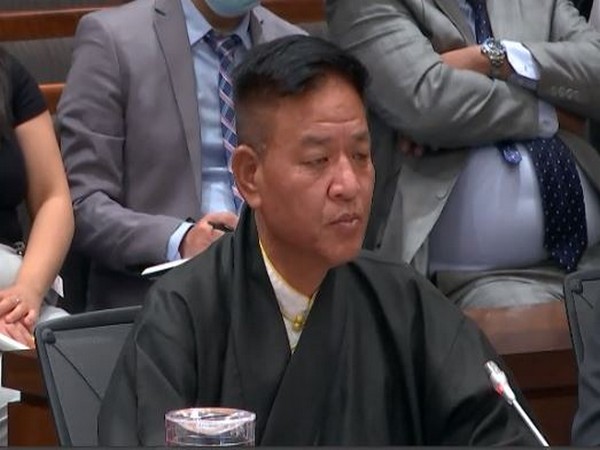

Penpa Tsering, the President of the Tibetan government-in-exile known officially as the Central Tibetan Administration (CTA), highlighted the worsening situation of the Tibetan people under the repressive policies of the Chinese Communist Party to Japanese parliamentarians in Tokyo.
Addressing the largest Parliamentary Support Group for Tibet in the world, he said, “Tibetan children are forced to learn the Chinese language instead of Tibetan and its propaganda with the aim to change their mind so that there won’t be any Tibetan in another 15 to 20 years.”
Choekyi Lhamo, writing in Phayul said that Tsering told lawmakers at the parliament building in Tokyo that the biggest threat facing Tibet is the colonial boarding system run by the government, which has forcibly separated 80 per cent of children from their parents to alienate them from cultural roots.
The CTA President said that the Chinese state continues to implement policies to wipe the cultural and linguistic identities of the Tibetan people.
He urged the Japanese parliamentarians to use their influence on UNHCR and come out with a comprehensive report on Tibet akin to the recently released human rights assessment on East Turkestan, reported Phayul.
The Sikyong (President) said that defending the historical truth about Tibet is crucial for the movement, as detailed extensively in Michael Van Walt van Praag’s book Tibet Brief 20/20.
Another notable remark was made about the egregious climate change in Tibet that is rapidly quickened by Chinese industrial policies, said Choekyi Lhamo.
He argued that environmental concerns in Tibet do not only affect Tibetan residents but the whole Asian subcontinent which is dependent on significant rivers originating from Tibet.
Tsering further appealed to the Japanese government to discuss the detrimental effect of changing climate in Tibet by highlighting the concerns on international platforms like the upcoming COP27 in Egypt, reported Phayul.
Meanwhile, he also extended an invitation to the parliamentarians to visit the exiled Tibetan capital and to meet the spiritual head, Dalai Lama.
The President noted that the Dalai Lama devolved his political authority and introduced democracy after coming into exile.
“Today we have a fully functional democratic system in the Tibetan community”, he said while praising Japan’s growing engagement with democratic countries like the US and India through collaborations including Quad (Australia, Japan, India and US) and AUKUS (Australia, UK, and US) for promoting values like “democracy, freedom and rule of law”.