
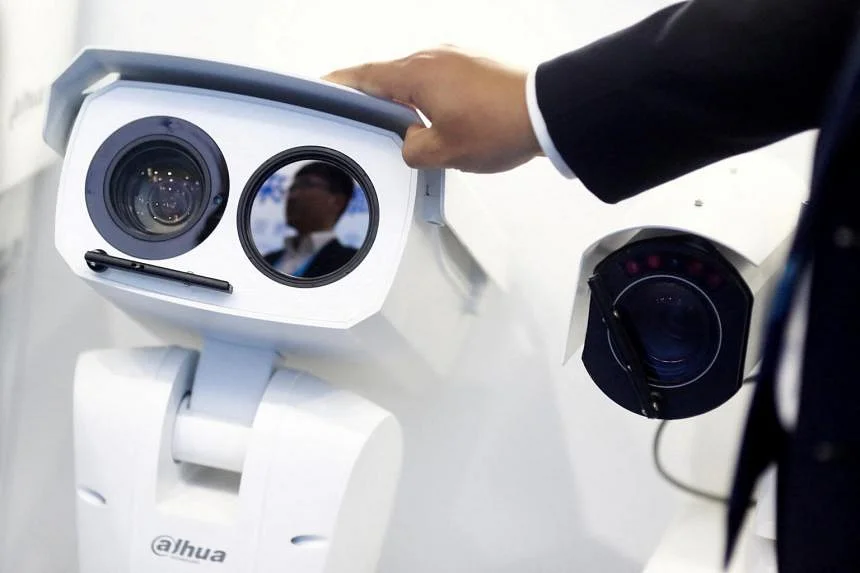

Myanmar’s junta government is installing Chinese-built cameras with facial recognition capabilities in more cities across the country, three people with direct knowledge of the matter said.
In tenders to procure and install the security cameras and facial recognition technology, the plans are described as safe city projects aimed at maintaining security and, in some cases, preserving civil peace, said the people who are or have been involved in the projects.
Since the February 2021 coup, local authorities have started new camera surveillance projects for at least five cities including Mawlamyine – the country’s fourth-largest city, according to information from the three people who asked not to be identified for fear of reprisals by the junta.
The new projects are in addition to five cities where camera systems touted as crime prevention measures were either installed or planned by the previous government led by Aung San Suu Kyi, according to the sources and local media.
A junta spokesman did not answer Reuters calls seeking comment. None of the 10 municipal governments, all of which are controlled by the junta, answered calls seeking comment. Reuters was not able to review the tenders or visit the cities to verify the installation of the cameras.
The junta is planning camera surveillance systems for cities in each of Myanmar’s seven states and seven regions, said one of the sources who was briefed on the junta’s plans on two occasions by different people.
The scale of the junta’s efforts to roll out camera surveillance systems has not been previously reported.
The tenders have been won by local procurement firms including Fisca Security & Communication and Naung Yoe Technologies Co, the three sources said. The firms source the cameras and some related technology from Chinese surveillance giants Zhejiang Dahua Technology (Dahua), Huawei Technologies Co Ltd and Hikvision, the three sources added.
Fisca and Naung Yoe, both headquartered in Yangon, did not respond to requests for comment.
Huawei and Dahua did not respond to Reuters requests for comment. Hikvision said in a statement it has never sold directly to Myanmar government authorities and its customers in overseas markets are distributors and integrators. It also said it had not sold facial recognition technology into the country.
Hikvision did not respond to queries about whether it knows of cases where its hardware capable of running facial recognition software had been sold into Myanmar.
The three sources also said Myanmar procurement firms that won the tenders sometimes use facial recognition software developed by local and regional companies as the Chinese software licenses are costly. They did not name the software companies.
Closed-circuit television (CCTV) or video surveillance systems are used by many cities around the world to discourage crime. Increasingly controversial facial recognition software is also being employed, with the technology gaining ground in the United States for law enforcement purposes. Some sophisticated systems, such as those used in Chinese cities, use artificial intelligence to match real-time images of people against a database of images.
The people with direct knowledge of the Myanmar projects and human rights groups said they fear the new projects could be used to crack down on activists and resistance groups, both of which have been designated as terrorists by the junta in the wake of its coup.
They were not able to provide evidence of the junta’s intentions.
“Surveillance cameras pose a serious risk to (Myanmar’s) democracy activists because the military and police can use them to track their movements, figure out connections between activists, identify safe houses and other gathering spots, and recognize and intercept cars and motorcycles used by activists,” Human Rights Watch Deputy Asia Director Phil Robertson said in a statement to Reuters.
Myanmar’s junta is engaged in widespread surveillance. It has installed intercept spyware at telecommunications and Internet providers to eavesdrop on communications of its citizens and deployed “information combat” units to monitor and attack dissenters online, Reuters has reported.
The army has officers dedicated to analysing surveillance camera feeds, Nyi Thuta, a former captain who defected from the military in late February 2021, told Reuters. He said he was not aware of how many officers were assigned to this work, but described visiting CCTV control rooms staffed by soldiers in the capital Naypyidaw. Reuters was unable to independently verify this and the junta spokesman did not respond to a request for comment.
MORE ON THIS TOPIC
Facebook to shut down its facial recognition system over privacy fears
Facial recognition reshapes people’s lives in China amid rising tide of artificial intelligence
Ten cities
Mawlamyine held a tender for a camera surveillance system shortly after the coup, according to the three sources. The cities of Taunggyi and Dawei followed in the months after, two of them said.
The Mawlamyine tender was jointly won by Fisca and Naung Yoe, the two sources said. The tenders for Dawei and Taunggyi went to Fisca, said one source, adding that each city has seen hundreds of Dahua cameras installed this year.
In Mawlamyine, there are now over 200 Dahua cameras and more are due to be installed, another of the sources said.
Dahua cameras were installed this year in Myitkyina, the capital of Kachin, a region of ethnic unrest, one source said, adding that the government of Hpa-an city has begun early discussions about a camera system.
Before the coup, Suu Kyi’s government installed CCTV cameras in Naypyidaw and Yangon, Myanmar’s biggest city, while the city of Mandalay had also inked an agreement for a camera surveillance system with Huawei, according to local media and two sources.
Soldiers standing guard along a sidewalk in Yangon, Myanmar, on April 16, 2022. PHOTO: AFP
Huawei cameras were combined with facial recognition software in Naypyidaw, one source said. In Yangon, the surveillance system consists of a Hikvision traffic command centre and a mix of camera brands, said another of the sources.
Since the coup, the junta has told Mandalay – Myanmar’s second-largest city – to move more quickly on installing cameras, two sources said. One source said that at least 300 Huawei cameras were installed before the coup, with hundreds more to come.
The city of Bagan – a historic tourist centre – also held a tender for a camera surveillance system before the coup, two sources said.
In the state of Rakhine, where the military is battling an ethnic armed group, CCTV systems with Huawei cameras have been deployed by Myanmar’s security forces since 2019 in the city of Sittwe and some villages, one source said.