
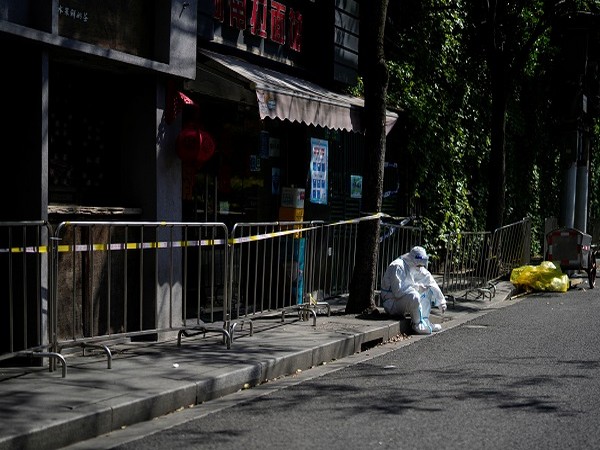

In the garb of tackling the COVID-19 pandemic, the Chinese Communist Party (CCP) is using the Shanghai lockdown to implement the most draconian of its surveillance and authoritarian systems, the kinds of which were only seen in far-off provinces like Xinjiang till now. Since April, the 25 million residents of Shanghai have gotten a small taste of the Xinjiang treatment in a strict citywide lockdown, the New York Times reported, highlighting the people lining up for rounds of COVID-19 tests to prove they are virus-free, a pandemic corollary to Uyghurs lining up at checkpoints to prove they don’t pose any security threat.
Residents in both places are subject to social control and surveillance. Instead of re-education camps in Xinjiang, about half a million Shanghai residents who tested positive were sent to quarantine camps. “Shanghai lockdown is a stress test of social control,” Wang Lixiong, an author of books on Xinjiang, Tibet, and surveillance, was quoted as saying. “If the authority can control a complex society like Shanghai, it can control any place in China,” Wang said. Wang himself has been locked down in Shanghai since March.
He fears an even more dystopian China than what it is today: a digital totalitarian regime that surveils everyone, makes each neighborhood an on-site concentration camp, and controls the society with the same iron fist in a future crisis, be it war, famine, climate disaster or economic meltdown, the report said. “The pandemic did a huge favor to the Chinese Communist Party, which took the opportunity to expand its power infinitely,” Murong Xuecun, author of a new book about the Wuhan lockdown, ‘Deadly Quiet City,’ reportedly said. One of the most striking similarities between the Shanghai lockdown and the Xinjiang crackdown is the political slogans used by the authorities, the report said.
In Xinjiang, a repeated order to detain Uyghurs in large numbers said, “Round up everyone who should be rounded up.” In Shanghai, the government demonstrated its determination by sending half a million people to quarantine camps with the slogan, “Take in all who should be taken in.” In Chinese, they’re the same four characters. Two young professionals documented some of the older people they encountered at their quarantine camps in Shanghai with a podcast, an article, and photos on WeChat.
They met one man who was recovering from a stroke and couldn’t use the portable toilets, another who lost his eyesight after his medication ran out, and a 95-year-old woman who was so frail that she had to be carried from the bus to the camp, the New York Times reported. Both the Xinjiang crackdown and the Shanghai lockdown are political campaigns that can be explained only through the governing rationale of the ruling Communist Party: Do whatever it takes to achieve the leadership’s goal, the report said. “There is a real fear that China could become more like Xinjiang or North Korea,” said Maya Wang, senior researcher of Human Rights Watch who has done extensive work on the repression in Xinjiang. “Watching Xi Jinping since 2013,” she said of China’s top leader, “I think the COVID control is almost like a milestone toward deepening repression.”
Like the Muslims in Xinjiang, the people in Shanghai and many other cities lost their rights and the protection of the law in lockdowns, the report said, citing the example of a city in northern Hebei Province which demanded that residents surrender their keys to the community workers so they could be locked up from outside. In a widely circulated video and a social media Weibo post, a woman documented how a group of police officers had broken the door of her apartment and taken her to a quarantine camp even though they couldn’t present a COVID test report, the New York Times reported. Some lawyers and legal scholars have voiced their concerns that some pandemic control measures are an obvious violation of the law. “The destruction of the rule of law is a far worse social pandemic than a biological pandemic,” wrote Zhao Hong, a law professor in Beijing. “The affluent, decent middle-class lifestyle that we managed to attain with hard work, intelligence, and luck was smashed into pieces in the glorious anti-pandemic campaign,” Sun Zhe, the editorial director of a fashion magazine in Shanghai wrote on his Weibo account reflecting on his life choices.