
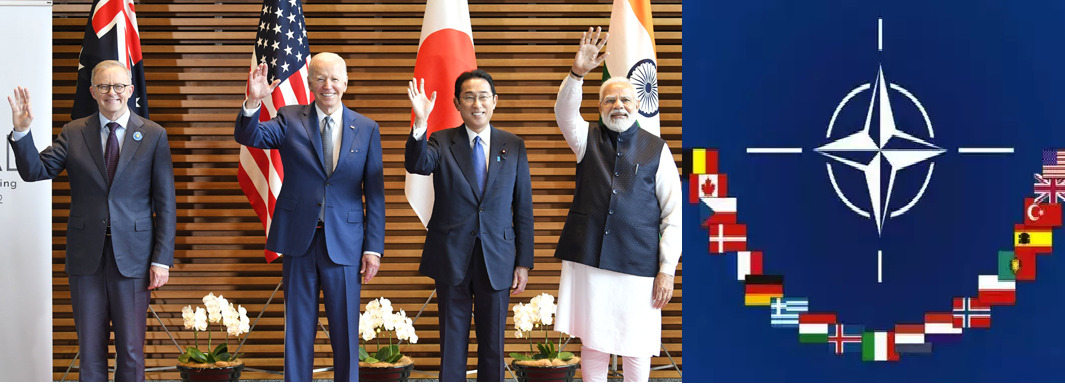

NATO Secretary General Jens Stoltenberg recently visited South Korea and Japan to convey the message that transatlantic and Indo-Pacific security are interconnected. The Western defence alliance emphasized the importance of democracies working together to protect the international rules-based order, united by the systemic challenges posed by the People’s Republic of China. Although Stoltenberg didn’t label China as an adversary, he acknowledged that its growing assertiveness and coercive policies have consequences for both Indo-Pacific and Euro-Atlantic security.
The Indo-Pacific region has become a focus of attention for many observers, who are watching how the China-U.S. great power competition is changing the security architecture, leading to new regional groupings such as the Quad and AUKUS. Others are examining the shifting geo-economic landscape, including free trade blocs and the Indo-Pacific Economic Framework for economic cooperation. Additionally, there is interest in the impact of competing infrastructural projects and the expansion of technological decoupling.
However, less attention has been paid to the role of identity-forming processes in the Indo-Pacific region. NATO defines “like-mindedness” as sharing basic political values and principles, which has become an important criterion for Western countries as they expand their engagement in the region and distance themselves from China. The more these identity dynamics grow, the more likely it is that the choice will come down to either aligning with China or the U.S.-led Western coalition.
The G-7 countries have taken the lead in Western coalition-building efforts in the Indo-Pacific since 2021. A new report from the Danish Institute for International Studies found that all G-7 countries share a commitment to the rule of law and a rules-based order in the region, despite the diversity of their individual strategies.
The G-7 countries have adopted a strong common stance as a coalition of likeminded states, promoting a narrative of a Free and Open Indo-Pacific that is inclusive and based on the rule of law, human rights, democratic principles, and peaceful dispute resolution. They have depicted China as the main challenge to this vision. The Quad countries have also pushed for building a coalition of like-minded nations in the Indo-Pacific and promoting liberal values through initiatives like the Open Societies Statement. The formation of this coalition will shape the geostrategic landscape of the region by influencing strategic choices about security assistance, geoeconomic partnerships, and infrastructural/technological connectivity.
The G-7 countries have demonstrated a united front in recent years through a series of joint statements that reflect their shared liberal values and principles. The group has portrayed itself as a coalition of like-minded states committed to a rules-based order and promoting a “Free and Open Indo-Pacific” based on principles such as the rule of law, human rights, democracy, transparency, and peaceful dispute resolution.
In their joint statements, the G-7 countries make it clear that China is viewed as the main challenge to their vision of a “Free and Open Indo-Pacific.” The group has called on China to uphold its commitments to the rules-based international order, respect human rights, and avoid the use of force in settling disputes.
These identity-building efforts to form a coalition of like-minded countries in the Indo-Pacific have also been advanced by the Quad countries (Australia, India, Japan, and the United States) in their summits and through declarations promoting liberal values. The Open Societies Statement suggests an even wider agenda for promoting these values.
The Biden administration has been a key player in the ongoing situation, with President Biden himself addressing the ideological conflict between democracies and autocracies and initiating the Summits for Democracy (the first held in December 2021 and the second scheduled for March 2023). However, the DIIS report shows that the like-mindedness agenda is widely supported by a larger group of Western countries who see themselves as key players in the Indo-Pacific.
China’s government has criticized the U.S.-led Western coalition building efforts in the Indo-Pacific as a relic of the Cold War and an attempt to form small cliques under the guise of “freedom and openness.” However, China is facing the possibility of facing an increasingly united Western bloc that seeks to bring Indo-Pacific countries into their sphere of influence, which could have a significant impact on the geostrategic landscape and potentially push China to the sidelines despite its strong economic ties to many countries in the region.
In light of this, Beijing has recently shifted from its aggressive “wolf warrior” diplomacy and has seemingly adopted a more conciliatory approach. It remains to be seen whether this change in tactics will be successful in breaking the alignment of Western countries in the Indo-Pacific.