

China’s ambitious bid to be the hegemon and Hercules of the universe is going to be a pipe dream for now with a US ban on import of Chinese products made with forced labour in Xinjiang province coming into force from June 21.
Henceforth the US Customs and Border Protection will not allow any goods of Xinjiang origin unless the importer provides “clear and convincing evidence” that the product is “not made either wholly or in part” by forced labour, reported Poreg.
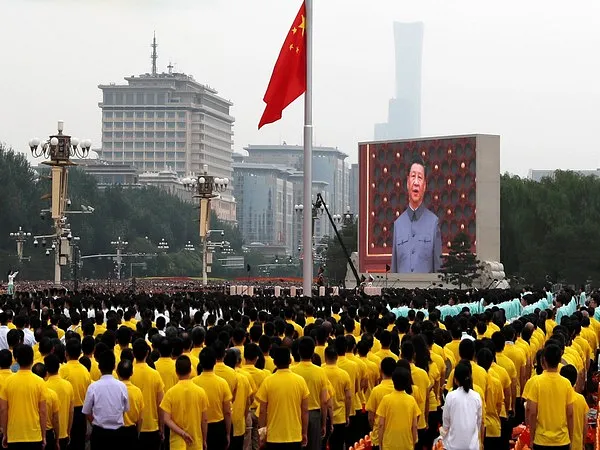
The ban will definitely upset the plans of President Xi Jinping to breathe life into the COVID-19 pandemic-hit manufacturing sector of his country.
The ban is a sequel to the Uyghur Forced Labour Prevention Act (UFLPA) adopted by the United States six months ago amidst reports of repression and forced labour in the minority Muslim-dominated Uyghur region.
However, the Chinese foreign ministry has since made a valiant attempt to wriggle out of the forced labour charge, reported Poreg.
‘Forced labour exists in the US, not China’, declared Zhao Lijian, the ministry’s spokesperson, and tried to turn the tables on the US, saying that forced labour is ‘a chronic problem that has existed in the US since the birth of the country’.
The claim has few takers because the ‘evidence from the ground’ presented this week to the International Criminal Court (ICC) by a group of lawyers amply describes Chinese repressions of Uyghurs. It was their third dossier to the ICC in the past two years
“They use what you might call legal means, they abuse legal means and they use extra-legal means in terms of economic coercion or retaliation, often times linked to non-economic issues”, says Marcus Noland, Director of Studies at the Washington-based Peterson Institute for International Economics (PIIE).
In the past, Beijing used “anti-dumping” measures to retaliate for what it has seen as political affronts. It slapped, for example, sanctions on Australian barley, beef and wine in a reprisal manner to an Australian call to probe the origin of COVID-19 in the central Chinese city of Wuhan, reported Poreg.
China also restricted imports of Norwegian salmon after the Nobel Committee awarded the Peace Prize to dissident Liu Xiao Bao.
Meanwhile, the US together with Canada, the UK, Australia and the European Union (EU) has taken the Uyghur forced labour issue to the International Labour Organization (ILO).
And asked the ILO to initiate a probe into whether China is abiding by its commitments to global labour conventions.
For China, this development comes as a big jolt just when its high-growth economic miracle has been losing mojo.
Structural headwinds were rising before this year’s GDP-sapping fall-out of the lockdowns and curbs related to President Xi Jinping’s zero-Covid policy.
The headwinds range from growth-retarding factors, including the high burden of debt and debt-service costs, rampant misallocation of capital, a declining labour force, low educational attainment and halting headway in productivity.
The Chinese problems are self-inflicted. And these range from unfavourable demographics to an inept financial system, and above all the very governance regime anchored in Xi’s “common prosperity” campaign, reported Poreg.