
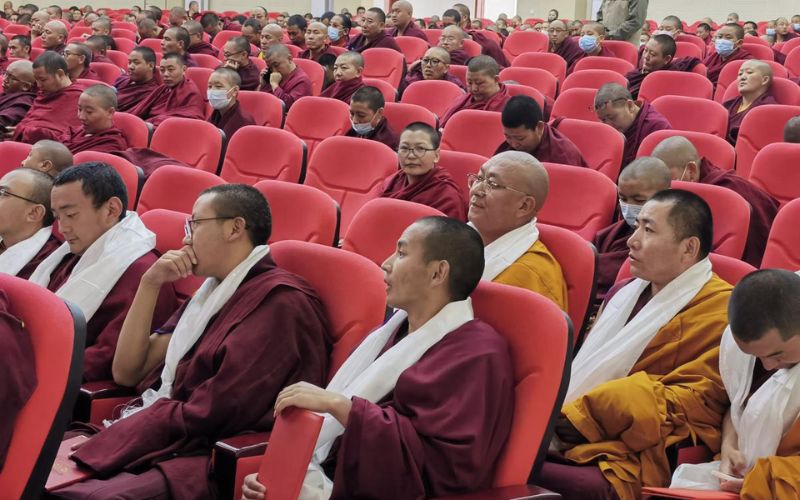

In a recent event covered by China Daily, the so called Tibet College of Buddhism held a graduation ceremony in Lhasa, Tibet on July 27 for its students, monks, and nuns. While this appear to be a celebration of religious and educational achievements, a closer look reveals a concerning pattern of control and assimilation by the Chinese government. The so called Tibet College of Buddhism was founded in 2011.
“More than 330 nuns have graduated from the college, and 30 outstanding nuns from the latest graduates have been selected to receive further learning of Buddhism philosophy and modern sciences as a four-year system,” claimed Drukhang Thubten Khedrub, head of the so called Tibet College of Buddhism during the 10th anniversary celebration in year 2021. Along with Chinese association of Buddhism, such colleges are part of the sinicization attempt.
Firstly, the attendance of government officials from the regional government and the China Buddhism Association raises questions about the level of state control over religious institutions. The Chinese government has a history of exerting control over religious practices in Tibet, aiming to dilute the influence of Tibetan Buddhism and maintain political dominance. The presence of government officials at the ceremony can be seen as a display of political endorsement and manipulation rather than a genuine celebration of religious education.
The graduates’ curriculum, which includes subjects like history, politics, Mandarin, and English, raises concerns about the ideological indoctrination. The Chinese government has been imposing its political agenda through education in Tibetan regions, with the aim of assimilating Tibetan culture and erasing distinct religious and cultural identities. This comprehensive curriculum might be used as a tool to align the graduates with the government’s narrative, undermining the authenticity of their religious teachings.
The International Religious Freedom Report 2022 stated “Chinese Communist Party (CCP) regulations, however, allow citizens to take part only in officially approved religious practices and stipulate religious activity “must not harm national security.” CCP regulations stipulate official control of all aspects of Tibetan Buddhism, including the recognition of lamas, religious venues, groups, personnel, and schools. They prohibit “accepting domination by external forces,” which authorities said included Tibetans living outside the country – particularly the Dalai Lama.”
Radio Free Asia (RFA) reported that on August 24, authorities in Serthar County, Kardze (Ganzi) TAP, Sichuan Province, arrested five Tibetans for publicly stacking Buddhist mani stones, performing sangsol (an incense offering ceremony), and praying. Two sources told RFA that police beat the five individuals – Chugdar, Ghalo, Tsedo, Bhamo, and Kori – and Chugdar subsequently died of his injuries while in custody. The four others remained in detention at year’s end. One source said authorities routinely prohibited inhabitants from performing the sangsol ritual, saying it was “harmful to the environment.”
Furthermore, they also raise questions about the motives behind such expansion. The Chinese government’s investment in religious institutions like this college can be seen as part of a broader strategy to exert control over Tibetan Buddhism and showcase an image of religious harmony to the international community. In reality, this expansion might be overshadowed by increased government surveillance and intervention within the college’s activities.
Children younger than 18 are prohibited from participating in religious activities and receiving religious education, even in schools run by religious organizations. Enforcement and implementation of these rules vary widely across and within regions. One regulation states that no individual may use religion to hinder the national education system and that no religious activities may be held in schools. These regulations have effectively barred Tibetan youth from entering monasteries prior to reaching 18 years of age.
In the pursuit of Sinicization, Tibetan Buddhist teachings and regulations are being interpreted and shaped to align with Chinese characteristics, undermining the rich cultural heritage and unique traditions of Tibetan Buddhism. Tibetan Buddhist figures are encouraged to use the Mandarin language and engage in translation and compilation work that aligns with the Chinese socialist system.
The Tibetan people, who have a long history and distinct cultural heritage, deserve the freedom to preserve and practice their own beliefs without interference or manipulation. The Chinese Buddhist Association’s efforts to promote propaganda and Sinicization in Tibet disregard the sentiments and aspirations of the Tibetan people, further exacerbating tensions in the region.
The establishment of a nunnery department within a government-controlled institution serve to monitor and manipulate the spiritual practices of female practitioners, rather than genuinely empowering them.
The attendance of government officials, the curriculum content, and the expansion of the college should all be viewed with skepticism, keeping in mind the Chinese government’s history of controlling religious institutions and practices in Tibet for political purposes.