
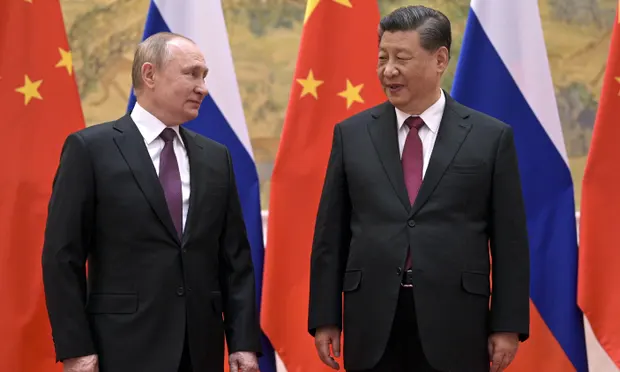

The Diplomat author Mercy Kuo regularly engages subject-matter experts, policy practitioners, and strategic thinkers across the globe for their diverse insights into U.S. Asia policy. This conversation with Dr. Sarah Kirchberger – head of Asia-Pacific Strategy and Security at the Institute for Security Policy at Kiel University (ISPK); vice president at the German Maritime Institute; and co-editor with Svenja Sinjen and Nils Wӧrmer of “Russia-China Relations: Emerging Alliance or Eternal Rivals?“ (Springer 2022) – is the 332nd in “The Trans-Pacific View Insight Series.”
Briefly characterize changing perceptions of Russia-China cooperation.
Until a few years ago, Western analysts mostly tended to downplay the prospects of Russia and China forming a truly strategic type of partnership. This perception began to change shortly before the pandemic, when China and Russia markedly stepped up their military cooperation. Both countries’ actions during the pandemic then made the synergies between Putin’s Russia and Xi’s China increasingly visible.
Explain the military, economic, and systemic dimensions of Russia-China relations.
In several areas of their cooperation, Russia and China have compatible goals, similar threat perceptions and synergetic interests. One such field is military security, where their shared long land border makes it attractive to have a good neighborly understanding, as this reduces the military burden of securing that border. Troops can then be deployed elsewhere. For both countries’ revisionist ambitions ̶ Russia’s in Europe and China’s in Taiwan and near the Indian border ̶ this is a huge advantage. Right now, we see the effects of this, as Russia would be unable to throw as many forces into the Ukraine war if China were still perceived as a military threat.
In economic cooperation, both countries’ capacities and needs are compatible even though both are highly asymmetric when it comes to their economic power, where China is vastly superior. Russia is chiefly an exporter of natural resources and arms technologies, for which China is the world’s largest market, while China in turn is able to inject desperately needed capital into Russian investment projects, e.g. along the Arctic coastline where Western investors have pulled out. China can also provide Russia help regulating the domestic internet based on its own “Great Firewall” experience, and offers Russia some relief from Western sanctions packages that were imposed after the various rounds of aggression against Ukraine since 2014.
There is also a systemic dimension to Russia-China cooperation based on shared survival interests of two autocratic governments that feel threatened by “color revolutions.” Putin’s Russia and Xi’s China reject Western interventionism as “imperialism,” dismiss universal human rights as a Western concept devoid of applicability to culturally Russian or Chinese societies, and assert their right to solve territorial disputes by military force. In that sense, they stand united in opposition to the Western rules-based order and work towards a so-called “democratization of international relations,” which basically means a rejection of U.S. leadership in world affairs.
Analyze the “Ukrainian Factor” in Russia-China military-technological cooperation.
Before 2014, Russia and Ukraine were in an arms-industrial symbiosis, both having inherited parts of the Soviet military-industrial complex. China used to be an important arms customer of both. Interestingly, historically Ukraine was often willing to provide critical technologies to China that Russia hesitated to supply. The most glaring example would be the hull of the first Chinese aircraft carrier, the Liaoning.
After 2014, when Ukraine began to turn strongly toward Europe and the West while its arms-industrial relationship with Russia came to a screeching halt, China profited in two ways: Russia, now under sanctions, was less reluctant to share its state-of-the-art arms technologies with China despite some risks, such as Chinese reverse engineering, increased competition on export markets, and the risk of sharing military secrets with a potential rival. Ukraine, on the other hand, was desperate after 2014 to bolster international support in its conflict with Russia, which made China an attractive partner and also a capable potential investor in the cash-strapped Ukrainian arms industries.
What is the impact of domestic politics on China-Russia relations?
Historically, there had been mutual prejudices and negative stereotypes about each other as a result of a history full of conflict and betrayals. A study by Marcin Kaczmarski in our book, however, indicates that in Russia, influential groups of stakeholders close to the Kremlin have by now developed a positive view of ever closer rapprochement with China.
It will be interesting to see the impact of the Ukraine war on the changing perception of Russia in China, which was analyzed by Jo Inge Bekkevold in our book. The botched conduct of the military campaign and the Kremlin’s strategic miscalculation may yet diminish Russia’s standing as a valuable partner in the eyes of the Chinese to some degree. Before the war, however, the view of Russia in China had been strikingly positive.
Assess the risks and rewards of China-Russia relations in the context of the Ukraine war and security implications for the U.S., EU, and NATO.
A lot of indications point to the conclusion that Russia would not have dared to attack Ukraine at this particular time without at least tacit approval from China. Beijing, however, likely expected this to be a short, sharp conflict that would lead to a quick overthrow of Ukraine’s government and a “new normal” rather than the costly, protracted, and bloody war of attrition it has in fact become. China also likely underestimated the Western reaction to Russia’s aggression and the degree of unity within the EU and NATO, which is now up for a further round of enlargement.
So far, China has neither dared to openly support Russia militarily (despite requests to do so) nor to openly breach the sanctions. While the danger of a simultaneous aggression by Russia in Europe and China in East Asia ̶ a scenario that could challenge the ability of the U.S.-led West to respond ̶ is not off the table, for the medium term it has become less likely as a result of this shock. Western countries would do well to use this time to learn the lessons of why deterrence failed in Ukraine, and how to enhance it regarding Taiwan.