
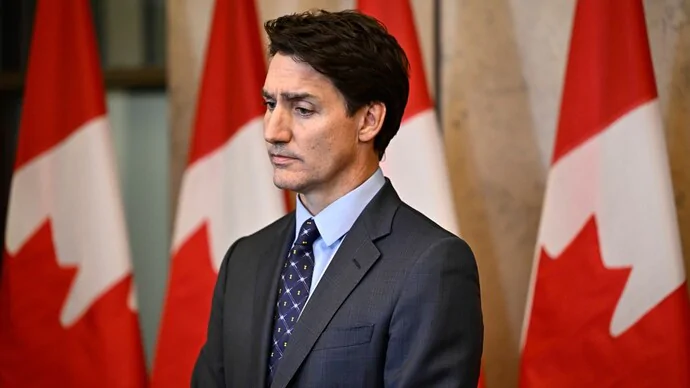

Canadian Prime Minister Justin Trudeau is facing a political reckoning like never before. Domestically battered by rising inflation, unaffordable housing, and surging unemployment, Trudeau’s government is increasingly out of step with a public eager for change. On the international stage, tensions with India over the killing of Sikh separatist Hardeep Singh Nijjar have plunged diplomatic relations into deep uncertainty. These dual crises—one at home, the other abroad—have pushed Trudeau’s leadership to the brink, sparking debate about his motives, methods, and future.
At the heart of this crisis is the question: Is Trudeau’s handling of the Nijjar case a pursuit of justice or a calculated political move? His critics argue that the latter is true, pointing out that his leadership has suffered a dramatic fall in approval ratings over the past year, and with a federal election looming next October, the stakes have never been higher.
According to recent polls, Trudeau’s disapproval rating has jumped to a staggering 65%, up from 39% just a year ago. His approval rating, meanwhile, has collapsed to a meager 30%, a freefall that mirrors rising frustrations over economic hardships. Inflation has strained household budgets, housing prices have soared out of reach for many, and unemployment has crept upward. For a prime minister once hailed as the progressive face of Canada, the dramatic decline in public support is a stark signal of discontent.
This discontent has also bled into his own Liberal Party. Once a political juggernaut, Trudeau’s leadership is now marked by internal revolt. As reported by the CBC, at least 20 Liberal MPs have signed a document calling for his resignation, fearing an electoral collapse under his watch. In the traditionally Liberal strongholds of Montreal and Toronto, recent by-elections yielded embarrassing defeats, deepening concerns about Trudeau’s ability to steer the party toward victory in 2025. Some analysts suggest that up to 40 MPs may be ready to push for a leadership change, though they lack the critical mass to mount a formal challenge—yet.
Amid this growing storm, Trudeau’s focus on the Nijjar case has raised eyebrows. His insistence on probing the killing, which he alleges involved Indian government agents, has worsened an already fragile relationship with New Delhi. In response, India has suspended visa services in Canada, expelled over 40 Canadian diplomats, and demanded that Ottawa curtail pro-Khalistan protests, further straining diplomatic ties.
But the timing of Trudeau’s aggressive stance on India is what has caught the attention of many. The Sikh community in Canada is large, politically influential, and includes vocal supporters of the Khalistan movement, a separatist cause calling for an independent Sikh homeland. With over 770,000 Sikhs in the country, some observers argue that Trudeau’s public commitment to the Nijjar investigation may be more about shoring up electoral support than delivering justice. After all, this is not the first time Trudeau has leaned into Sikh politics for political gain. His 2018 visit to India, marred by the invitation of a convicted Sikh extremist to a state dinner, underscored the sensitivity—and potential payoffs—of this dynamic.
Critics argue that Trudeau’s stance is part of a broader pattern. His government has been accused of turning a blind eye to foreign interference in Canadian politics while using the Nijjar case to deflect attention from his domestic woes. By reigniting the Khalistan debate, Trudeau risks alienating a broader Canadian electorate while courting a key demographic in his quest to hold on to power.
And yet, Trudeau shows no signs of backing down. His recent meeting with Indian Prime Minister Narendra Modi offered little hope for a quick resolution, with both sides signaling that tensions would persist. Trudeau’s declaration that “we spoke about the work that we need to do” rings hollow to critics who see it as a political maneuver rather than a genuine effort to address the growing diplomatic rift.
This situation has deeper historical echoes. In the 1980s, Trudeau’s father, Pierre Trudeau, also faced diplomatic crises over Sikh separatism. The elder Trudeau’s government refused to extradite Talwinder Singh Parmar, the alleged mastermind of the 1985 Air India bombing—an act of terrorism that remains one of Canada’s darkest moments. The Trudeau legacy on Sikh extremism continues to haunt Canada’s relations with India, casting a long shadow over the younger Trudeau’s leadership today.
What makes this political tightrope so perilous for Justin Trudeau is the growing perception that his leadership is not only faltering but increasingly reactive. Instead of offering bold solutions to Canada’s economic challenges or finding a path to repair international relations, he appears caught in a cycle of crisis management. As Conservative leader Pierre Poilievre gains ground in the polls, positioning himself as a viable alternative, Trudeau’s once-ironclad grip on power is slipping.
Poilievre, whose approval ratings have surged alongside Trudeau’s decline, represents the changing political winds in Canada. An Ipsos poll revealed that only 26% of Canadians now see Trudeau as the best candidate for prime minister—a stark contrast to Poilievre’s rising appeal. If Trudeau doesn’t change his ways, and cannot turn his fortunes around in the coming months, his government’s survival is far from certain.
khalsavox