
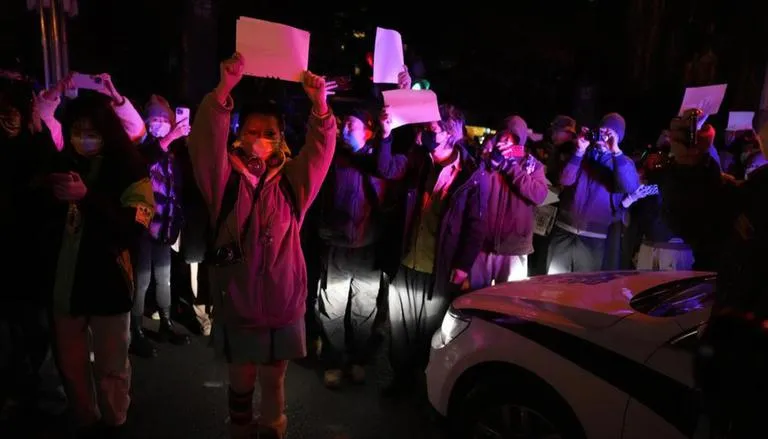

Videos of hundreds protesting in Shanghai started to appear on WeChat on Saturday night. Showing chants about removing COVID-19 restrictions and demanding freedom, they would stay up only a few minutes before being censored.
Elliot Wang, a 26-year-old in Beijing, was amazed.
“I started refreshing constantly, and saving videos, and taking screenshots of what I could before it got censored,” said Wang, who only agreed to be quoted using his English name, in fear of government retaliation. “A lot of my friends were sharing the videos of the protests in Shanghai. I shared them too, but they would get taken down quickly.”
That Wang was able to glimpse the extraordinary outpouring of grievances highlights the cat-and-mouse game that goes on between millions of Chinese internet users and the country’s gargantuan censorship machine.
Chinese authorities maintain a tight grip on the country’s internet via a complex, multi-layered censorship operation that blocks access to almost all foreign news and social media, and blocks topics and keywords considered politically sensitive or detrimental to the Chinese Communist Party’s rule. Videos of or calls to protest are usually deleted immediately.
But images of protests began to spread on WeChat, a ubiquitous Chinese social networking platform used by over 1 billion, in the wake of a deadly fire Nov. 24 in the northwestern city of Urumqi. Many suspected that lockdown measures prevented residents from escaping the flames, something the government denies.
The sheer number of unhappy Chinese users who took to the Chinese internet to express their frustration, together with the methods they used to evade censors, led to a brief period of time in which government censors were overwhelmed, according to Han Rongbin, an associate professor at the University of Georgia’s International Affairs department.
“It takes censors some time to study what is happening and to add that to their portfolio in terms of censorship, so it’s a learning process for the government on how to conduct censorship effectively,” Han said.
In 2020, the death from COVID-19 of Li Wenliang, a doctor who was arrested for allegedly spreading rumors following an attempt to alert others about a “SARS-like” virus, sparked widespread outrage and an outpouring of anger against the Chinese censorship system. Users posted criticism for hours before censors moved to delete posts.
As censors took down posts related to the fire, Chinese internet users often used humor and metaphor to spread critical messages.
“Chinese netizens have always been very creative because every idea used successfully once will be discovered by censors the next time,” said Liu Lipeng, a censor-turned-critic of China’s censorship practices.
Chinese users started posting images of blank sheets of white paper, said Liu, in a silent reminder of words they weren’t allowed to post.
Others posted sarcastic messages like “Good good good sure sure sure right right right yes yes yes,” or used Chinese homonyms to evoke calls for President Xi Jinping to resign, such as “shrimp moss,” which sounds like the words for “step down,” and “banana peel,” which has the same initials as Xi’s name.
But within days, censors moved to contain images of white paper. They would have used a range of tools, said Chauncey Jung, a policy analyst who previously worked for several Chinese internet companies based in Beijing.
Most content censorship is not done by the state, Jung said, but outsourced to content moderation operations at private social media platforms, who use a mix of humans and AI. Some censored posts are not deleted, but may be made visible only to the author, or removed from search results. In some cases, posts with sensitive key phrases may be published after review.