
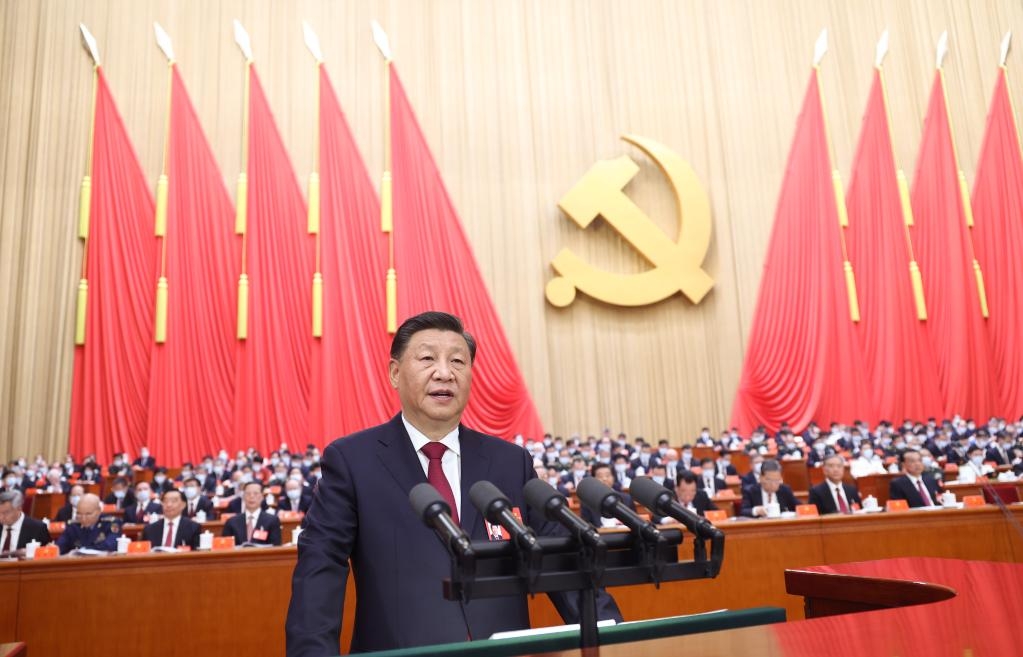

As Chinese leader Xi Jinping kicks off his third term as general secretary of the Chinese Communist Party (CCP), with Beijing reeling under economic stress due to the real estate crisis and zero-Covid policy, deeply affecting its manufacturing units.
Niels Graham, an assistant director at the GeoEconomics Center, writing in Atlantic Council said that the decisions he makes during this third term risk reducing the Chinese economy by as much as five trillion dollars over the next five years, with potentially devastating effects for global growth.
The economy that greets him today is vastly different from the one that saw him ascend to his role a decade ago. When Xi became China’s leader in 2012, he inherited a nation of newfound wealth growing rapidly. Expanding at an average pace of around 7 per cent a year, the Chinese economy nearly doubled in size over the course of Xi’s first two terms.
Now, the situation is markedly different. For the first time since 1989, China will miss its annual gross domestic product (GDP) growth target, said Graham.
Officially, Beijing points to the sweeping COVID-19 restrictions it has implemented across the country to explain the slowdown, reported Atlantic Council.
However, deceleration in growth prior to the start of the pandemic and economic crises including a meltdown in the property sector, distressed local government finances, and rising youth unemployment suggest that the slowdown may have deeper roots.
As questions mount around China’s economic performance, new research from the Atlantic Council GeoEconomics Center and Rhodium Group’s China Pathfinder explores whether the growth slowdown is truly a temporary blip caused by Beijing’s pandemic response or a sign that China is splitting from market thinking.
In evaluating China’s progress, the data–spanning from 2010 to 2021 and covering financial system development, market competition, trade openness, moves toward a modern innovation system, direct-investment openness, and portfolio openness–shows that China’s economy has unequivocally converged with open market economy norms, although the progress has been uneven.
Over the past decade, Beijing has focused on integrating its economy with global trade flows of goods. It has lowered the tariffs it applies to imports–going from a mean tariff rate of around 10 per cent in 2010 to 7.5 per cent in 2021–and has increased the portion of global goods that flow through its economy from around 9 per cent in 2010 to 12.5 per cent in 2021.
Moreover, China’s trajectory on trade liberalization has not been so unequivocal. Non-tariff barriers on goods, services, and digital trade (alongside subsidies and Beijing’s refusal to adjust exchange rates to correct its balance of payments) muddle the story of China’s progress.
Beijing’s restrictions on digital trade are of particular note given the growing significance of digital trade for advanced economies. China’s score in this area has worsened since 2014, a reflection of additional restrictions Xi imposed over the past eight years, reported Atlantic Council.
As the rest of the world teeters towards recession, near-term demand abroad for Chinese goods is weakening, and a long-term focus on export-driven growth cannot supplant a shift towards domestic consumption, said Graham.
Beijing still needs to boost the country’s own household consumption for China to transition toward a sustainable growth model.
The past decade has also seen China turning away from the United States and European Union as partners in innovation and opting to look inward instead. This trend will likely continue with Xi emphasizing the importance of greater “self-reliance and strength in science and technology” during the party congress.
This is not without risk: Weakening foreign investment in China could diminish the country’s innovative potential by squeezing funds and reducing opportunities for international collaboration, said Graham.
Despite China’s progress in R&D spending, the country still lags behind the open-market economy average in measures of innovation quality. For example, in 2021 the payments China received for foreign use of its intellectual property only reached around one-seventh the average amount that an open-market economy receives when adjusted for GDP; that implies that Chinese intellectual property remains unattractive relative to that in other leading economies.
Furthermore, China’s progress toward market economy norms slowed in most areas, including innovation, in 2021. Beijing’s reforms to develop its financial system and boost market competitiveness have stagnated, and its openness to both portfolio and direct investment has decreased since 2020.
The Twentieth Party Congress showed no signs of bucking this trend, especially since for the first time since 1989, the Politburo Standing Committee is entirely composed of loyalists to the party leader. This will have dangerous consequences for China’s long-term growth rate, reported Atlantic Council.
There is a chance the damage done to China’s GDP growth prospects by its property sector collapse and its adherence to its zero-COVID policies will compel Beijing to return to the pro-growth reform path the CCP outlined in 2013 but largely abandoned during Xi’s second term.
Unfortunately, the fear–and the more likely outcome–is that Beijing will instead fall back on statist solutions that have defined the economic direction of the end of Xi’s second term. This could mean a long-term GDP growth rate of around 2 to 3 per cent, a far cry from the 5 per cent analysts forecasted prior to the pandemic.