
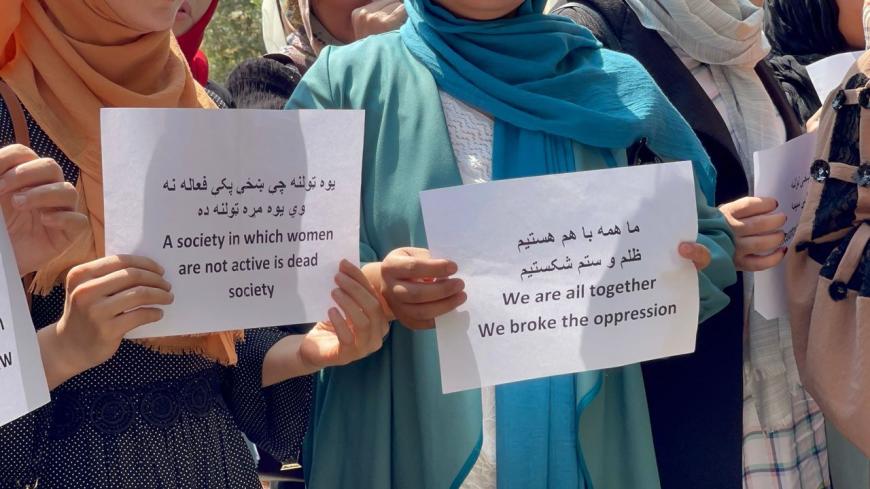

“Look—this is my daughter. She was in Taliban jail. They tortured her. They tortured her. All of you people, all of the world, is responsible, is responsible to me, as an Afghan woman… I lost everything of my life.”—Afghan woman calling in to a UK conference, July 18, 2022.
Afghan women feel abandoned by the world. They are justified in feeling this way.
In 2001, the US and its allies cited Taliban violations of the rights of women and girls to build support for military intervention in Afghanistan after the 9/11 attacks. During their 20 years in Afghanistan, the same countries often pledged to stand by Afghan women and girls forever, defending their rights.
The Taliban rollback of the rights of women and girls began immediately after they took power on August 15, 2021. So Afghan women and girls have been waiting for 327 days for the world take action to end this wholesale attack on their rights.
It has been 327 days now since the Taliban imposed a de facto ban on girls’ secondary education in Afghanistan. That’s 327 days of a nation’s girls being denied education—327 days they will never get back. Girls in primary school are demoralized, counting the grades before they too will be forced out of school. Women in university know the classes of women who should come after them have been cut off. Their future has been curtailed dramatically by Taliban bans on women working in most professions, and surveillance of women, restrictions on women’s movement, and workplace rules that have driven many women out of even those jobs that, on paper, they are permitted to do.
The Taliban dismantled the system to respond to gender-based violence, created new barriers to women accessing health care, blocked women aid workers from doing their jobs, and attacked women’s rights protesters.
The Taliban’s violations of the rights of women and girls were deeply shocking when they were last in power, from 1996 to 2001. But they are much more so now. In the years since 2001, there has been uneven but overall important progress toward respecting the rights of women and girls in most countries. In 2014, Sweden became the first country to declare that it has a “feminist foreign policy”; many other countries have now made this commitment.
We expect countries—especially those that have pledged to have a feminist foreign policy–to be much more active in opposing Taliban violations of the rights of women and girls this time, to coordinate closely with each other, use all mechanisms and measures available including travel bans and other sanctions against Taliban leaders, and make the rights of Afghan women and girls a major priority in their foreign policy
The international response has been deeply inadequate. Many countries—and the OIC and EU—have issued statements, expressed deep concern, and called on the Taliban to end their rights violations. But concrete, coordinated, practical actions have been few and far between.
In August 2021, a special session of the UN Human Rights Council on Afghanistan produced only statements of concern. The September session of the council created the position of a new special rapporteur on human rights in Afghanistan, a positive step, but organizations including Human Rights Watch had called for a much more robust mechanism—an independent fact-finding mission or commission of inquiry.
In March, the Security Council renewed the mandate of the UN mission in Afghanistan, making it responsible for “promotion of the human rights of all Afghans” and instructing it to “support and promote gender equality, women’s and girls’ empowerment and the full protection of their human rights” in areas including education, leadership, and participation in decision-making. The mandate also gives the mission responsibility for monitoring violations of the rights of women, with specific reference to categories of women including activists.
This mandate is powerful. But four months on, there is little evidence that the mission—which is also responsible for engaging the Taliban on a political level and supporting the international response to Afghanistan’s dire humanitarian crisis–is able to achieve these goals.
In June, the Security Council imposed travel bans on two Taliban officials complicit in putting education off limits to girls and women—but renewed travel ban exemptions for 13 other Taliban leaders. In July, the Human Rights Council held an urgent debate on the situation of women and girls in Afghanistan. This allowed the Council to hear powerful statements from Afghan women. But the resolution adopted after the debate contained only one concrete step–an “enhanced interactive dialogue” at the Council’s next session in September.
The plan is for a panel of representatives from the UN Office of the High Commissioner for Human Rights, with the participation of the special rapporteur on the situation of human rights in Afghanistan. It will include other relevant human rights mechanisms, United Nations bodies and agencies including the UN Assistance Mission in Afghanistan, and non-governmental organizations, including Afghan women’s rights organizations in Afghanistan and in the diaspora. The panel will provide updates and engage with states on the situation of women and girls in Afghanistan.
Afghan women and girls are experiencing irreparable harm every day. They have a right to expect the world to do more to halt this crisis.
But we are not seeing that kind of response. The response has been uncoordinated and lacking in urgency. There are no easy solutions because the Taliban are very resistant to pressure. But given the global consensus on issues as fundamental as girls’ right to secondary school, the response should be much stronger.
“To those world leaders [of countries departing Afghanistan], I’m going to say shame on you. I’m going to say to the whole world, shame on you, for what you did to Afghanistan.” Those were the words of Afghan women’s rights activist Mahbouba Seraj days before the Taliban takeover. Her words feel even more painfully true now, a year later.
But it’s not too late. It is time now—right now—for countries around the world, especially those deeply involved in Afghanistan for the last 20 years, to do much more. The September Human Rights Council session should bring concrete steps demonstrating a much stronger commitment by states to protecting Afghan women and girls’ rights and helping to ensure accountability for violations of their rights.
It is unimaginable that in 2022 Afghan women and girls are being erased from society and denied their basic humanity. The world owes them action—now–not more words.