
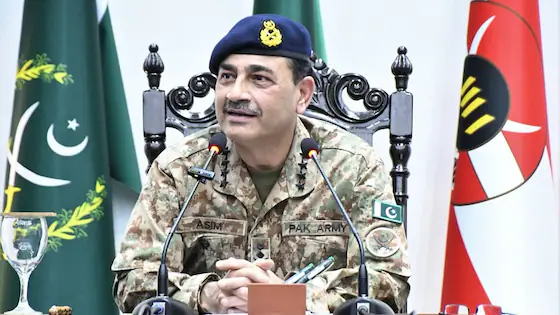

Pakistan’s current political theatre is not a democracy, it is a carefully choreographed act of submission, with General Asim Munir pulling the strings and Prime Minister Shehbaz Sharif playing the compliant marionette. After decades of repeated coups and direct military interventions, Pakistan’s latest army chief appears to have realised that outright takeovers no longer work. In the post-Cold War, post-FATF, IMF-dependent world, staging a coup is not just unfashionable, it’s self-destructive. So, Munir has chosen a subtler strategy: rule from behind the curtain, while keeping the façade of a “democratically elected” government intact for international consumption.

A General Who Learnt from Others’ Failures
Munir’s playbook is born from the failures of his predecessors. From Musharraf’s international isolation after the 1999 coup to the diplomatic quagmire that followed the ouster of Imran Khan, Pakistan’s military has learnt that open power grabs come with heavy costs, sanctions, aid freezes, and global scrutiny. Munir has internalised this lesson well. Why invite condemnation when you can control everything anyway?
Under the guise of “civil-military harmony,” Munir has ensured that Shehbaz Sharif’s coalition government functions as little more than an administrative wing of Rawalpindi GHQ. Ministers whisper before speaking, bureaucrats defer to the uniformed, and policy decisions, from foreign relations to economic recovery, are vetted by the army chief himself. Pakistan’s parliament may sit in Islamabad, but the real decisions are drafted elsewhere, in rooms where Shehbaz isn’t even invited.
The Imran Khan Lesson
Imran Khan’s spectacular fall was Munir’s warning to all civilians who might dream of autonomy. Khan’s attempt to cross swords with the military establishment ended in one of the most ruthless political takedowns in Pakistan’s modern history. Once the favourite of the khakis, Khan misread his leverage, believing mass popularity could outweigh military patronage. When he dared to challenge the institution and its intelligence wing, Munir struck back with surgical precision. Khan was dismantled politically, discredited publicly, and incarcerated legally. His party was splintered, his supporters hunted, and his image of defiance systematically erased.
That episode cemented Munir’s authority not just over politics but over Pakistan’s psychological landscape. The message was clear: defy the general, and you will cease to exist. But this very obsession with total control reveals Munir’s insecurity. He is not a confident statesman but a paranoid custodian, afraid of the same ghosts that haunted every general before him, the ghost of legitimacy.
A General with a Messiah Complex
What makes Asim Munir particularly dangerous is not just his power, but his delusion. Those close to his circle say he believes he is divinely guided, a “man of God” chosen to cleanse Pakistan of its corruption and moral decay. His public posturing and speeches drip with religious overtones, blending the military’s usual nationalism with theological self-righteousness. In his mind, he is not merely a soldier, he is Pakistan’s saviour.
This self-image is coupled with an almost pathological obsession with India. Every crisis, economic, political, or social, is framed through the lens of Indian enmity. Munir’s rhetoric tries to fuse religion, nationalism, and anti-India sentiment into one ideological weapon, as though demonising India could redeem Pakistan’s crumbling reality. But this obsession is suicidal. While India rises as a global economic and technological powerhouse, Pakistan is sinking deeper into debt, extremism, and isolation. Munir’s fixation blinds him to the truth that his nation’s greatest enemy is not across the border, it’s within the cantonments of Rawalpindi.
Begging with One Hand, Funding Terror with the Other
Pakistan today is the world’s only nuclear-armed state perpetually on a financial ventilator. Its leadership, military and civilian alike, shuttle between Riyadh, Doha, and Beijing, pleading for bailouts to keep the state machinery afloat. Yet, even as it begs for international charity, the same establishment shelters terror outfits that target its neighbours, from India to Afghanistan and Iran. Munir continues this toxic duality, believing he can deceive the world with diplomatic smiles while nurturing militancy at home. The reality is that donors are no longer fooled. Each bailout comes with stricter strings, and every terror strike pushes Pakistan closer to the status of a pariah.
Denial as Doctrine: The Myth of Victory
The Pakistan Army’s greatest talent has always been its ability to deny defeat. Whether it was Kargil, Balakot, or the more recent Operation Sindoor, where Indian forces dealt a decisive blow, Rawalpindi’s propaganda machinery spun humiliations into “strategic successes.” The same playbook continues under Munir: suppress facts, glorify failure, and feed citizens the narcotic of nationalist delusion. But denial does not stop decay. It only postpones collapse.
A Nation Heading Toward the Abyss
Munir’s reign from behind the curtain might appear clever for now, but it is built on sand. Puppet regimes do not inspire stability; they breed cynicism. The illusion of democracy cannot sustain a nation already fractured by poverty, extremism, and regional alienation. Pakistan’s youth, jobless, disillusioned, and hyperconnected, are no longer willing to believe the army’s mythology. Munir can silence journalists, arrest politicians, and rewrite textbooks, but he cannot manufacture hope.
The world is watching, but not with fear, with fatigue. Even Pakistan’s traditional allies are exasperated by its addiction to self-sabotage. Munir’s hybrid dictatorship may delay the inevitable reckoning, but it cannot prevent it. Every time the army plays god, Pakistan bleeds a little more, financially, morally, and institutionally.
In the end, Asim Munir’s grand illusion will meet the same fate as all before him. His paranoia will isolate him, his delusions will misguide him, and his puppets will eventually turn into liabilities. Pakistan’s spiral is not the story of one general’s hubris, it is the tragedy of a state that never learnt to live without one.
globalorder.live