
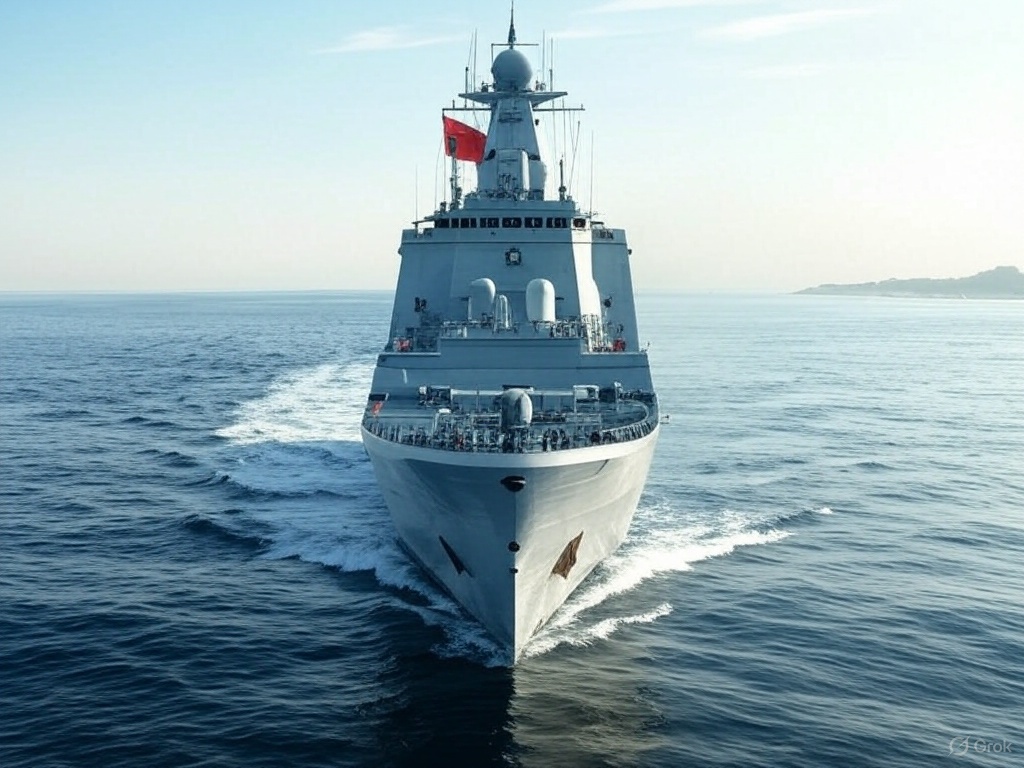

The Chinese navy, long championed as a cornerstone of national pride by the Chinese Communist Party (CCP), faces a myriad of systemic issues that undermine its projected image of strength and sophistication. While the CCP often highlights its military advances and technological capabilities, beneath the surface lies a troubling reality of corruption, insufficient maintenance, and substandard manufacturing practices that call the navy’s operational effectiveness into question.
One emblematic example of these shortcomings is the Liaoning aircraft carrier, which has been touted as a key asset in China’s blue-water ambitions. Originally purchased as an unfinished Soviet vessel and retrofitted domestically, the Liaoning was meant to symbolize the modernization of China’s navy. However, photographs surfaced showing the carrier rusting, sparking concerns about its upkeep and durability. In response, the CCP imposed strict bans on photography near the ship, hoping to suppress public scrutiny. Further investigation revealed that cost-cutting measures during maintenance led to shoddy practices, such as painting over rust with low-quality materials that ultimately exacerbated hull corrosion. This approach not only compromised the carrier’s structural integrity but also highlighted a culture of short-term fixes over long-term solutions.
Similar challenges plague the Type 055 destroyer, often described as a state-of-the-art warship and a “ national treasure.” Despite claims that its hull is constructed using high-strength, low-alloy steel designed to resist seawater corrosion, reports indicate that significant rust developed just two years into service. Investigative findings suggest that budget allocations for premium materials were misappropriated by officials to fund personal luxuries, including high-end real estate. As a result, ordinary steel was used as a substitute, undermining the destroyer’s durability. Inspection reports were allegedly falsified, and lucrative contracts were awarded through nepotism, further illustrating the corruption deeply embedded within the system.
Corrosion, however, is just one of the navy’s many problems. Technological inadequacies have also been a consistent source of criticism. China’s fourth-generation fighter jets, widely promoted as cutting-edge, remain unproven in real-world scenarios. The CCP has notably refrained from releasing detailed footage of these jets in action, fueling speculation about their performance capabilities. The Type 055 destroyer, which boasts advanced radar and missile systems, has similarly faced scrutiny. Reports reveal that its vertical launch system jammed during a recent exercise due to rust, causing a missile launch failure. Additionally, its radar systems are reportedly limited, with only one capable of 360° scanning, while others are fixed to specific angles. These limitations raise serious concerns about the destroyer’s ability to perform in combat scenarios.
The issues are not confined to older vessels. Newer additions to the fleet, such as the Shandong and Fujian aircraft carriers, have also exhibited signs of neglect and poor construction standards. The Shandong’s deck, for instance, shows burn marks and discoloration, while reports indicate that the Fujian’s catapult structures have been removed due to severe rust damage. Critics argue that these flaws stem from rushed production timelines and the use of substandard materials, compounded by widespread corruption at various levels of the supply chain.
The international response to these revelations has been overwhelmingly critical. U.S. media outlets have described China’s blue-water navy ambitions as a façade, labeling its fleet a “ paper tiger” incapable of withstanding modern warfare challenges. Japanese analysts have been equally scathing, pointing to technological deficiencies and endemic corruption that make the navy a liability in the Indo-Pacific region. French and German commentators have echoed these sentiments, with some even suggesting that the rust scandals are symptomatic of broader systemic failures within the CCP’s military-industrial complex.
The implications of these deficiencies are particularly concerning given the current geopolitical climate. With tensions rising in the Indo-Pacific region, particularly in the South China Sea, the readiness of China’s navy is under intense scrutiny. Experts warn that in the event of a conflict, the fleet’s operational weaknesses could prove catastrophic. Predictions suggest that many of China’s J-15 fighter jets would be unable to perform effectively, and a significant number of Type 055 destroyers could suffer from radar failures or other mechanical issues. These vulnerabilities would leave the fleet highly exposed to adversaries, undermining its ability to project power or defend Chinese interests.
Underlying these operational challenges is a broader issue of systemic corruption and mismanagement. Reports indicate that contracts for critical components, such as anti-corrosion coatings and advanced radar systems, have been awarded to unqualified suppliers with political connections. In one instance, the supplier of anti-corrosion coatings was found to be related to a high-ranking general and delivered substandard materials that failed to meet even civilian shipping standards. Such practices not only erode the navy’s combat readiness but also reflect a governance structure prioritizing personal enrichment over national security.
Despite these challenges, the CCP continues to present an image of unshakable confidence in its naval capabilities. During a high-profile meeting with global CEOs in Beijing, President Xi Jinping emphasized China’s commitment to strengthening its military and remaining an attractive destination for foreign investment. However, such assurances have done little to allay skepticism among analysts, who highlight the stark contrast between the CCP’s rhetoric and the realities faced by its navy.
As the spotlight remains firmly fixed on China’s military ambitions, it is clear that the navy’s structural and operational issues must be addressed urgently. Without meaningful reforms to tackle corruption, improve manufacturing standards, and enforce stringent oversight mechanisms, the fleet risks becoming a liability rather than an asset. For a nation striving to establish itself as a dominant maritime power, the current state of its navy serves as a sobering reminder of the challenges inherent in balancing ambition with execution.