
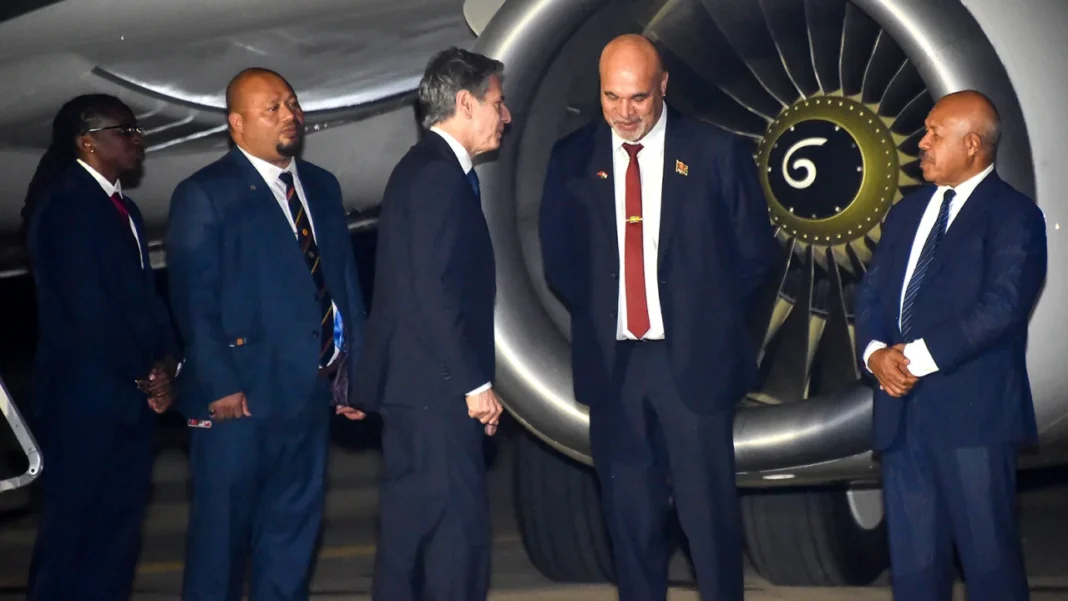

The United States and Papua New Guinea have signed a new bilateral defense cooperation agreement – a move that has sparked controversy in the Pacific Island nation and comes as Washington and China jostle for influence in the region.
US Secretary of State Antony Blinken and Papua New Guinea (PNG) Prime Minister James Marape signed the pact and a maritime security agreement on Monday during Blinken’s visit to the capital Port Moresby.
Advance text of the agreements were not released by either side, but the new defense cooperation was expected to expand US access to military and other facilities in PNG, bolstering Washington’s security ties in the South Pacific.
That region – a constellation of sparsely populated island and archipelago nations and territories as well as New Zealand and Australia – has outsized strategic significance. The Pacific Islands, for example, were the site of decisive battles during World War Two.
The region has taken on renewed importance for Washington as it seeks to bolster its relationships and presence in Asia amid rising tensions with an assertive China that’s rapidly expanded its naval capabilities in recent years.
Those concerns were heightened last year after Beijing signed a security pact with the Solomon Islands – and tried, but failed, to win support for a sweeping, regional trade and security communique with Pacific Island nations.
Blinken’s visit to PNG comes after US President Joe Biden last week cut short an Asia trip that would have included stops in Port Moresby and Sydney, Australia, due to ongoing debt ceiling negotiations at home.
New pact
In a statement Saturday, PNG framed its agreement with the US as an opportunity to advance its infrastructure and capacity for national defense at a time of growing global security concerns.
“Papua New Guinea does not have enemies but it pays to be prepared. Territorial dispute is (imminent), as in the case of Ukraine-Russia,” the statement said.
“This agreement is not about geopolitics but rather recognizes the country’s need to build its defense capabilities because border disputes are inevitable in the future,” it said, adding it did not preclude the government from “working with” other countries, including China.
China has become a significant player in the country’s economy, both as an investor and consumer of its rich natural resources.
The US and PNG militaries already have a cooperative security assistance relationship focused primarily on joint humanitarian exercises and the training of PNG military personnel, according to the State Department.
Tiny island nations at the center of giant geopolitical rivalry
The new agreement has sparked debate in Papua New Guinea – including over a lack of transparency from the government on what it entailed, while purported leaked drafts circulated online.
The pact would need Parliament’s approval and could face judicial challenges, experts say.
But its signing sends a significant message to the region.
“PNG signing a defense agreement signals to the rest of the Pacific that its largest nation has chosen the West – Australia and the US – as its security partner,” said Maholopa Laveil, FDC Pacific Fellow at the Lowy Institute, seconded from the University of Papua New Guinea.
The defense pact and Fiji’s reported ending of its police training agreement with China earlier this year “are major wins, getting the largest Pacific nations on side for the US in its attempts to limit China’s influence in the region,” Laveil said, adding that Marape may “leverage the threat of China” to request more development assistance from the US.
Meanwhile, Australia is preparing to sign its own security treaty with PNG.
Pacific Island dynamics
The US deal with PNG – especially on the heels of the Solomon Islands’ security pact with China last year – may also raise concerns about lines of alignment being drawn in a region that has long prioritized projecting strength through unity.
“(Signing such pacts) can also create divisions,” said Patrick Kaiku, an academic focused on international relations at the University of Papua New Guinea, noting a perspective among Pacific Island states that they should not take sides in geopolitical rivalries.
“If states are not adhering to it … that can also be a problem for regional solidarity,” he said.
Blinken is expected to meet with leaders of the Pacific Island Forum regional body in Port Moresby on Monday, the forum has said, taking Biden’s place at the gathering.
Australian Prime Minister Anthony Albanese, US President Joe Biden, Japanese Prime Minister Fumio Kishida and Indian Prime Minister Narendra Modi pose prior to a Quad meeting last year on May 24 in Tokyo, Japan.
Quad summit in Australia canceled after Joe Biden shortens Asia trip
The cancellation of Biden’s trip – which would have been the first from a sitting US President to Papua New Guinea – has been characterized by some observers as a potential ding to Washington’s recent bid to up its engagement with the region.
That bid has included opening embassies in the Solomon Islands and Tonga this year, while Biden hosted Pacific Island leaders in Washington for a summit in September and released the first-ever national strategy on engaging the Pacific Islands.
“US President Joe Biden’s now-scrapped visit to PNG was meant to be a culmination of these efforts and send a powerful signal to Pacific Islanders about the US commitment to the region,” said Parker Novak, a non-resident follow at the Atlantic Council think tank in Washington’s Global China Hub.
“Instead, it underlines skepticism about the United States’ ability to follow through on the promises it has made,” Novak said, adding that with Blinken’s visit and other expected diplomacy, it may not do “long-term damage to US efforts in the Pacific.”