
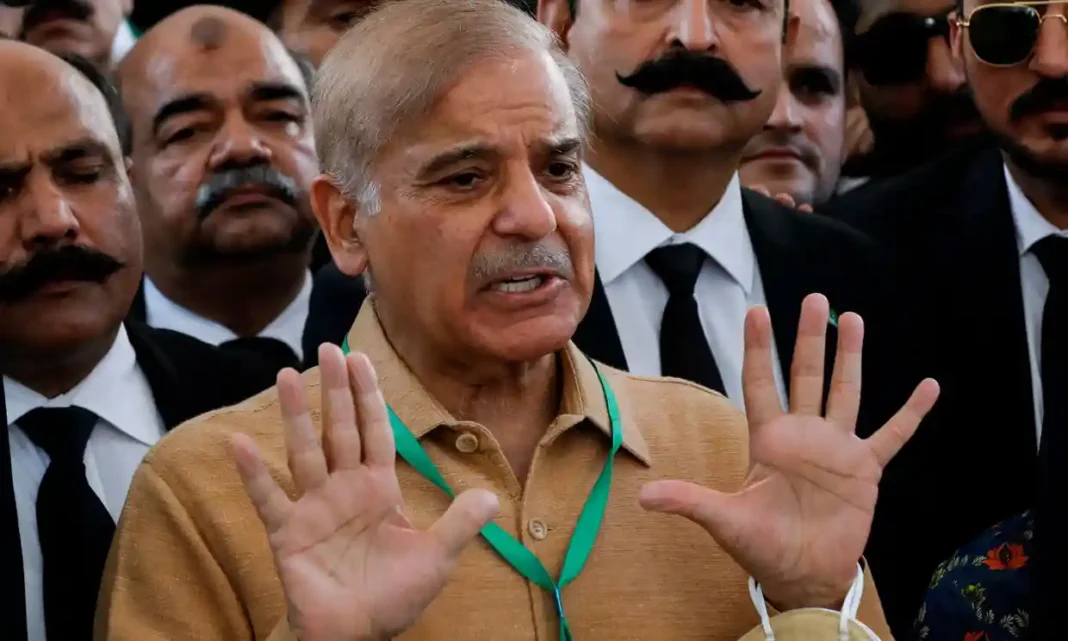

Pakistani politicians and activists have raised fears about the military increasing its control over the country’s public life after the new prime minister, Shehbaz Sharif, gave the ISI spy agency vetting power over civil service appointments.
The move has placed the verification and screening of government officials in charge of postings, appointments and promotions in ISI hands, leading to concerns of a shrunken civilian space.
Pakistan’s powerful military, which ruled the country directly for three decades, and its premier intelligence agency have a long history of meddling in politics and controlling politicians.
It is widely perceived in Pakistan that politicians need the military’s backing to come to power, but many now fear that bureaucrats could also need the same support for their appointment and postings.
“If we keep in mind Pakistan’s history of takeovers and the sway that military has over our politics, this decision will weaken civil bureaucracy and compromise their independence,” said senator Mustafa Nawaz Khokhar. “We have shot ourselves in the foot and it’s a decision worth reconsidering.”
Raza Rabbani, the former chair of the senate, called Sharif’s decision an attack on the constitution. “The concept of civilian supremacy is tarnishing,” he said.
Before ousting the former prime minister, Imran Khan, in a no-confidence vote in April, opposition parties now in power had criticised the military for its meddling in politics, rigging elections and bringing Khan into office.
Ayesha Siddiqa, an author and expert on military affairs of Pakistan, said it was depressing that none of the senior leadership of the major political parties had condemned Sharif’s move.
“The government’s notification has legalised military intelligence’s power over other institutions,” she said. “At the same time [it has] sown seeds for a long-term disempowerment of the political class to strengthen its position and that of the parliament to weaken the military’s control over politics.”
Maryam Nawaz, the leader of Pakistan Muslim League-Nawaz (PML-N) and daughter of the former prime minister Nawaz Sharif, defended the prime minister’s decision.
Advertisement
“ISI works with the government and it directly works under the prime minister,” she told local media. “If the prime minister has taken such a step, he knows very well how to assign responsibilities and tasks to which organisation and at what time.”
Siddiqa disputed her reading of the situation, saying a Pakistani prime minister could only dream about controlling the ISI. “ISI is theoretically under the prime minister’s office but in reality, it has never been controlled by the head of government.
“In the last decade, the ISI chief has become almost as powerful an officer as the army chief due to power to intervene in politics and society … Maryam Nawaz’s statement is nothing but a wish to control the ISI.”
The military has always refuted allegations that it meddles in politics and rigs elections.
The Human Rights Commission of Pakistan, an NGO, has also expressed concern over the prime minister’s decision. “Even if this practice was already in place, it goes against democratic norms,” it said. “The role of the military in civilian affairs needs to recede if Pakistan is to move forward as a democracy.”
Pervaiz Rasheed, a former information minister, said there were already laws governing the appointment and promotion of bureaucrats and that if the government wanted to adopt another system it should have amended the constitution via parliament rather than issuing an executive order.
“If the scrutiny of civilian bureaucracy is to be included in the responsibilities of the ISI, then ISI too should be answerable and accountable to the civilian bureaucracy as well as the parliament,” he said.