
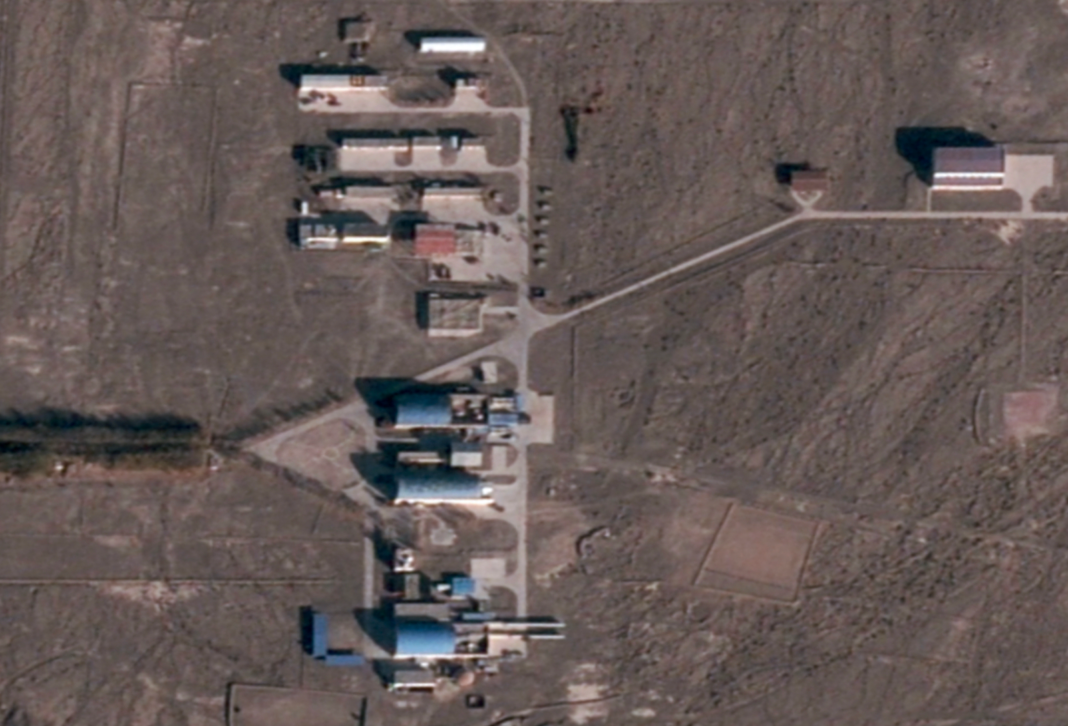

China may be building anti-satellite ground-based lasers at its secretive Korla facility in western Xinjiang, weapons that could aim to conceal its sensitive military satellites from the prying eyes of foreign spy satellites.
Army Technology reported that satellite imagery of China’s Korla East Test from geospatial intelligence company BlackSky shows two laser gimbals housed in hangars with retractable roofs opening around solar noon when foreign imaging satellites are most active.
Besides ground-based anti-satellite lasers, Army Technology mentions that the Korla site houses electromagnetic pulse and aerostat facilities.
The report says the satellite imagery of Korla shows huge anti-satellite lasers close to the size of ship-mounted weapons alongside domed structures likely housing gas required to operate the lasers.
China built the Korla site in 2003 but much of its activity since 2005 remains undocumented. Korla is managed by Unit 63655 of the People’s Liberation Army – Strategic Support Force (PLA-SSF), which is in charge of research on lasers and optics, very large stratospheric airships and high-powered microwaves.
In a December 2022 article for Arms Control Wonk, Eli Hayes writes about China’s Bohu facility in Xinjiang, which satellite imagery shows may have been built in 2002 and became operational in 2004, suggesting that China’s anti-satellite laser program may already be two decades old.
Like Korla, Hayes notes that Bohu hosts research about lasers and optics, giant stratospheric airships and high-powered microwaves and that Unit 63655 of the PLA-SSF manages the facility.
In a separate article, Hayes mentions that satellite imagery shows that the Bohu site has fixed lasers for ranging and mobile truck-mounted lasers for dazzling.
These developments, Hayes says, suggest that China has achieved a limited capability in anti-satellite directed-energy weapons technology. However, he cautions that such assessments must be taken with a grain of salt due to a lack of information and the unproven effectiveness of lasers in anti-satellite operations.
China is not alone in building dedicated ground facilities for anti-satellite warfare. Last July, Asia Times reported on Russia’s Kalina laser facility, which operates in the Caucasus and aims to dazzle the optical sensors of other nation’s spy satellites by flooding them with laser light.

The Kalina facility operates in infrared pulse mode by producing 1,000 joules per square centimeter, delivering a large percentage of the light it makes at low Earth orbits where spy satellites operate.
Using a telescope several meters in diameter, Kalina can target an overhead satellite for hundreds of kilometers, thereby shielding a 100,000-square-kilometer area from spy satellites.
However, Kalina has unclear operational status as sanctions since 2014 may have impeded the import of required sensitive electronics. Unprecedented sanctions imposed on Russia after last February’s invasion of Ukraine may have exacerbated the situation.
Zhenhua Liu and other writers note in a 2020 article published in the Journal of Physics: Conference Series that a ground-based laser can accurately target specific points on low-earth orbit satellites to disable or destroy them by thermal damage.
Liu and others note that ground-based lasers can temporarily blind or permanently disable the optical sensors on satellites, burn out their solar panels or overheat sensitive satellite electronics.
They also say that space powers such as China, Russia and the US have extensively tested anti-satellite lasers and now have preliminary operational capabilities. They note that ground-based lasers have size, coverage and power advantages over airborne and satellite-mounted weapons.
The difficulty of distinguishing between carelessly ranging a satellite and a deliberate attack makes it challenging to respond to possible ground-based laser interference against satellites.
Yousaf Butt notes in a 2008 article in the peer-reviewed Science and Global Security journal that while satellite laser ranging is a widely-used technique to determine the orbits of space objects with great accuracy, there is a slight chance that satellite rangefinding lasers could damage sensitive optical sensors, with such an incident having the potential of being misinterpreted as an attack.
Chris Zappone notes in an August 2021 article for The Sydney Morning Herald that ground-based anti-satellite lasers can also be used to hide sensitive military facilities, such as nuclear missile silos. Such laser-protected naval and air bases could be used as staging areas for an invasion of Taiwan, the writer suggests.
Zappone also notes other advantages of ground-based anti-satellite lasers, such as the ability to destroy satellites while having scalability and plausible deniability. He mentions the difficulty of attributing a blinding ground laser attack on a satellite orbiting hundreds of kilometers above Earth at thousands of kilometers per second, as the temporary outage of a satellite could be accidental or the result of hard-to-detect aggression.
However, he cautions that interference with satellites, especially those for missile defense, may be interpreted as a prelude for a nuclear attack, resulting in unintended escalation and potential disaster.
Zappone notes that satellites now serve as the nerve centers of modern military operations as well as many civilian functions such as navigation, weather forecasting and space-based timing for financial transactions, meaning the damage from ground-based laser attacks on satellites can cause ripple effects beyond military applications.