
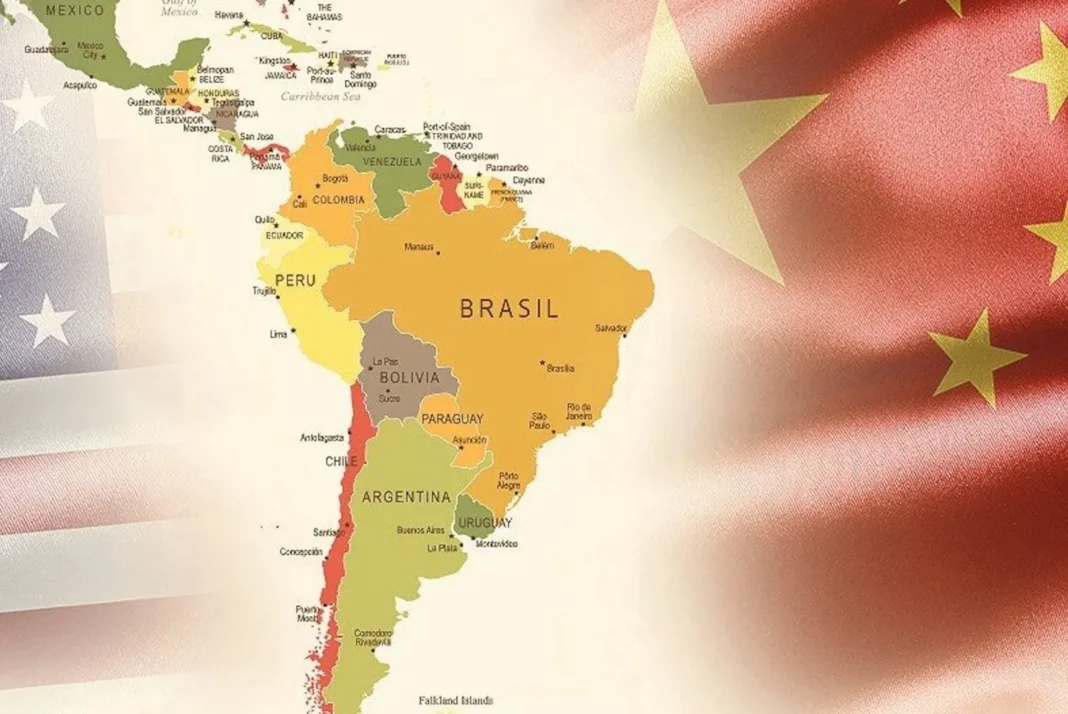

In early March 2023, General Laura Richardson, head of the United States Southern Command, told a US congressional hearing that Chinese actions in South America posed a threat to US safety. According to General Richardson, China is on a relentless march to replace the United States as the leader in the region.
While China’s presence in the region has grown substantially in the past decade, it is unlikely that China will replace the United States as the dominant political, economic and military power in Latin America for the foreseeable future.
On the economic front, China has made inroads into South America and the Caribbean, a region where US power once went unchallenged. Starting in the late 1990s, Chinese interest in South America and the Caribbean began to grow.
In order to sustain its unprecedented economic growth China began to search the globe for oil and other raw materials. In 2000, Chinese trade with the region totalled US$12 billion, reaching $314.8 billion in 2021. In 2023, China is the largest trading partner of nine countries in the region: Argentina, Brazil, Bolivia, Cuba, Chile, Peru, Paraguay, Uruguay and Venezuela.
While the growth in trade between China and the region is impressive, the United States remains Latin America and the Caribbean’s largest trading partner. In 2020, US trade with the region was $758.2 billion. But 71 per cent of this trade was with Mexico. In 2021, Chinese foreign direct investment in the region totalled $130 billion.
Before the Covid-19 pandemic, China was the biggest lender to the region, with Chinese development banks having issued $66.5 billion in loans — mostly for infrastructure projects that offer Chinese companies better access to the region’s rich natural resources. A small portion of these loans were provided under China’s Belt and Road Initiative (BRI).
While China’s economic footprint in the region has increased significantly, the United States and the European Union remain the largest foreign investors, accounting for 36 per cent and 34% of total investment respectively.
As China faces an economic slowdown due to the Covid-19 pandemic, Chinese loans have dried up. When countries in the region fall into financial crisis, Western institutions such as the International Monetary Fund have provided the lion’s share of structural adjustment loans, not China.
The extent to which China’s economic gains in the region have resulted in political and diplomatic influence is unclear. While China has been Brazil’s largest trading partner for over a decade, tensions have arisen under both left- and right-wing Brazilian governments.
Chinese President Xi Jinping and Brazilian leader Luiz Inácio Lula da Silva in a state of embrace. Image: Twitter
In Panama, after relentless US pressure, several multibillion dollar infrastructure contracts initially awarded to Chinese companies were cancelled and given to South Korean and Japanese companies.
During her testimony to Congress, General Richardson also warned that China has increased its support for anti-US regimes in the region including Venezuela, Cuba and Nicaragua.
But with the exception of Venezuela, Chinese investment and trade with these countries is minimal compared with its presence in most other countries in the region. In the cases of Cuba and Nicaragua, their desperate economic situations and US sanctions render them less attractive to China.
In the defence and security sector, China has made modest inroads into the region. While the number of South American and Caribbean military and security officers going to China for training has increased, the United States remains the primary destination for training thousands of officers from the region. The United States has dozens of bases and other installations throughout the region and is the region’s ultimate guarantor of security.
While the power of the United States in the region remains solid, challenges on the economic front are increasing. No other power — not even the Soviet Union — has been able to challenge US economic dominance of the region.
Apart from in Cuba, Soviet trade and aid to the region was negligible and its diplomatic influence limited. While most countries in the region want to maintain close ties with the United States, they also want the benefits of China’s massive trade and investment flows.
On the eve of the pandemic, total trade between China and Latin America had hit $314.8 billion. Chinese foreign direct investment in Latin America was about $130 billion and net development lending by the China Development Bank and Export–Import Bank of China was about $66.5 billion. Taking 2000 as the baseline, the figures in all three categories have grown exponentially.
China is taking many steps to improve its economy and its currency. Photo: Facebook
While trade and FDI inflows dipped slightly during the pandemic, Chinese development lending to the region dropped to zero in 2020. With just two years of operation in Latin America and the Caribbean, the BRI accounts for only a few million of the $43.5 billion disbursed to the region by Chinese policy banks between 2015 and 2019.
China’s growing presence and rising economic importance to the Global South should be expected. But China was able to build such a strong presence in Latin America and the Caribbean in large part due to US neglect of the region.
The United States can no longer take the region for granted. Perhaps Washington should start treating Latin America as its front yard rather than its backyard.
asiatimes.com