

Fifty-one years on, Pakistan gets sharp reminders of its Bangladesh loss as yet another province, Balochistan, rises in revolt.
They are more urgent and alarming as, besides being closer home now, they hit ties with neighbours Afghanistan and Iran and threaten the China-Pakistan Economic Corridor (CPEC), the key to Pakistan’s economic well-being.
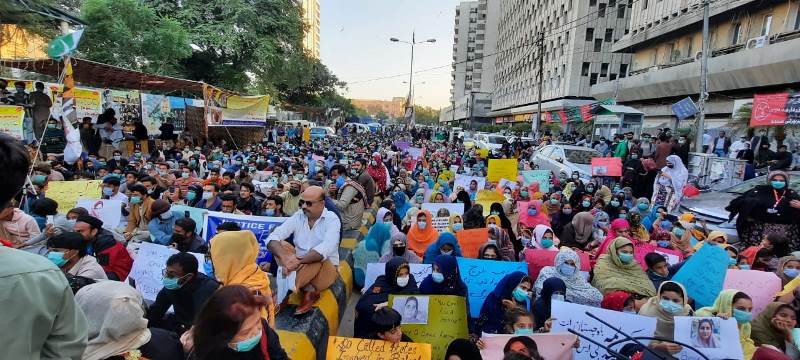
The last week of the year 2022 is filled with unrelenting, almost daily violence, with six casualties, and counting among it, men in uniform. This is caused by both the militants and an unarmed civil disobedience movement demanding economic inclusion.
The latter, too, is desperately taking to violence and has one soldier’s death to its account, although the latter is claimed by the militant Baloch Liberation Army (BLA).
File image: Twitter/Baloch Women Forum (@BalochWF)File image: Twitter/Baloch Women Forum (@BalochWF)
The double trouble, and that the two may have forged an alliance is worrying Islamabad.
Despite Islamabad’s loose, unsubstantiated talk of ‘foreign’ involvement, its chief perpetrator is the home-grown Tehreek-e-Taliban Pakistan (TTP) that has spread out of the tribal areas of the Khyber Pakhtunkhwa in the north, to the Arabian Sea in the south, operating at will from its safe havens in Afghanistan.
This gets complicated by its alleged alliance with the Baloch militant groups, also using the same territory and similar tactics, giving the Pakistan Army a hard time.
“The prospect of TTP and Baloch militants combining forces would be a particularly disturbing one for the state, as it would present an even greater security challenge,” Dawn newspaper noted in its editorial (December 27, 2022).
Pakistan’s allies of 1971 are wary. The problem spills over to an already-troubled Iran.
Afghanistan’s ruling Taliban will not contain or evict the TTP, and their ideological brothers. And China is incensed by militancy and violence that threaten its access to the Indian Ocean, the reason why it has laid the multi-billion CPEC.
To top it all, Pakistan is gripped by prolonged political turmoil and unprecedented economic stress, with neither showing signs of easing. It must fight TTP and other groups, many affiliated with the Islamic State of Khorasan Province (ISKP), the South Asian version of the dreaded Islamic State (IS), but seems clueless about when to stop talking and start acting tough.
In Balochistan’s current spate of violence, media reports unanimously report on the TTP’s claims of responsibility.
The commentators note that Islamabad’s allegations of “foreign conspiracy” have become muted. Abbas Nasir writes in his commentary (Dawn, December 27, 2022): “The policy pursued so far has inflicted considerable pain and agony on the law-enforcement personnel and the Baloch population alike. While the paramilitary forces are armed with the ‘writ of the law’ in taking on the ‘terrorists’, the general Baloch public is furious at being treated like a hostile, alien presence on their own soil.”
File image: Pixabay/Wikimedia CommonsFile image: Pixabay/Wikimedia Commons
Typical of Pakistan, complicating the real issues, the militancy and the protests are both religion-laced and are led by hard-core Islamists. With such elements silently influencing the government from top to bottom, the polity is showing signs of imploding.
The main recourse has been one of tough military action. This has only escalated militancy and prevented solutions to deeper ethnic, economic and regional issues.
The protest movement is led by Maulana Hidayatur Rahman, the local chief of the Jamaat-e-Islami and has attracted thousands of families hit by economic miseries for which they blame both the federal government and China.
Both Islamabad and Beijing are concerned at the bad vibes and negative publicity of CPEC which is the latter’s showpiece of the larger Belt and Road Initiative (BRI), sold to scores of other countries.
If militancy – of state-sponsored elements turning rogue – has persisted for years, the Balochistan protests have roots in history that go back to Pakistan’s creation in 1947.
The Balochs were forcibly included and resisted assimilation at the army’s gunpoint. Millions have been killed, abducted and made to ‘disappear’. Yesterday’s angry tribal leaders have partially ceded the protest grounds to educated and more resolute youths.
Neglect by successive regimes and economic deprivation when compared to other provinces have worsened Balochistan’s problems.
The largest, yet sparsely populated province, is now key to CPEC and to China’s strategic plans. Its Gwadar port gives China access to the Arabian Sea. Militancy and now civilian protests prevent that as many Chinese have been killed.
China cannot escape blame in Balochistan and Gwadar’s strife.
The demand of the protesters of “Haq Do Tehreek” (HDT) who have been demonstrating periodically, the current one being for nearly two months now, includes an end to illegal trawling in Gwadar’s waters.
File image: Twitter video grabFile image: Twitter video grab
Baloch fishermen feel discriminated against and threatened by Chinese high-speed fishing trawlers. High-security checkpoints prevent their fishing activity and more. They feel closer to Iran and want to open up trade on the Pak-Iran border.
“Years of policies led by the establishment to pacify Balochistan have failed. Therefore, along with kinetic action, the state must also look at why it has been unable to bring socioeconomic uplift to this resource-rich, but appallingly poor province,” Dawn editorial said.