
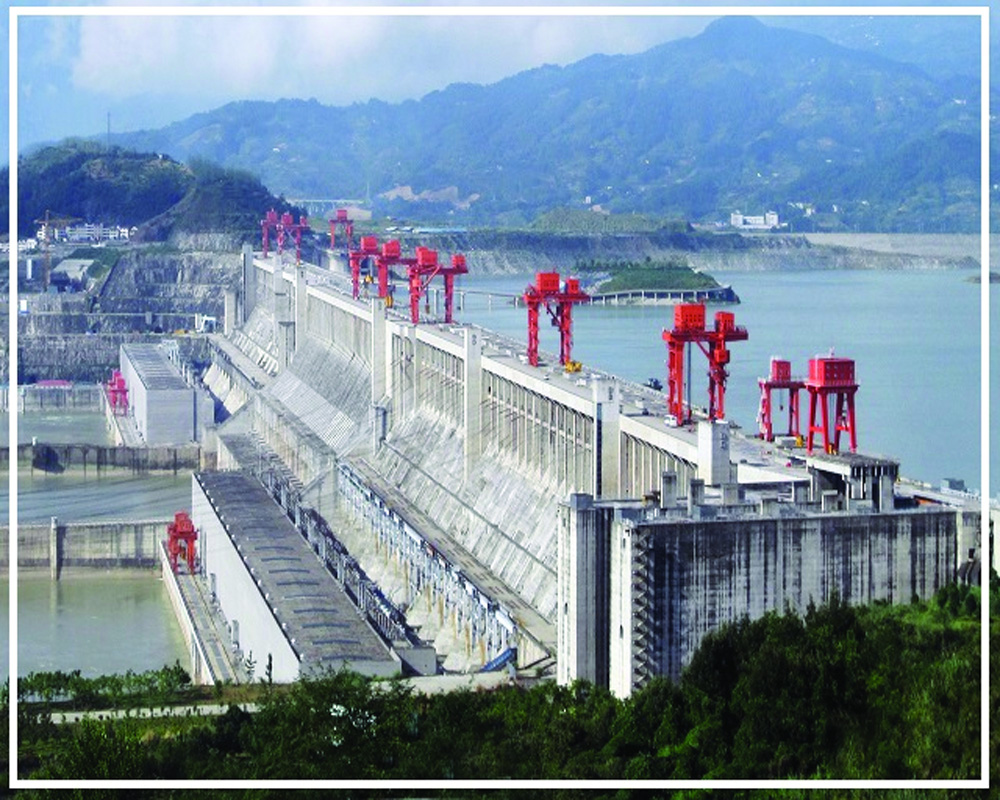

With the Tibetan region’s seismic vulnerability due to tectonic plate activity, such mega-dam projects could exacerbate risks to life, biodiversity and regional stability
Earth quake of 7.1 magnitude on the Richter scale on January 7 in Tibet killed 126 people and injured 188 making rescue and relief difficult as the temperature dropped to -60 Celsius. Tremors were also felt in Nepal, Bhutan and the Indian states of Bihar and West Bengal. The epicentre of the quake was Tibet’s Tingri County, 75 km north of Mount Everest, the World’s highest mountain. The quake brings focus on China’s latest plan to build the World’s biggest dam on the Yarlung Tsangpo River in Tibet, very close to the Indian territory of Arunachal Pradesh. Tibetan region and its fringe areas in China are seismically quite active.
This is the area where the Indian and Eurasia plates clash and the force generated can be strong enough to cause uplifts and increase the height of the Himalayan peaks. In Sichuan province alone earth earthquake of 7.9 magnitude was struck in May 2008 killing 90,000 people, another of 7.1 magnitude in April 2013 killing 196 people, and the third one of 6.8 magnitude in September 2022 killing 93 people has been recorded. Qinghai province has also seen two major earthquakes of 7.1 magnitude in April 2010 and 6.2 magnitude in December 2023 killing 2698 and 126 people respectively.
Two earthquakes have also struck Gansu province in July 2013 and December 2023. A report released after the 7th January earthquake in Tingri, Tibet, NASA has brought out that the speed of earth rotation has slowed down after the water was impounded in three gorges dam (607 meters in height and 2 km long) on the River Yangtze in China. The report further says that the earth takes .06 microseconds more to complete a rotation about its axis, post-construction of the dams. Earth rotation is linked to interplanetary activities, and can influence activities from Sun as well as the atmosphere.
The dams make the region seismic prone increasing the vulnerability of the population. More such dams in the region would increase the vulnerability further. Seismic activities have the potential to damage large dams too. If any such dam bursts in an earth quake, a large quantity of water would outflow through human areas washing away lives and properties.
This can be catastrophic in the region. The world’s mightiest river Yarlung Tsangpo in Tibet, which becomes Brahmaputra as it flows in Arunachal Pradesh has several gigawatts of energy stored as it runs down the steep mountains. China has projected 60 gigawatts of power by damming this river in Tibet at the cost of $137 billion.
The power output of this project is two and half times the output of the Four Gorges Dam, along the river’s upper and middle reaches. These are Dagu dam (640 megawatts), Zangmu Dam (510 megawatts), Jiacha Dam (320 megawatts) and Jiexu Dam (300 megawatts). The Zangmu dam project is the only one among these that has been operational so far. The other three projects are still in the construction stage and are marred by logistical and technical challenges posed by steep mountains and deep gorges. China being an upper riparian state should not work on such projects in secrecy and put lower riparian states like India and Bangladesh to a disadvantage.
It is irresponsible and aggressive posturing of China that it plans to change the flow of water in the Brahmaputra River during lean as well as peak seasons. Data suggest that the total annual outflow of Yarlung Tsangpo in China is significantly lower than the Brahmaputra in India. Brahmaputra, therefore enjoys a much bigger catchment in steep mountains than Yarlung. This is when only the Zangmu dam project is operational. The challenges encountered by China in completing other projects in the middle reaches are not unsurmountable.
With the level of technological advancements, the country possesses, the remaining dam projects will also be a reality and eventually, very little water will be allowed to flow in the Brahmaputra in the lean period. This is likely to hurt biodiversity conservation and agricultural production in India and Bangladesh.
For more than a decade China has been dumping the maximum amount of greenhouse gases nearly 14 gigatons annually into the atmosphere. The US is the distant second with 8 gigatons annually.
With the warming Sea surface huge amount of moisture is dumped in the atmosphere having the potential to bring heavy downpours for one or two days. In such circumstances, 400 mm of rain in 48 hours is not uncommon these days. It would result in unprecedented flooding and the authorities would be forced to release water from the dams, to save the lives and livelihood of the population.
The Brahmaputra in India during the rainy season always swell. It has more disadvantages than advantages. While the floodplains of Brahmaputra in Arunachal Pradesh and Assam become fertile when the water recedes and leaves silt behind, the flooding brings misery to people and biodiversity. Kaziranga National Park, a UNESCO hotspot, is world world-famous site for biodiversity conservation. It is one of the best conservation sites for endangered single-horn rhinoceros. Though Kaziranga is a tiger reserve, but state of Assam gives first preference to rhinoceros conservation. Poachers kill this huge animal for a single horn. Forest personnel sacrifice their life to protect it. During the flood, many species of even big mammals get washed away with the flow of water.
The Forest department of the Assam government has made several arrangements including the construction of high-rise embankments using earth, to ensure that wild animals take shelter on these embankments during peak flooding.
The release of any additional quantity of water from the Chinese dams will cross the threshold and wash away wild animals in even bigger numbers. Though there is no formal water treaty between the two countries, the Chinese plan for the dam without consulting riparian states and UNESCO is morally inappropriate. Since China won’t listen to anyone on earth, India must take certain actions in its interest.
We should enhance our monitoring system and record the volume of flow of water in different seasons in rivers flowing from China. Satellite imagery should also be used in mapping and forecasting flood risk. More storage facilities should also be created so that the flood water can be diverted into them, whenever the river crosses the high flood level mark.
While selecting sites for flood storage structures, local and ecological factors must be taken into consideration. Further seismic activities must also receive proper consideration. State governments and the centre must boost navigation activities in the Brahmaputra basin. The central government has already prioritized investments in inland waterways. Brahmaputra Waterway 2 has direct access to Chittagong Port in Bangladesh and Haldia in West Bengal.
It can be a very good economic corridor for trade with south-east Asian countries. In the absence of a water treaty, we should flag the issues relating to climate change, wetland conservation, and biodiversity conservation on all forums where both India and China are signatories.
(The writer is retired principal chief conservator of forests, head of Forest Force, Karnataka. Views are personal)
dailypioneer