
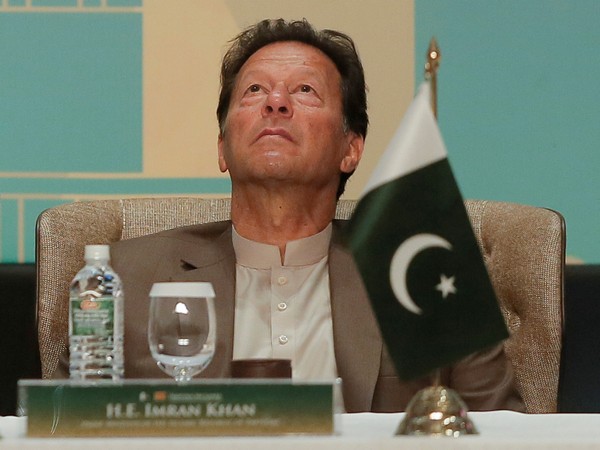

Pakistan’s financial condition is in a precarious situation under the inefficient leadership of its Prime Minister Imran Khan.
As reported on February 28, the country’s former finance minister and well-known economist Dr Hafeez A Pasha disclosed that the current account deficit was heading towards a historic record by touching the USD 20 billion-mark or 6 percent of Gross Domestic Product (GDP) for the current fiscal year.
He said the international prices of various commodities were witnessing skyrocketing trends and now the Current Account Deficit (CAD) would witness more pressure with the possibility of touching a historic high.
“For God’s sake, the political parties must shun their differences because the country is heading towards a serious financial crisis,” he appealed.
Amidst such horrific statistics, Imran Khan is announcing one economic package after another. On March 2, he launched an interest-free loan programme worth PKR 407 billion under the “Kamyab Pakistan Programme”, which he claimed that it would contribute to making the country’s low-income groups self-reliant.
Addressing the programme’s launching ceremony at Faisal Mosque in Islamabad, the premier said 4.5 million families would benefit from interest-free loans under this initiative to set up. The prime minister stressed the need for transforming Pakistan into a welfare state, along the lines of the state of Madinah, saying that the country was envisioned as a socio-welfare state.
Three days back, on February 28, he announced the slashing of the price of petroleum products by PKR 10 per litre and electricity tariff by PKR 5 per unit as part of a series of measures to bring some relief to the public.
No increase in petrol and electricity prices until the next budget; tax exemption for companies and freelancers in IT sector; foreign exchange exemption; exemption from capital gain tax for IT startups andEhsaas stipend increased to PKR14,000 from PKR12,000.
However, in reality, while the cut in petrol and energy prices were immediately implemented, the other measures announced by Imran Khan might take more time or might not even see the light of day until the adoption of next budget.
The process of designing and executing these reforms, other than Ehsaas transfers, may take another two to three months, when it is time for the next budget. The proclamation, though, will be enough to create some goodwill on its face value and buy the government some time.
Incidentally, Pakistan and the International Monetary Fund (IMF) are also scheduled to hold review talks this week whereby both sides will discuss the merits of relief package announced by Imran Khan for reducing the Pakistan Oilfields Limited (POL) and electricity prices amidst a challenging external environment.
If indeed the government will push on for the execution of all the measures announced by Imran Khan, it would not only be defaulting on its commitments to the IMF, specifically in relation to fiscal reforms and pricing in the energy sector, but also jeopardising the seventh review by the Fund.
Not only will this hurt the government’s credibility, any form of derailment from the IMF programme will have an adverse effect on the exchange rate as well as the foreign exchange reserves, further elevating the inflationary pressure. This in turn can have wide ranging medium to long term consequences for the economy.
Earlier on November 24, shamefully, official figures revealed that Pakistan’s total debt and liabilities have crossed PKR 50.5 trillion, an addition of PKR 20.7 trillion under the current government alone.
The State Bank of Pakistan (SBP) released the debt figures till September 2021, a day after Prime Minister Imran Khan described the increasing debt as a “national security issue”. As expected, figures showed that the total debt and public debt situation deteriorated during the tenure of current Pakistan Tehreek-e-Insaf (PTI) government.
Pakistan’s total debt and liabilities jumped to the record PKR 50.5 trillion at the end of September 2021, an addition to PKR 20.7 trillion in the past 39 months. There was an increase of nearly 70% in total debt of the country.
The so-called benefits announced will be celebrated briefly as “relief” but will further deteriorate Pakistan’s financial health, because they will create a burden that its decrepit tax machinery cannot shoulder through practical revenue collection elsewhere.
For an efficient economic system, it is essential that prices be connected directly to costs. When primary costs rise, as they do when international commodity prices increase, the government cannot insulate the population from higher domestic prices without creating a higher debt burden for future generations. Insufficient tax collection from broad paths of the economy and a lack of productivity in comparison to other countries are at the core of ailments of Pakistan’s economy, under Imran Khan’s government.
There is no doubt that the Prime Minister is living in his self-created bubble, miles away from reality and actual ground situation of the country. But, at the same time, it has to be kept in mind that, Pakistan will go into general elections in less than 1.5 years. As a politician, he has already started to ‘project’ the efficiency of his party in comparison to others.
On March 1, he said that the previous governments have failed to uplift the economy of the country because they did not pay attention on the small and medium scale industries whereas his government has made policies especially for these industries.
There is no doubt that Khan has been at the receiving end of people’s rage and outburst due to skyrocketing inflation, somewhat because of external reasons like exorbitant fuel and commodities prices, and he is trying to make a fool out of common Pakistani citizen by showing them these economic ‘goodies’ with no stable, secured and self-sustaining future