
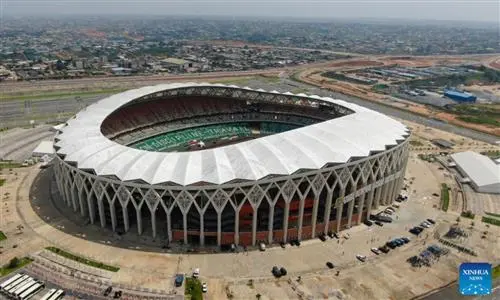

China’s stadium diplomacy has been a subject of serious concern for the global community. Through stadium diplomacy, China has succeeded in exploiting natural resources of African countries for its own benefit.
While proponents lauded China’s efforts in uplifting African nations through sports infrastructure, critics have raised serious concerns about the underlying motives and long-term implications of such initiatives. They described China’s Stadium Diplomacy as nothing but a ‘Strategic Manoeuvring’ tactic.
China has constructed over 100 stadiums across Africa so far. It has positioned itself as a key partner in the continent’s sports modernization efforts. The recent surge in Chinese involvement in construction projects reflects Beijing’s growing influence on the continent. China has leveraged the Belt and Road Initiative (BRI) as a framework for infrastructure development
The narrative of stadium diplomacy portrays China as a benevolent actor, extending a helping hand to African nations grappling with infrastructure deficits. Projects like the Alassane Ouattara Stadium in Ivory Coast and the Laurent Pokou Stadium in San Pedro are touted as symbols of China’s commitment to mutual cooperation and friendship. However, beneath the surface lies a complex web of economic, political, and strategic calculations.
Besides its involvement in Quattara project in Ivory Coast, China was deeply involved in building other sports venues too. In San Pedro, the Laurent Pokou Stadium was built by the China Civil Engineering Construction Corporation. While the China National Building Material Group (again, state owned) served as general contractor on the Amadou Gon Coulibaly Stadium in Korhogo.
According to experts, China’s stadium diplomacy is not driven by altruism, but it is a calculated strategy to expand its influence and secure access to Africa’s abundant natural resources. While the construction of stadiums may offer short-term benefits, such as job creation and enhanced sports infrastructure, the long-term consequences for African nations remain uncertain.
According to an article by Skema business school, China has been using stadium diplomacy across the continent to increase its influence. Linked to the BRI, which is intended to promote trade and foster inter-dependence between China and other nations, stadiums have frequently been gifted to African nations (or else paid for using relatively cheap loans).
For instance, when Gabon co-hosted (with Equatorial Guinea) the Cup of Nations in 2012, China was involved in building both of its stadiums. Five years later, when Gabon hosted the tournament again, China built another two. Gabon now sends around 15% of its exports – mostly crude petroleum and manganese – to China.
And just as construction of the Alassane Ouattara Stadium got underway, Ivory Coast’s president Alassane Ouattara visited Beijing to finalise a strategic cooperative partnership. By 2020, China had invested 1.5 billion US dollars in Ivory Coast. Now the African nation exports 700 million US dollars worth of natural resources and goods to China, up from 100 million US dollars in 2016.
Chinese stadium diplomacy, which also exists in countries including Angola, Equatorial Guinea, Mali and Cameroon, is officially framed as being mutually beneficial. But some critics disagree.
The reality is that China has got advantage of Stadium diplomacy enabling the country to extend its sphere of influence in Africa, often creating a political imbalance which leaves African nations at the behest of Beijing. At the same time, Africa has become a source of raw materials that help sustain China’s economic growth and global dominance in sectors such as battery manufacturing and telecommunications.
One of the primary concerns raised by skeptics is the issue of debt sustainability. African countries, enticed by the prospect of modern sports facilities, often find themselves burdened with hefty loans from Chinese lenders. The financing model adopted by China, which includes concessional loans and infrastructure-for-resources deals, raises questions about the true cost of these projects and their implications for national sovereignty.
China’s dominance in stadium diplomacy faces challenges from emerging players, particularly Saudi Arabia and Qatar, who are also vying for influence in Africa through sports diplomacy. The influx of Gulf nations into Africa’s sports landscape adds another layer of complexity to an already crowded arena.
Saudi Arabia’s ambitious plans to invest in football infrastructure and position itself as an “Afro-Eurasian” hub of international football, signals a new phase of competition in the region.
With Qatar leveraging its experience as the host of the 2022 FIFA World Cup to forge partnerships in Africa, the geopolitical dynamics of stadium diplomacy are undergoing significant shifts.
China also has a strategic rival in the form of Saudi Arabia which too wants a piece of the football diplomacy action. The Saudi Arabia is charging ahead with its own economic transformation and development, part of which involves investing hundreds of millions of dollars in sport. Saudi plans to make it as an “Afro-Eurasian” hub of international football.
pmldaily.com