
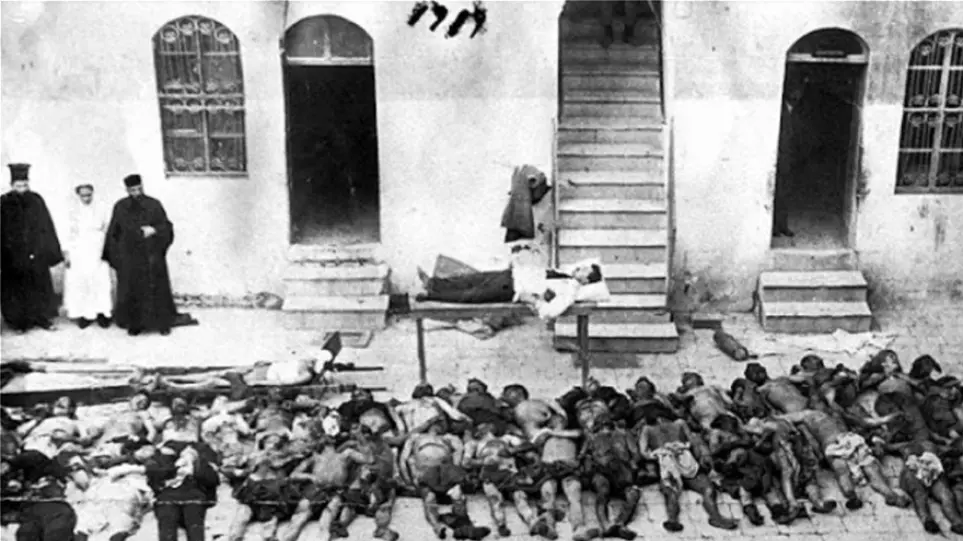

The Greek genocide, which included the Pontic genocide instigated by the Ottoman Empire and the Turkish national movement, is one of the darkest chapters in all of Greece’s long history.
An organized plan to eliminate the indigenous Greek population of Asia Minor, it included massacres, forced deportations involving death marches, expulsions, executions, and the wholesale destruction of Eastern Orthodox cultural, historical, and religious monuments.
The Turks feared that the Greek-speaking Christian population would welcome liberation by the Ottoman Empire’s enemies.
The day commemorates the systematic violence aiming at the extermination of the ethnic Greeks in Turkey approximately one century ago, during the second and third decades of the 20th century, as the old Ottoman Empire collapsed and the modern Turkish state was formed. Hundreds of thousands of Pontian Greeks were massacred and driven out of their ancestral homes at that time, fleeing a purge fuelled by a rising tide of Turkish nationalism in the previously multinational Ottoman Empire.
When the ‘new’ Turks gained power in Ottoman Thessaloniki in 1908, this sparked off what contemporary historians and scholars of this period view as “systematic” and “organised” persecution of the Christian populations of the region. These events took place at various times and in various places over the decade spanning 1913 until 1923, often in conditions of war but also during intervals of peace.
By the mid-19th century, the Greeks of Pontus were flourishing, economically and demographically. In 1865, there were 265,000 Pontians, but by 1880 their number had grown to 330,000.
By the early 20th century, their population had reached 700,000, and in 1860, there were 100 Greek schools in Pontus along with printing businesses, newspapers, magazines, clubs, and theaters.
The year 1908 was a grim milestone for the peoples of the Ottoman Empire. It was the year of the formation of the “Young Turk” movement, the extremist nationalist party that launched the persecution of Christian communities to ensure the Turkification of the region.
These Turks, on the pretext of “national security,” displaced the majority of the Greek population in Asia Minor’s inhospitable hinterland via so-called “labor battalions.”
The men who would not join the Turkish Army were forced to join these units. They were put to work in quarries, mines and road construction under crippling, inhumane conditions. Most soon died of hunger and disease.
Reacting to the oppression of the Turks—the murders, deportations, and burning of villages —the Pontic Greeks took to the mountains to salvage what was left of their lives.
After the genocide of the Armenians, the Turkish nationalists under Mustafa Kemal Ataturk then began the Pontic genocide.
In 1919, the Greeks and Armenians, along with the temporary support of the Eleftherios Venizelos government of Greece, attempted to create a standalone Greek-Armenian state.
This plan was thwarted by the Turks, who took advantage of the event to advance to their “final solution,” the Pontic genocide.
On May 19, 1919, Ataturk landed in Samsun to start the second and most brutal phase of the Pontic Greek genocide under the guidance of German and Soviet advisers.
By the time of the Asia Minor catastrophe of 1922, the number of Pontians who died had exceeded 200,000; some historians put the figure at 350,000.
Those who escaped the Turkish sword fled as refugees to southern Russia. After the end of the 1919 to 1922 Greco-Turkish War, most of the Pontian Greeks remaining in the Ottoman Empire were transported to Greece under the terms of the 1923 population exchange.
The number of people exchanged between Greece and Turkey is estimated to have been at 400,000.