
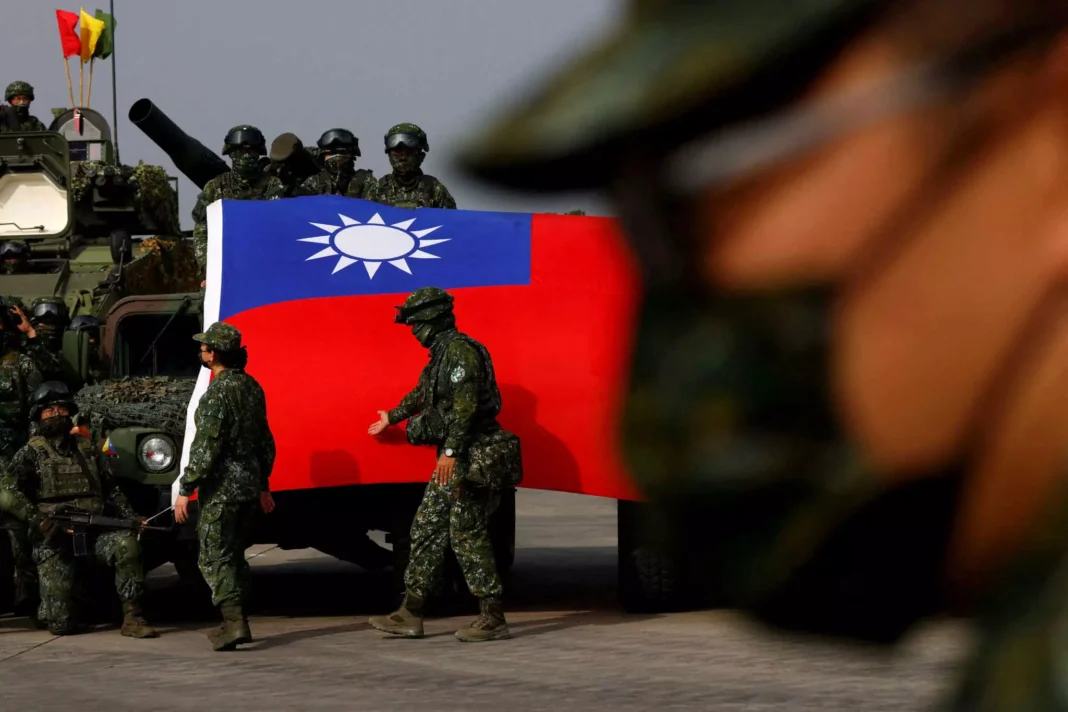

As increasing tensions between China and the US roil international relations, I am often asked a deceptively simple question: “What would a war over Taiwan look like?”
Frankly, we don’t have to guess much, because two recent sets of Chinese military exercises around the island gave us a pretty good idea of Beijing’s well-formulated battle plan.
The first of China’s major exercises was conducted after former Speaker of the House Nancy Pelosi went to to Taipei in 2022; the second came after Taiwan’s president, Tsai Ing-wen, met with current Speaker Kevin McCarthy this month. The People’s Liberation Army was clearly trying to demonstrate its ability to wage multi-domain war, and show China’s ire over increased diplomatic and military cooperation between the US and Taiwan, which Beijing regards as a “rogue province.”
Based on these exercises, China would likely begin with a ring of combatant warships around the island, with three purposes: cut Taiwan’s economic lifeline by scaring away commercial shipping; demonstrate to the US and the world that it controls the strategically vital South China Sea; and prepare for a Chinese invasion fleet aimed at Taiwan’s shores.
If China succeeded in creating a de facto blockade, it would use long-range cruise and ballistic missiles to devastate the island’s air defenses. This assault would likely target the military’s command-and-control nodes to decapitate the government. Other probable targets would be military airfields, air-defense systems, electronic-warfare centers, fuel-storage areas and ammunition depots.
In the two recent military exercises, China showed the ability to conduct a significant wave of these missile attacks, which could come from warships, aircraft and, of course, the massive unsinkable aircraft carrier 100 miles from Taiwan: the Chinese mainland. Recent news accounts of apparently leaked Pentagon intelligence documents allege that US officials feel Taiwanese air defenses would be overwhelmed by such an assault, and China would rapidly achieve air superiority.
A third element of the attack would be invisible but perhaps most devastating of all: a major cyberattack against every military target on the island. China could also use cyberwar against key civilian facilities to terrify the general population: lights would go out; drinking water and gas for cooking would be shut off; bank accounts and credit cards would be wiped out, rendering normal commerce impossible; and public transportation would face major disruptions.
At that point, however, things might get tricky for Beijing: It would probably need to pause and assess. One big variable is whether Taiwan’s people would rally to protect their shores from a manned invasion. It might seem like a long shot, but we’ve seen how Russia’s invasion only enraged and rallied the Ukrainian population behind the charismatic leadership of President Volodymyr Zelenskiy.
I’ve been to Taiwan many times and have met Tsai and her senior officials, and I believe they would fight. She showed her mettle recently by increasing the mandatory period of conscription for young men to a full year, up from four months — and nearly three quarters of the population supported the change.
Another reason the PLA would temporarily hold back is to assess the extent of the damage to the island’s infrastructure — after all, the objective would be to gain full control over Taiwan, not to destroy it.
However, the biggest reason for a pause in the invasion is that China would be watching the world’s reaction, particularly that of the US. Would Washington decide to provide full military support to Taipei — including not only the massive level of diplomatic, economic and military assistance now going to Kyiv, but also the direct firepower of the US Navy and Air Force? Given the long-standing US policy of strategic ambiguity, nobody can predict how the US would respond.
What we can see happening right now is the increasing number of sophisticated weapons sold by the US and other democratic powers to Taiwan; the robust economic integration with the bustling Taiwanese economy; and increased diplomatic support globally. All this should help make Taiwan more of a “porcupine,” an indigestible target.
The right kinds of defensive weapons systems to sell Taiwan — in addition to improving its questionable air-defense capability — would include sophisticated fighter aircraft, unmanned air- and seagoing vehicles, “smart” underwater mines, and cybersecurity training. Every new sale of US arms to Taiwan increases the uncertainty in the minds of Chinese strategists as to whether they could easily win a war for the island.
bloomberg.com