
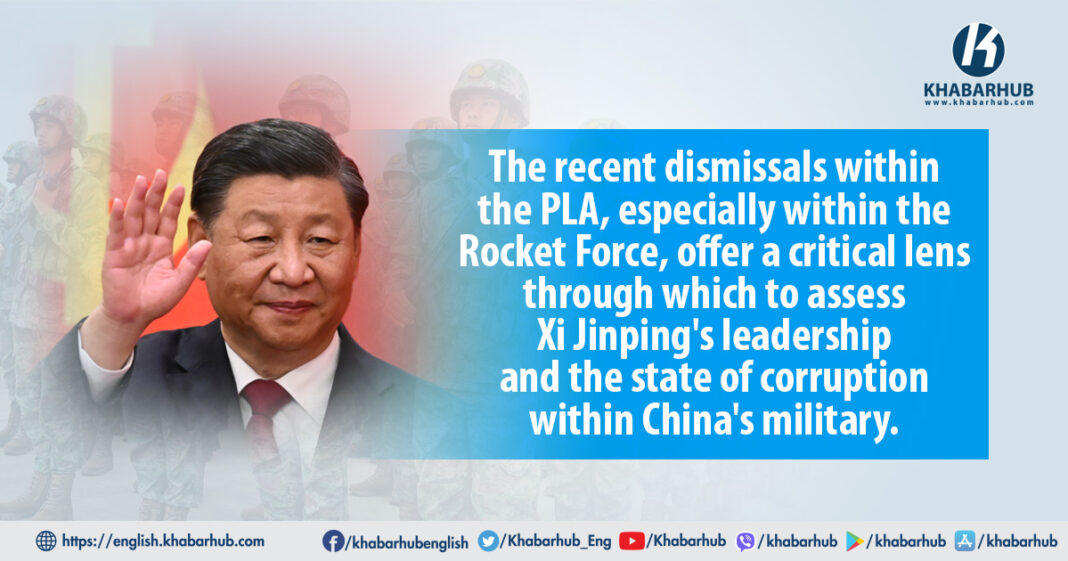

Corruption within the People’s Liberation Army (PLA) continues to cast a dark and concerning shadow over China’s military might, with recent dismissals shedding light on the pervasive issue despite years of anti-graft campaigns.
The ousting of nine senior generals, including key officials from the PLA’s Rocket Force, from the National People’s Congress (NPC) not only underscores the deep-seated corruption within the military but also reflects systemic fault lines that threaten the integrity of China’s armed forces.
These systemic fault lines highlight the persistent struggles within the PLA and raise questions about the efficacy of Xi Jinping’s leadership in addressing corruption and ensuring military readiness.
President Xi Jinping’s touted anti-corruption campaign within the PLA has been hailed as a resolute effort to cleanse the military of malfeasance.
The focus on the PLA’s Rocket Force, responsible for managing China’s missiles division and a vital part of the nation’s nuclear arsenal, highlights a systemic rot that extends beyond individual actions.
However, a recent series of events expose the facade of success, revealing that corruption remains entrenched within key military branches, especially the Rocket Force.
Despite Xi’s narrative of consolidating control, the dismissals of high-ranking officials point to a leadership that is either unable or unwilling to uproot corruption entirely.
Three high-ranking executives in the aerospace and military industry, Wu Yansheng, Liu Shiquan, and Wang Changqing, faced political repercussions with the revocation of their titles by the Chinese People’s Political Consultative Conference (CPPCC) on December 27, 2023.
Corruption investigations have led to swift removals of Chinese leaders associated with the PLA Rocket Force since 2023, signaling significant disruptions despite President Xi Jinping’s previous investments in the force’s growth.
The reorganization within the Rocket Force, highlighted by the resignation of former commander Wei Fenghe in March 2023 and the subsequent anti-graft purges, adds another layer of complexity to China’s military dynamics.
Of note, the matter of corruption in Rocket force comes at a crucial time when China aims to make significant changes in its nuclear capabilities.
The abrupt removal of General Li Shangfu, the former Defence Minister, and the subsequent purging of nine senior generals linked to him raise questions about the extent of corruption within the PLA’s top echelons.
Xi Jinping’s leadership style, marked by centralization of power, does little to address the underlying structural issues that foster corruption.
Xi Jinping’s acknowledgment of hidden risks in areas of concentrated power, such as finance, energy, and state-owned enterprises, raises questions about the extent of corruption’s influence across various sectors.
Instead, it appears to prioritize loyalty over competence, leading to an environment where corruption can flourish under the guise of party loyalty.
The focus on the PLA’s Rocket Force, responsible for managing China’s missiles division and a vital part of the nation’s nuclear arsenal, highlights a systemic rot that extends beyond individual actions.
The alleged involvement of high-ranking officials in corrupt practices, including embezzlement and bribery, reflects a culture of impunity that has seeped into critical military decision-making processes.
The dismissals of commanders closely associated with the Rocket Force, such as Li Yuchao, Zhang Zhenzhong, and Liu Guangbin, underscore a disturbing trend.
The claims of corruption compromising the combat readiness of the Rocket Force, with reports of missiles filled with water and malfunctioning silo lids, raise serious concerns about the nation’s defense capabilities.
This points not only to individual failures but a wider failure in the PLA’s procurement, oversight, and accountability mechanisms.
Xi Jinping’s Leadership Challenges: A Campaign for Loyalty or True Reform?
Xi Jinping’s anti-corruption campaign within the PLA is framed as a necessary measure to ensure absolute loyalty to the party.
However, the recent dismissals suggest a campaign more focused on loyalty than on genuine structural reform.
The promotion of individuals to key positions based on allegiance rather than merit perpetuates a culture where corruption can thrive under the guise of party loyalty.
The dismissal of generals linked to the ousted Defence Minister Li Shangfu and the subsequent appointments of new leadership, including General Dong Jun as the Defence Minister, indicate a continuous cycle that fails to address the root causes of corruption.
Xi Jinping’s approach of reshuffling personnel may be perceived as a cosmetic solution that obscures deeper issues within the PLA’s organizational culture.
The implications of corruption within the PLA extend far beyond the military establishment, impacting national security and China’s standing on the global stage.
Reports of compromised combat readiness in the Rocket Force, a crucial component of China’s defense strategy, reveal a worrisome intersection of corruption and strategic vulnerabilities.
The nation’s security and global standing hinge on its ability to confront systemic issues within the military, moving beyond cosmetic solutions toward genuine structural reforms that prioritize competence over loyalty.
This not only jeopardizes China’s military effectiveness but also undermines its credibility globally.
Xi Jinping’s acknowledgment of hidden risks in areas of concentrated power, such as finance, energy, and state-owned enterprises, raises questions about the extent of corruption’s influence across various sectors.
The lack of a comprehensive and transparent approach to addressing corruption suggests that the leadership is more focused on maintaining control than on genuine systemic reform.
The recent dismissals within the PLA, especially within the Rocket Force, offer a critical lens through which to assess Xi Jinping’s leadership and the state of corruption within China’s military.
Despite the proclaimed success of the anti-corruption campaign, the persistent issues reveal a leadership that prioritizes loyalty over genuine reform.
The hollow promise of reform becomes evident as the PLA grapples not only with individual cases of corruption but with a deeply ingrained culture that fosters malfeasance.
The dismissals, rather than signaling a resolute commitment to eradicating corruption, indicate a reactive approach that addresses symptoms rather than causes.
As China navigates the path forward, the critical examination of the PLA’s struggles against corruption and Xi Jinping’s leadership challenges becomes imperative.
The nation’s security and global standing hinge on its ability to confront systemic issues within the military, moving beyond cosmetic solutions toward genuine structural reforms that prioritize competence over loyalty.
Until then, the shadows of corruption will continue to loom large over China’s military might and the credibility of its leadership.
/english.khabarhub.com