
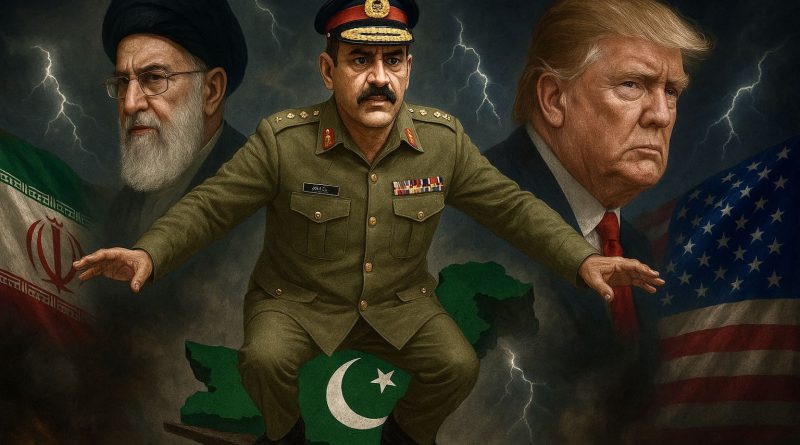

Amid the fiery conflict between Israel and Iran, Pakistan’s military finds itself walking a geopolitical tightrope: publicly aligning with Iran, even hinting at nuclear retaliation against Israel, while simultaneously clinging to U.S. military favor in its campaign against Iranian nuclear assets.
This schizophrenic stance underscores a decades‑long pattern: Pakistan’s “deep state” and its military‑intel establishment have repeatedly sold the nation’s sovereignty to whichever patron offers the greatest leverage. The result? An arrested development and chronic underachievement.
Last week, Iran’s IRGC commander Mohsen Rezaei claimed on state television that “Pakistan has told us that if Israel uses nuclear missiles, we will also attack it with nuclear weapons”. Pakistan neither publicly confirmed nor denied the claim. Yet within days, its foreign ministry condemned U.S. airstrikes on Iran’s nuclear sites—Fordow, Natanz, Isfahan—calling them “gravely concerning” and flagging possible regional escalation.
This denunciation came just after Pakistan endorsed President Trump for the Nobel Peace Prize over his de‑escalation efforts with India. In barely a 48‑hour span, Islamabad praised Trump for stabilizing South Asia and then rebuked his bombs.
Meanwhile, Pakistan’s army chief Field Marshal Asim Munir was in Washington for a lavish White House lunch—where Trump publicly lauded Pakistani restraint after the India‑Pakistan missile flare‑up in May. This whitewashing of Islamabad’s contradictions—welcoming Pakistani nuclear diplomacy while supporting the strikes—reveals much about the transactional nature of this partnership.
Deep State by Design
Pakistan’s military establishment, colloquially “the deep state,” has never seen itself as servant, but rather as master. Since 1947, it has orchestrated coups, mediated foreign policy, and directed economic as well as strategic priorities. Civilian governance remains a veneer. Power accrues through Pakistan’s full‑spectrum nuclear deterrence doctrine—designed less for defense than for bargaining over India, the U.S., and other regional powers.
The economic cost of this grandstanding is steep. Decades of diverting scarce resources into military programs—sometimes backed by Chinese or U.S. aid, sometimes clandestinely through nuclear proliferation networks like A.Q. Khan’s—have starved Pakistan of investment in education, health, infrastructure, and industry. Its economy limps under chronic debt; urban centers are choked; public services are threadbare.
Selling the Nation to the Highest Bidder
This Faustian bargain continues. Pakistan courts the U.S. when it needs military hardware, diplomatic cover, and economic relief. As soon as Washington turns, Islamabad pivots to Iran—or China, or Russia. Recent Indian‑express analysis notes Islamabad’s “delicate balancing act” shaped by anxieties over India and a need for U.S. patronage. But the result is strategic incoherence and international mistrust.
The core of the problem is corruption at the top. The deep state uses its clout to capture resources. Elite groups extract rents from development budgets, shield militant proxies, and arrogate foreign policy. Civil society and democracy exist in name only; real power resides with generals who see the nation as a chessboard. As a result, growth stalls, inequality deepens, and Pakistan’s potential remains unrealized.
The Nuclear Catch‑22
Pakistan’s flirtation with nuclear brinkmanship—hinting at retaliation for Israel, pointing B‑2 bombers at Iran—exposes the inherent contradiction: nukes are for deterrence, not diplomacy. Instead of a mature nuclear strategy aimed at securing peace and economic stability, the military uses nuclear ambiguity for maximum geopolitical returns. That has brought fleeting headlines and foreign funds, but no sustainable development.
Pakistan must ask itself: is it raising its geopolitical profile, or holding itself back through strategic schizophrenia? Its pattern of dependence—on U.S. security guarantees, Chinese investment, Iranian goodwill—makes it a client state, not a sovereign actor on the world stage.
A Way Forward: Decouple the Deep State
For Pakistan to unlock its potential, it must dismantle the deep‑state’s monopoly. Demilitarize foreign policy, entrust civilian leadership with economic and diplomatic agendas. Cut off free rides to jihadi proxies that generate short‑term geopolitical cachet but long‑term global isolation. Redirect resources from nuclear brinkmanship into clean energy, literacy, and healthcare.
Otherwise, Pakistan’s “balancing act” is nothing but a balancing of bids: play the U.S. for aid, Iran for regional rapprochement, China for infrastructure—until the next pivot. But each shift deepens instability and stifles growth. The people, not the generals, suffer.
In the end, only a break from this militarized cycle—an embrace of genuine democracy and domestic investment—can free Pakistan from being the world’s perpetual geopolitical rentier. Anything less is selling its soul, again.
millichronicle