

With a delicate ceasefire in place between India and Pakistan even as Operation Sindoor remains active, the latest conflict between the two nuclear-armed states is very different from any previous contestation. The warfare was largely aerial this time, with conventional systems, such as tanks, not being part of the action on the frontlines. Instead, both countries utilised drones to target, surveil, and disrupt. More importantly, the use of cheap drones en masse by Pakistan brought the modern reality of grey-zone warfare to the world’s most militarised geography.
In almost all active global theatres of conflict, from the Russia-Ukraine war to the American campaign against the Houthis in the Red Sea, drones have taken up significant capacity space for their utility, cost-effectiveness, lack of manpower losses, ability to challenge older air defences meant to target large aircraft, and overall nimbleness as a platform.
MQ-9s And ‘DIY’ Drones
In the world of counter-terrorism, drones had two main eras of prominence. The first was the US ‘war on terror’, which saw the popularisation of the MQ-9 ‘Reaper’, whose shape and silhouette itself became a mark of death, destruction, and propaganda for terror groups. The second period – the more interesting and consequential one – saw the proliferation of crude, ‘Do-It-Yourself’ (DIY) drones built by ISIS (Islamic State, or ‘Daesh’ in Arabic) and institutionally incorporated into its forces.
The Reaper’s legacy is based on the two main theatres of war from the past two decades: Iraq and Afghanistan. In both these battlefields, the Reaper reigned supreme largely due to the lack of any – or minimal – air defences to contend with. But fast forward to 2024-25, and the US has suffered multiple Reaper losses in Yemen against the Houthis as the Iran-backed militant group onboarded surface-to-air missiles into its military inventory.
Ingenuity Trumps Technology
On the contrary, much like the difference between a state and a non-state militant group, the drones developed by ISIS were based on ingenuity, not technological prowess. Their effectiveness was unmatched.
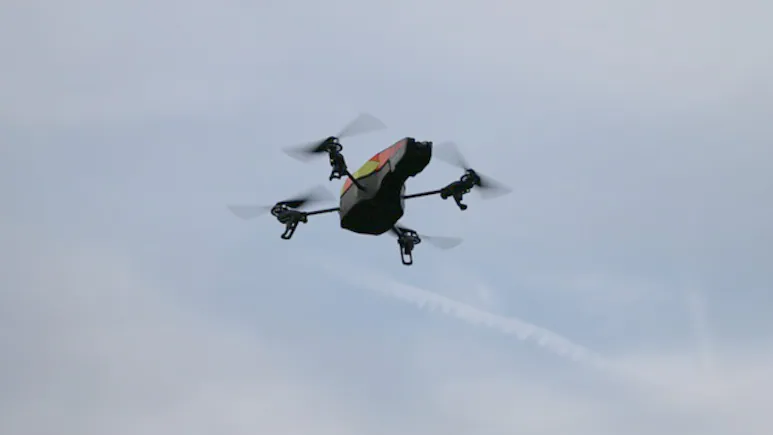
In the initial stages, these drones were made from scratch, using debris, wood, and small motors from other mechanical equipment, before the group moved on to modifying commercial quadcopters for carrying small and crude pipe bombs using basic pulley systems to drop them. These quadcopters were sourced commercially from around the world, including, in one case, New Delhi. Their initial success was based not on their ingenuity, but on the fact that their detractors were not prepared to respond to this brand of warfare from a terror group. The US military, with an active annual budget of over $600 billion, active in Iraq at the time, was clueless.
How ISIS Developed Its Unique Warfare
ISIS, in its initial years, benefited tremendously from the success of its heavy global propaganda. Hundreds from across the world, including Europe and the United States, arrived largely in Syria and northern Iraq to join Abu Bakr Al Baghdadi’s clan. A significant chunk of these cadres were well-educated and had earlier been engineers or tech professionals. In 2017, terrorists such as Abu Muadh Al Tunisi and Sajid Farooq Babar were killed in US airstrikes for their role in helping build the group’s drone ecosystems. According to scholar Don Rassler, two Bangladeshi brothers were also instrumental in mobilising funds, drones, and components required to build ISIS’s aerial repertoire. At least one of them was also a founding figurehead of Dawlatul Islam Bengal, an ISIS affiliate from Bangladesh involved in the Holey Artisan bakery attack in Dhaka in 2016, which killed 29 people.
The success of ISIS’s aerial fleet has been well acknowledged by the US military itself. “About five or six months ago, there was a day when the Iraqi effort nearly came to a screeching halt, where literally over 24 hours, there were 70 drones in the air. At one point, there were 12 ‘killer bees’, if you will, right overhead and underneath our air superiority,” explained General Raymond Thomas in 2017, the then head of the US Special Operations Command. He further added that with its modified drones, ISIS, for a time, enjoyed tactical air superiority in the air under conventional American air power.
Grey Zone Warfare
What ISIS started – and arguably perfected – almost a decade ago today shapes frontline mechanisms of state militaries. After Operation Sindoor, Pakistan launched a gamut of drone capabilities against India for multiple reasons: to target installations, map out adversarial air defence systems, and damage frontline infrastructure at bases. India also utilised similar tactics, though at a smaller scale, as it banked on its technological and conventional superiority. However, even under conventional air superiority, grey-zone warfare can be equally intrusive. This is further underlined by the fact that even after agreeing to a very delicate ceasefire, Pakistani drones continue to create annoyance in Indian airspace.
Grey-zone warfare also makes for an active industry within the international military-industrial complex. However, it is largely the middle powers that have been investing in it heavily – and thriving. Turkey, whose drones were used by Pakistan, and Israel, whose drones were used by India – and even Iran, whose drones are used by Russia – are a few states at the forefront of these systems. Small- and medium-sized countries, which cannot afford large-aircraft-led, expensive-to-run air forces and do not have adversaries sporting the same, are increasingly opting for drones as their frontline equipment.
Turkey is a leader in this arena, with more than 20 of its companies having invested in such technologies. Of these, Baykar is the most successful one, with the likes of Pakistan, Bangladesh, and 25 other militaries being known operators of a variety of its products, including the popular Bayraktar TB-2 armed drone.
Terror-Tech Link Is As Old As Time
Terrorism’s relationship with technology is not new, and neither was ISIS the first terror group to mobilise technology. Even the use of aircraft as weapons in the 1960s and 1970s, when pro-Palestine groups unleashed a spate of hijackings, or, more recently, the manufacturing of mobile and improvised explosive devices, are examples of how the technological ingenuity of terror groups often forces strategic and policy changes. Even then, it can’t be denied that ISIS’s drone squadrons have been one of their kind, for not only did they disrupt conventional warfare in active theatres, but they continue to serve as blueprints for how wars in the near future will be fought.
(Kabir Taneja is Deputy Director and Fellow, Strategic Studies Programme, Observer Research Foundation)
ndtv.com