
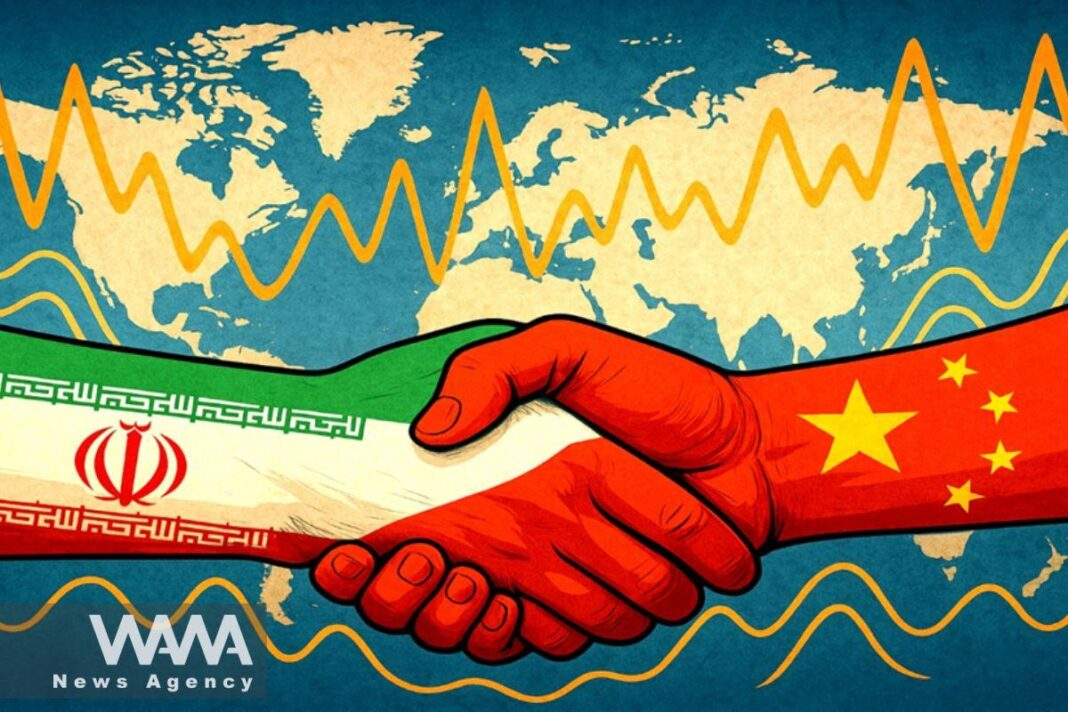

The war in the Middle East has delivered a body blow to the plan of Beijing to build an overland railway corridor between China and Iran that can offer Tehran and Beijing a potential alternative to bypass sanctions by the United States on Iranian oil. Beijing also wants to use the corridor to capture the European market.
The overland railway corridor as a trade route avoids vulnerable maritime chokepoints for China like the Strait of Malacca, connecting the Indian Ocean with the South China Sea; the traditional route of Chinese oil imports. This route is regularly policed by the US Navy to make sanctions work. Washington maintains strategic control over the Malacca Strait through the Seventh Fleet and regional allies.
Beijing has invested in this railway corridor under the Belt and Road Initiative so it can continue to obtain Iranian oil uninterrupted at concessional rates despite American sanctions and can keep its oil supply free from interruptions by the US military in case China launches an attack on Taiwan, which it wants to annex.
Sanctions usually put restrictions on a global scale on doing business with the sanctioned company or country. The effectiveness of sanctions depends on the ability of the US to intercept or block the flow of goods and money.
An overland railway corridor eliminates the risk of US naval interdiction of China’s oil trade with Iran as countries through which land corridors pass are not a party to the Western sanction regime. Under a sanction regime, the US also cuts off the targeted companies or countries from global trade by controlling their access to the American banking system through the SWIFT clearing platform.
Cargo travelling by sea between Iran and China is exposed to risks like storms and accidents, piracy and geopolitical tensions. Dollar-dominant markets like the Lloyd’s of London specialize in insuring such maritime risks. Trade between Iran and China using the railway corridor also circumvents the Western-controlled insurance mechanism for global trade, thus reducing the bite of sanctions.
Some observers have thus described this railway corridor between China and Iran “the nightmare of the US.” The rail link is expected to allow the direct delivery of Iranian bulk goods like petrochemicals, agricultural products and construction materials in China, while facilitating the import of Chinese electronics, machinery and consumer goods in Iran.
A planned extension of the corridor from Iran to east Europe through Turkey and connecting with the railway network in Europe will offer China an overland route for conducting business in Europe; providing a shorter alternative to the existing routes — both sea and overland — and thus providing China with an opportunity to increase its footprints in Europe.
The commissioning of the direct railway corridor between Iran and China has come at an inopportune moment when, according to reports, the Donald Trump government in the US was preparing to lift some of the secondary sanctions on companies doing business with Iran.
In return, Washington had wanted that oil transactions of Iran would be routed through escrow accounts controlled by the US which would work as a neutral party holding funds on behalf of China and other countries and Iran; releasing them when contractual conditions have been made. This would have offered Tehran limited access to dollars, but under American financial supervision.
The establishment of the direct railway line to China may have undermined this prospective arrangement, with the corridor providing an alternative for China and Iran to deepen economic ties beyond the reach of US policing; at a time when Washington is trying to control the oil export revenues of Iran.
Beijing and Tehran are using China’s Cross-Border Interbank Payment System for financial transactions to avoid the SWIFT system. These transactions do not appear in mainstream international banking records. This also promotes the Chinese goal of undermining the dollar-dominated world order controlled by the US.
The two wars in Iran launched by the US and Israel, one in last June and the other this year, have rendered this railway corridor uncertain. While the main targets of attack in the two wars have been the nuclear facilities in Iran, the railway network has also been hit. Reports say that the railway network and railway facilities at Bandar Abbas on the Persian Gulf have been hit by the current American and Israeli air strikes and also were damaged in the 12-day war launched on Iran in June 2025.
Generally, a strong Iran can be a pivot in the strategic designs of Beijing in the Middle East. A weakened Iran, or an Iran where the ruling anti-US regime has been replaced, will defeat the Chinese strategy. The latest announcement by Donald Trump that the US is in dialogue with an important leader of Iran will push up blood pressure among mandarins of the CCP in Beijing.
It may not be just a coincidence that the combined attack by the US and Israel on Iran in June 2025 came within a month of Iran launching the direct railway connection to China in May and that the second US-led attack in March this year came within months of six countries signing an agreement in Istanbul on November 25, 2025, to develop the southern section of the China-Europe Corridor.
The deal, promoting Iran as a gateway for the rail cargo transit from China to Europe, was signed by officials from Iran, China, Turkey, Kazakhstan, Turkmenistan and Uzbekistan.
The six countries have committed to increasing rail traffic along the corridor which passes through Iran by implementing competitive unified tariffs, improving train transit times, lowering secondary costs and customs duty and ensuring that the necessary infrastructure is in place.
Iran stands to benefit once these commitments are carried out. A large portion of the current rail transit volume between China and Europe will then be redirected through Iranian territory. For Beijing, this will bring more business opportunities in Europe.
Three transport corridors currently connect China to the European Union: The Northern Corridor through Mongolia and Russia, the Middle Corridor, a mixed sea-rail route crossing the Caspian Sea toward Azerbaijan, Georgia and the Black Sea, and the third, long known as the Southern Corridor but inactive until now, passing through Iran and dates back 2,000 years to the original Silk Road. China’s rail diplomacy focuses on activating the Southern Corridor. The agreements on unified tariffs among six countries cutting transit times will reduce transport costs and ensure cargo moves quicker.
The line enters Iran through the Turkmenistan border in the north-east and exits towards Turkey in the north-west. Some links on the railway line towards the Turkey border would have to be completed.
In view of the disruptions in the Northern Corridor due to the war in Ukraine and the Middle Corridor involving multimodal complications associated with Caspian Sea crossings, the fully rail-based Southern Corridor could be the most attractive option as a transit route between China and Europe.
For manufacturers moving electronics, automotive components, pharmaceuticals, textiles and consumer goods between China and Europe, this is not just a marginal improvement over the sea routes but a different supply chain option.