
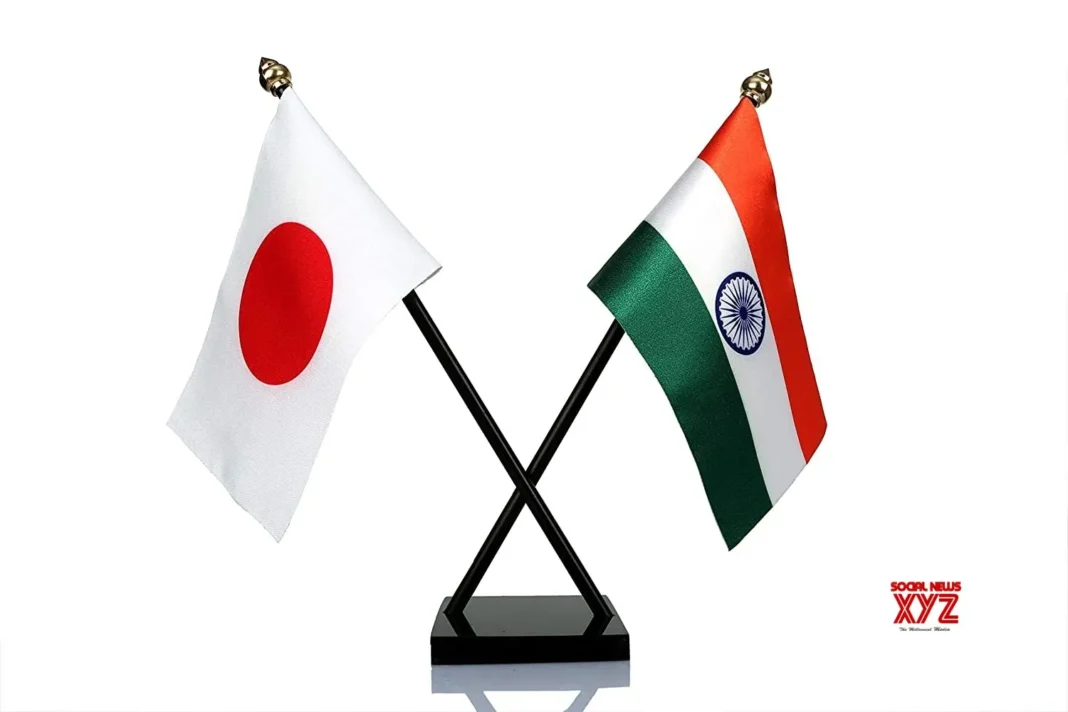

India and Japan agreed to strengthen bilateral cooperation on maritime security, including expansion of joint drills and institution of a high-level defence dialogue.
Indian Defence Minister Rajnath Singh and External Affairs Minister S. Jaishankar met their Japanese counterparts Hamada Yasukazu and Hayashi Yoshimasa during the second India-Japan 2+2 Ministerial Dialogue held in Tokyo on September 8.
They held detailed discussions on all critical challenges to a rules-based global order which increasingly binds the two countries, reinforcing their special strategic and global partnership.
India and Japan are members of several influential global platforms. India will be chairing the G20 next year, overlapping with Japan’s chairship of the G-7. Their common commitment to reformed multilateralism is reflected in their regular G-4 consultations, the next session of which is to be held later this month.
Citing their common interests as active providers of development assistance, especially in South East Asia, South Asia, and Africa, Jaishankar observed that the scope of the special strategic partnership between India and Japan exceeds well beyond the immediate region.
Japan was the second country, after the US, to establish two-plus-two talks with India. The SDF and the Indian military, which ran their first joint naval exercise in 2012, have since participated in several joint drills and exercises with other countries. Japan and India inked an acquisition and cross-servicing agreement in 2020.
The 2+2 ministerial meet assumes significance against the background of heightened tensions across the Taiwan Strait. In August, China reportedly lobbed five ballistic missiles in Japan’s exclusive economic zone, during a military exercise, China’s largest ever in the Taiwan Strait.
Japan’s Defence Minister Nobuo Kishi called it “a serious problem that affects our national security and the safety of our citizens”.
The exercise came two days after US House Speaker Nancy Pelosi visited Taiwan and hours after China cancelled a scheduled foreign minister-level meeting with Japan expressing displeasure with a G-7 statement urging China to resolve Taiwan tensions peacefully.
Japan is currently witnessing a massive domestic debate that will hopefully result in a revision of Tokyo’s national security strategy, national defence strategy, and medium-term plans to build new military capabilities.
Deepening defence partnerships forms one of the three broad elements in Japan’s new strategy to cope with the rising Chinese power. The other two are reorienting Japan’s diplomacy and boosting national capabilities. Japan is currently the 9th largest defence spender in the world, but a doubling of the defence allocation over the next few years, could make it the third-largest defence spender after the US and China.
Some defence experts in Japan are calling for the acquisition of counterstrike capabilities, meaning the deployment of long-range missiles. Tokyo is also seeking to strengthen security partnerships with like-minded countries such as Australia and India, promising to strengthen the defence capabilities of the Indo-Pacific countries, unilaterally as well as through the Quad.
In a reference presumably to Chinese “expansionism”, the four ministers affirmed their opposition to attempts to unilaterally change the status quo in the East China Sea and the South China Sea area. Jaishankar called for stronger bilateral security and diplomatic relations, while Hayashi emphasized the need to cooperate more than ever, given the challenges to the “existing global order”.
In a joint statement following the meeting, the ministers highlighted their commitment to a common strategic goal of a free, open, inclusive, and resilient Indo-Pacific, coercion free and based on the rule of law. Reiterating their strong support for ASEAN’s unity and centrality, they reaffirmed their strong support behind the framework of “ASEAN Outlook on the Indo-Pacific (AOIP)” which upholds the principles such as the rule of law, openness, freedom, transparency, and inclusiveness.
There has been considerable progress in India-Japan bilateral relations since the last meeting in November 2019 in the bilateral security and defence cooperation, which constitutes an important pillar of the India-Japan Special Strategic and Global Partnership.
Noting with approval the importance of multilayered dialogues between the two countries, the ministers welcomed the deepened cooperation discussed through the Disarmament and Non-Proliferation Dialogue of February 2021, the Maritime Affairs Dialogue of September 2021, the Space Dialogue of November 2021, and the Cyber Dialogue of June 2022.
Looking ahead, the two countries geared up to enhance dialogues in economic security.
In a statement after the meeting, Jaishankar observed that the two countries were also working together on cyber security, 5G deployment, and critical and strategic minerals, which formed part of the deliberations.
Several agreements on defence cooperation were arguably the most significant takeaway from the meeting. The ministers noted with pleasure the progress in the defence cooperation and exchanges, welcoming the participation of Japan for the first time in the multilateral exercise MILAN and the operationalisation of the Agreement Concerning Reciprocal Provision of Supplies and Services between the Self-Defence Forces of Japan and the Indian Armed Forces.
They also appreciated the close cooperation between the air services of the two countries towards the early conduct of the inaugural India-Japan fighter exercise. There were talks also on enhancing cooperation in defence technology. The Ministers noted with satisfaction the cooperation in the areas of Unmanned Ground Vehicle (UGV)/Robotics, under the auspices of the Sixth India-Japan Joint Working Group on Defence Equipment and Technology Cooperation.
Japan and India will “further identify concrete areas for future cooperation in defence equipment and technology,” the joint statement said.