
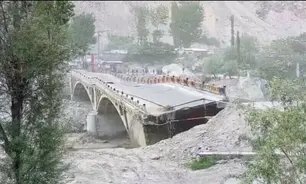

The main bridge connecting Pakistan and China along the Karakoram highway has been washed away. The Hassanabad bridge—a part of the China Pakistan Economic Corridor (CPEC) has collapsed, unable to withstand the flash flood caused by melting ice of the Shishper glacier. The bridge was located in Hunza Tehsil of Gilgit-Baltistan region of Pakistan Occupied Kashmir (PoK).
Footage uploaded on social media showed the bridge made by the Chinese companies collapsed like a house of cards by the force of the flood caused by the outburst from a glacial lake on Saturday.
Sharing the video clip, Pakistan’s new climate and environment minister Sherry Rehman said in her post that, “Pakistan Climate and Weather department had warned that Pakistan’s vulnerability is high due to high temps. Hassanabad bridge on the KKH collapsed due to a glacial lake outburst flood from the melting Shishper glacier which caused erosion under pillars.”
According to Pakistani agencies, “as a result of global warming, rapidly melting glaciers have created more than 3,000 glacial lakes in Gilgit-Baltistan and Khyber Pakhtunkhwa. Thirty-three of these could burst at any moment.”
Gilgit-Baltistan is a part of the erstwhile princely state of Jammu and Kashmir and is under the occupation of Pakistan since 1947. The China Pakistan Economic Corridor (CPEC), the flagship of China’s Belt and Road Initiative (BRI) traverses through this region, which has a special constitutional status in Pakistan. CPEC starts from Gwadar in restive Balochistan, then passes through Gilgit-Baltistan, and terminates at Kashgar in China’s Xinjiang region.
Since the beginning of ambitious CPEC, environmentalists and activists have been issuing warnings of major disasters in the Gilgit-Baltistan region of PoK. Gilgit-Baltistan is home to some of the world’s highest mountain ranges.
Due to this large-scale exploitation of the land and resources of the region, Gilgit-Baltistan continues to witness protests on a daily basis over forced usurpation of village lands and the plundering their natural wealth—a recipe for major environmental disasters.
According to Manzar Shigri, an activist, the main cause of the melting of the ice caps is the ongoing deforestation in the region by the Chinese companies. The local population, well aware of its expected negative impact, was not given any voice in the decision-making process of the project and denounced the indifferent attitude of the Pakistani government.
According to a recent survey by Focus Pakistan, an NGO, thirty-six glacial lakes in various valleys of Gilgit-Baltistan have been declared dangerous, with seven of them posing a major threat to the region and its people.
In the Shimshal Valley there are three glaciers; out of which one took the shape of a lake. The lake is expanding rapidly which poses a threat to Hunza and the entire Gilgit Baltistan. No attention was paid to protect the environment since the CPEC project was launched.
According to activists, the Chinese companies have been using “blasting” techniques for their projects which are very dangerous for the region.