
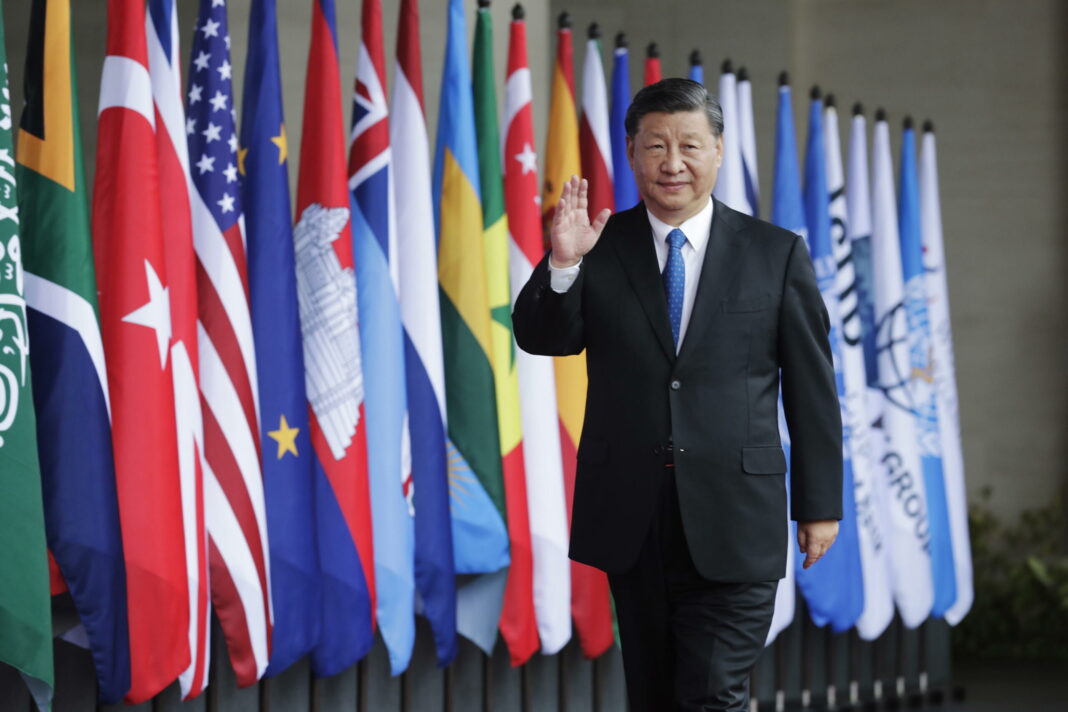

At the recently concluded “rubber-stamp” National People’s Congress (NPC) session in Beijing , Chinese President Xi Jinping signalled that his government would oppose “pro-independence” influences in Taiwan and called for the “peaceful development of cross-strait relations”.
While he sounded “moderate” in his messaging on the Taiwan issue, Xi reiterated the fundamental policy stand on it: “We should unswervingly advance the cause of national rejuvenation and reunification.” For the “reunification” of Taiwan, Xi stressed boosting the prowess of the Chinese military in the next five years of his unprecedented ‘third’ presidential term. Analysts believe that Beijing is eyeing the next year’s presidential elections in Taiwan. Therefore, it is hinting at a “peaceful” reunification of the self-governed island into China by supporting a “Beijing-friendly” candidate in power. Nevertheless, tensions over Taiwan may deepen as Xi focuses on enhancing China’s military strength to deter the United States and other countries from interfering in Beijing’s “internal” matters.
In his speech at the NPC, laying out his priorities for China, Xi described the need for “national reunification” as the “essence of national rejuvenation”, casting the issue of Taiwan’s relationship with China as a focus of the new political term. In his speech, Xi remarked: “We should actively oppose the external forces and secessionist activities of Taiwan’s independence. We should unswervingly advance the cause of national rejuvenation and reunification.” In the past, Xi did not rule out the use of force against Taiwan. While speaking at the opening ceremony of the ruling Communist Party of China’s 20th National Congress last October, Xi said China reserves the option of “taking all measures necessary” against “interference by outside forces” on the issue of Taiwan. It is noteworthy, Xi gave the issue of Taiwan “greater prominence” in his 2022 Party Congress speech than he had five years ago at the party’s 19th National Congress.
Many analysts maintain that the escalating US pressure on China regarding the Taiwan issue has exacerbated tensions within Beijing. Additionally, tensions have been amplified since last summer when the US House Speaker, Nancy Pelosi, made a “controversial” visit to Taiwan. This visit was viewed as a major provocation by Beijing, resulting in sanctions against Pelosi, an intensification of “reunification” rhetoric, and an increase in military pressure on the island. Furthermore, the ongoing Russia-Ukraine conflict has fuelled concerns in the ‘West’ that China may follow a similar path and militarily capture Taiwan in the coming years. According to US intelligence reports, President Xi Jinping has instructed the Chinese military to be “ready by 2027” to invade Taiwan. Moreover, the head of the US Air Mobility Command (AMC), Gen Mike Minihan, has predicted that China will invade Taiwan between 2022 and 2049, with the possibility of a conventional war between the US and China in 2025.
Amid the simmering geopolitical rivalry between the Western powers and the China-Russia strategic partnership, there is an escalating possibility of military clashes in the Indo-Pacific region, centred around a potential invasion of Taiwan. In addition to adopting a firm stance on Taiwan, Xi Jinping is engaged in a shrewd game of narrative on the issue. While maintaining a “muscular policy” towards the island, he is also making efforts to reunite it with mainland China through peaceful means.During his recent NPC speech, Xi emphasized the imperative to “promote peaceful development of cross-strait relations,” hinting at China’s intention to employ a “carrot and stick” strategy to seize Taiwan. However, it is widely speculated that Beijing is not in a position to engage in a protracted conventional war with Taiwan, and the United States, given the significant economic toll that the Covid-19 pandemic and Xi’s stringent lockdown policies have exacted on China. Also, Beijing has learned lessons from the ongoing Russia-Ukraine war that an unjustified invasion of Taiwan’s sovereign territory could invite economic sanctions and exacerbate military tensions with the western countries, weakening Xi’s presidency.
Therefore, Beijing may opt to meddle in Taiwan’s upcoming presidential elections in January 2024 to influence the outcome in its favour or take a few years to prepare for a full-scale invasion. Last year, Admiral Michael Gilday, the US Chief of Naval Operations, predicted that China might invade Taiwan by 2024 instead of their original plan of 2027, as their plans to take over the self-governing island were accelerating beyond expectations. Similarly, in March 2021, Admiral Phil Davidson, who was then the head of the US Indo-Pacific Command, warned that China could attempt to recapture Taiwan within the next six years. These projections have intensified the Chinese threat of invasion and further strained the already tense relationship between the US and China.Following the brutal suppression of the democratic movement in Hong Kong in 2019, President Xi’s final objective is to accomplish the supposed “reunification” of Taiwan. Despite the Chinese Communist party’s absence of authority over Taiwan, it considers the island a rebellious region that must be “reunited” with the mainland. As tensions with the US continue to escalate, Xi has placed greater emphasis on China’s territorial claim to Taiwan, portraying it as a “historical obligation.”