
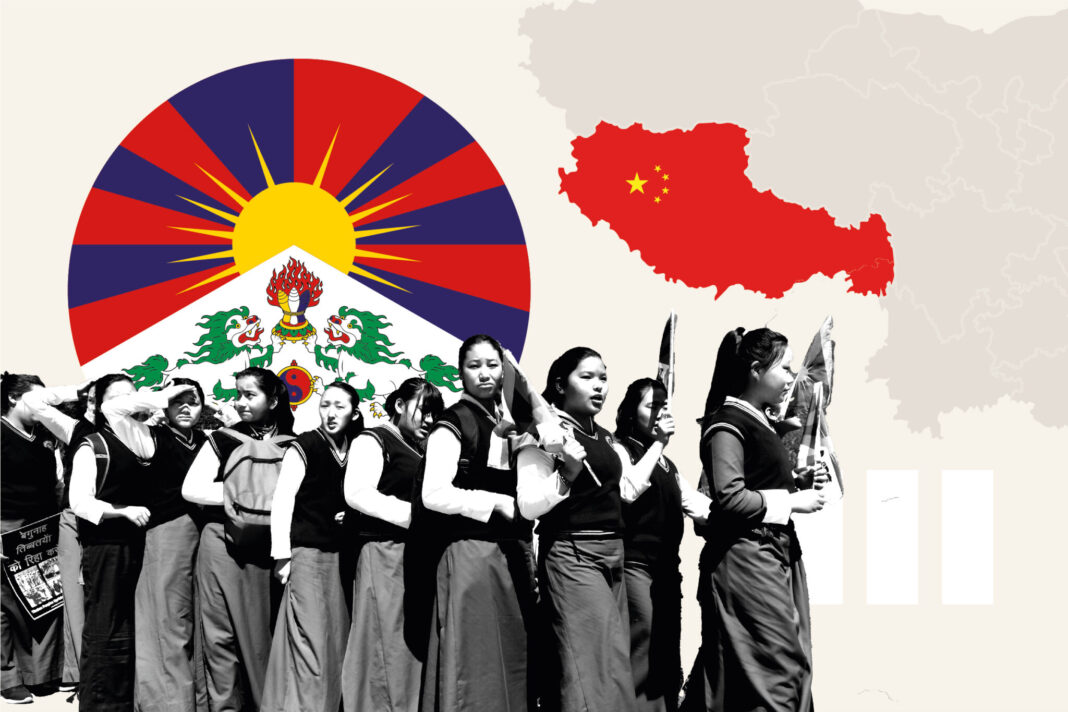

Tibetan children are losing their facility with their native language and the ability to communicate easily with their parents and grandparents in Tibetan, experts of the United Nations Office for the High Commissioner of Human Rights have noted with alarm in a report published in June 2025. This is contributing to their assimilation with the Han culture and leading to the erosion of their identity.
BBC has quoted the experience of a Tibetan educational sociologist. After observing in a family dinner two of his grandnieces who had been sent away to boarding school when they were four and six years’ old he realized that they felt awkward speaking their mother tongue. “The way they were sitting there made me think they were not comfortable sharing the same identity as their family members. They were like guests.” The sociologist has since fled China for Canada.
The Chinese authorities have enforced the separation of one million Tibetan children from their families and their assimilation with the Han way of life at residential schools. “We are very disturbed that in recent years the residential school system for Tibetan children appears to act as a mandatory large-scale programme intended to assimilate Tibetans into the majority Han culture, contrary to international human rights standards,” UN experts said in a report in February 2023.
But the mandarins of the Chinese Communist Party are no respecters of either the United Nations or human rights. In August 2025, they took a step further to complete the cultural genocide of the Tibetans by removing Tibetan language in the college entrance examinations in the plateau.
Chairman of the Tibet Autonomous Region Gama Cedain announced in the first week of August that Tibet, like other provinces of China, would have “unified examination subjects” such as Chinese, mathematics and foreign languages. But Tibetan will no longer be a core subject in the examination. The new policy would come into effect next year. From 2026 only Tibetan students applying for specialized areas of study such as Tibetan literature that require the Tibetan language will be allowed to take the Tibetan language subject test. But this would constitute only a small fraction of the Tibetan students.
The real motive behind the new policy is to repress the use of the Tibetan language in the plateau, the Tibetan government –in-exile in Dharamsala in India says. “Once you no longer have the Tibetan language in your entry examination, it is no longer a legal means of communication or useful to seek a profession or get a job,” Director of Tibet Policy Institute in Dharamsala Dawa Tsering has been quoted. He has accused the Chinese government of preparing to “completely eradicate” the use of the Tibetan language for education, business, travel and office work. Visitors to the Tibet plateau have met with numerous young Tibetan children unable to speak their native language.
The UN High Commission for Human Rights has pointed out that the residential schools have been spread out in the Tibet plateau by the Chinese authorities with the motive to wean Tibetan children of their mother tongue. “In residential schools, the educational content and environment are built around the majority Han culture, with textbook content reflecting almost solely the lived experience of Han students. Children of the Tibetan minority are forced to complete a compulsory education curriculum in Mandarin Chinese, without access to traditional or culturally relevant learning. The Putonghua language (mainland China’s official language) government schools do not provide a substantive study of Tibetan language, history and culture.”
In the Ngaba Prefecture, all core curriculum textbooks in Tibetan schools have been replaced with Chinese-language variants. The teaching staff has been ordered to deliver all classes in Mandarin Chinese. Only the optional Tibetan language classes are to be taught in Tibetan with Tibetan textbooks.
There have been substantial increases in the number of residential schools operating in Tibet and the number of Tibetan children living in them. The concentration of residential schools is more in areas populated by Tibetans than in other parts of China. While at the national level the percentage of boarding students is around 20, in Tibetan areas the vast majority of the children are in residential schools. Rural schools in Tibet are being actively closed and replaced by township- or county-level schools which almost exclusively use Putonghua in teaching and communications and usually require children to board. Many of these residential schools are situated far from the family homes of students boarding them.
“The most challenging aspect of my life was missing my family,” BBC has quoted a Tibetan teenager who had attended a boarding school for several years, till she was 10 years of age when she fled Tibet for India. “There were many other children who missed their families and cried too. Some of the younger ones often woke up in the middle of the night crying and would run to the school gate.”
This inability of Tibetan children to comprehend their mother tongue is having a devastating effect in some areas of traditional learning in Tibet, like traditional Tibetan medicine. In Lhasa Tibetan Medical and Astrological College, there are difficulties in imparting instructions from medical texts as these instructions must be given in Chinese due to the inability of the students to comprehend Tibetan. The astrology department of the college has been forcibly closed due to its religious connections. As a result, Tibetan families now struggle to perform traditional religious funeral rites. Traditional Tibetan medicine, astrology, religious history and historical chronicles face the serious risk of being lost to future generations.
Another diabolical aspect of the conspiracy to wipe out Tibetan culture is the carrying away of Buddhist scriptures from Tibet to mainland China. Most of these scriptures had their origin in the ancient Indian Buddhist university of Nalanda. In the wake of the Mohammedan invasion of India, Buddhist monks had fled with these scriptures to Tibet for their safe custody in the monasteries there. While China has offered the excuse of restoration and preservation behind the move to deprive Tibetan monasteries of their priceless Buddhist scriptures, Research Fellow at Tibet Policy Institute Tsewang Dorji has explained that this is an attempt by the Chinese government to claim Tibetan Buddhism as China’s own while in reality it has its roots in the Nalanda tradition of Buddhism. “China wants to show they are the authoritative figure when it comes to matters of Tibetan Buddhism, so they can interfere in the Dalai Lama’s succession,” Dorji has explained.
Thus, the Chinese conspiracy for the cultural genocide of the Tibetans is multidimensional.