


The Chinese Communist Party is using social media and disinformation campaigns to project its preferred narratives about Xinjiang and influence unwitting audiences around the globe. Instead of improving its treatment of Uyghurs and other Turkic minorities, the CCP is responding to critiques of its human rights record by coordinating its state propaganda apparatus, security agencies and public relations industry to influence and even silence governments, businesses and civil society at home and abroad.
For our new ASPI report, Assessing the impact of CCP information operations related to Xinjiang, we collected and analysed a vast amount of multi-language data, including Chinese government documents and speeches, government statements made to the UN Human Rights Council, corporate responses to Chinese state-affiliated consumer backlashes (regarding Xinjiang-related forced labour), 613,301 Facebook posts, 6,780,809 tweets and retweets, and 494,710 media articles.
The findings come on the back of President Xi Jinping’s recent visit to Xinjiang—his first since 2014. Despite almost a decade of repressive and discriminatory policies, including the arbitrary detention, mass sterilisation and cultural degradation of minorities in Xinjiang, reporting from Xi’s visit showed Uyghurs and other Muslim minority residents apparently waving and cheering the draconian policies they have been forced to live under.
Our research reveals that CCP information operations are successfully silencing governments, businesses and civil society organisations globally and deterring them from criticising the CCP’s humans rights record and actions. CCP online information operations deny, distract and deter voices critical of CCP policies by flooding social media with positive depictions of Xinjiang and whitewashing evidence of human rights abuses. These activities are coordinated with other coercive tactics such as state-affiliated trolling campaigns, cyber surveillance operations and offline harassment.
Xinjiang-focused CCP propaganda and information operations were more effective on Facebook than on other platforms such as Twitter. For example, of the top 400 Facebook posts with the most interactions (including reactions and shares), 60.3% were posted by Chinese state media and diplomats. Of the top 1,000 tweets with the most interactions (including likes and retweets), only 5.5% were posted by Chinese state media and diplomats, and 4% were from accounts suspended by Twitter for platform manipulation.
Social media data collected in this report also confirmed that the CCP and state-affiliated entities are likely deploying coordinated inauthentic accounts to amplify their online public diplomacy and disseminate disinformation. In the top 400 Facebook posts mentioning Xinjiang, there was a statistically significant difference in the number of comments posted by non-CCP Facebook accounts compared to posts from CCP-affiliated accounts with similar numbers of total interactions. Facebook posts by CCP-affiliated accounts tended to have fewer comments than posts by other accounts with a similar number of interactions. One explanation for this could be that CCP-affiliated accounts (such as those of Chinese diplomats and state media) are being inauthentically amplified.
News articles in different languages varied significantly in the tone of their reporting about Xinjiang and reflected differences in global public opinion about the CCP’s policies in the region. Of 494,710 articles analysed in more than 65 languages, Chinese-language articles were more likely to convey positive assessments of Chinese state policy and action in Xinjiang. Statistically similar results came from analyses of articles published in Urdu, Japanese, Thai and Turkish.
Our analysis of government statements at UNHRC sessions that found most countries that have supported CCP policies were based in Africa or the Middle East, which are emerging markets for US-based social media companies, while countries that have condemned CCP policies were mostly democratic nations in Europe and elsewhere. Most notable is the silence of governments in Muslim-majority and non-Western countries. Of the 57 member states forming the Organisation of Islamic Cooperation, only Albania and, more recently, Turkey have condemned the CCP for its policies in Xinjiang.
Countries supporting or condemning CCP human rights abuses in Xinjiang at UNHRC sessions, 2019 to 2021
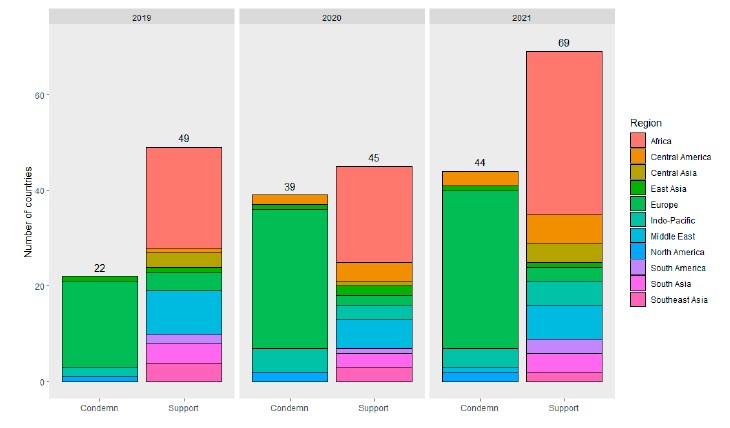
Source: ASPI analysis.
The impact of these operations isn’t widely understood, and the international community—including governments and social media platforms—have failed to adequately respond to the global challenges posed by the CCP’s rapidly evolving propaganda and disinformation operations. The CCP’s public diplomacy is bolstered by covert and coercive campaigns that impose costs and seek to constrain international entities—be they states, corporations or individuals—from offering evidence-based critiques of the party-state’s record on human rights in Xinjiang and Hong Kong and other sensitive issues.
CCP information operations—including those targeting Xinjiang narratives and human rights abuses—should be countered now to mitigate the party’s global campaign of transnational repression and information warfare. Achieving that will require governments and civil society to work more closely with social media platforms and broadcasters to deter and expose propaganda organisations and operatives.
Governments must lead this policymaking process in coordination with allies and partners with shared interests. We recommend expanding economic sanctions regimes that target the perpetrators of serious human rights violations and abuses to include the distributors of disinformation and foreign propaganda who silence, intimidate and continue the abuse.