
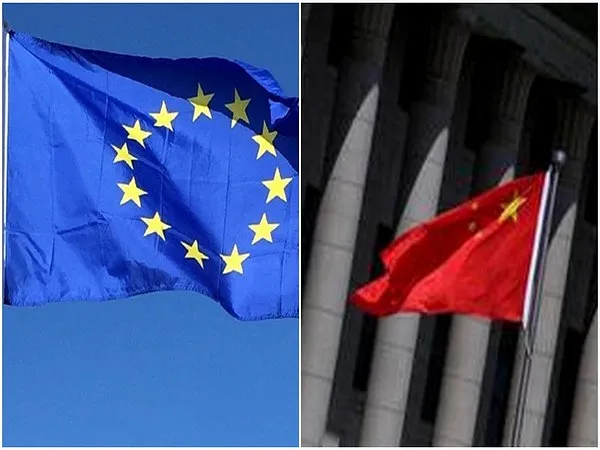

China once saw Europe as a counter to US power, however, the ties are at an abysmal low as China refused to condemn Moscow in the Russia-Ukraine war.
When Chinese leader Xi Jinping made his first state visit to Europe in 2014, he set out to herald a new era of cooperation in a multi-country tour, which the European Parliament President at the time called “a welcome signal of the importance that the new Chinese leader attaches to a strengthened EU-China partnership.”
Eight years later, the optimism of that period has cratered, with the relationship between China and the European Union reaching what analysts call a clear low point of recent decades, reported CNN.
It is China’s most recent calculations over how to respond to Russia’s war in Ukraine that may end up the most costly when it comes to European ties.
As European countries and the US united in support of Ukraine, China refused to condemn the war — instead bolstering its relationship with Russia and joining the Kremlin in finger-pointing at the US and NATO, reported CNN.
There were leading policy analysts in China who understood the negative consequences China’s position would have on its European ties, according to Li Mingjiang, an associate professor and Provost’s Chair in International Relations at Nanyang Technological University’s S Rajaratnam School of International Studies in Singapore. But that assessment may have been “underestimated” by decision-makers, Li said.
Calculations about the geopolitical importance of ties with Russia, and also the close bond between Xi and Russian President Vladimir Putin also likely came to bear, he added.
“It’s a really huge dilemma for China … and they couldn’t afford any major negative consequences on the China-Russia strategic partnership. That imperative really prevailed,” Li said.
There has been an acknowledgement of China’s myopia among mainland scholars, Chen Dingding, founding director of the Intellisia Institute think tank in Guangzhou, wrote in a co-authored article in The Diplomat, that the risks of the war in Ukraine are “not fully understood in China,” where officials and academics had failed to acknowledge the “shock” that death and destruction in Ukraine would bring Europeans.
“The geographic, as well as emotional proximity of the war, will fundamentally change European sentiments toward common security, economic dependencies, and national sovereignty for years to come,” Chen and his international group of coauthors wrote.
European concern about China’s global ambitions and its human rights record, US-China tensions, tit-for-tat sanctions and, now, Russia’s war in Ukraine — the impact of which on China-EU ties Beijing appears to have either underestimated or dismissed — have all brought relations to a nadir, reported CNN.
Both the Group of Seven (G7) advanced economies and NATO significantly hardened their lines on China, in a signal that views in Europe have fallen more in line with Washington’s.
The shift is the culmination of a series of steps in which Beijing may have at times underestimated the extent to which it was pushing Europe away, but also appeared prepared to pay that price.
US concerns about the risks of collaboration with China resonated in Europe. And European nations were themselves watching Xi’s China grow increasingly assertive in its foreign policy, from the combative tone of its “wolf warrior” diplomats to the establishment of a naval base in Africa, rising aggressiveness in the South China Sea and toward Taiwan, and the targeting of companies or countries that ran foul of its line on hot-button issues, reported CNN.
Allegations of major human rights violations in China’s north-western region of Xinjiang, and its dismantling of civil society in Hong Kong also played a role in shifting European perceptions, analysts said.
China was the third largest export market for European goods and the largest source of products entering Europe last year, but frictions have taken their toll on the economic relationship between the EU and Beijing, reported CNN.
Earlier this year, a dispute between China and Lithuania pushed the EU to level a case at the WTO. It accused Beijing of “discriminatory trade practices against Lithuania” in retaliation for what Beijing views as a violation by the Baltic state of its “One China” principle, by which it claims self-ruled Taiwan as its sovereign territory.
The greatest financial casualty was the long-awaited trade deal between the EU and China, which stalled last year after being caught in the crossfire of a sanctions exchange.
Beijing slapped penalties on EU lawmakers and bodies, European think tanks and independent scholars after the EU sanctioned four Chinese officials for alleged abuses in Xinjiang.