
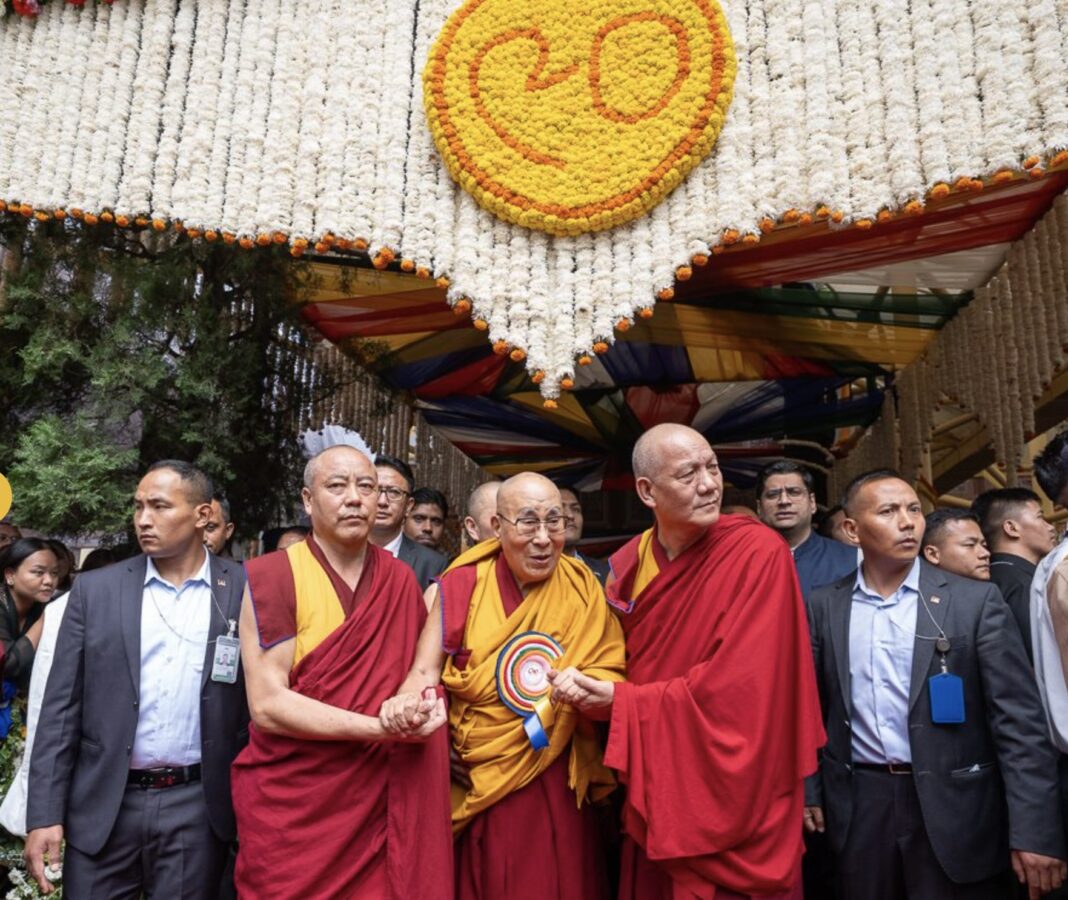

As the Dalai Lama turns 90, the world is once again reminded of a quiet paradox: the spiritual leader of a stateless people has outlasted every Chinese ruler who sought to erase his influence. From Mao Zedong to Xi Jinping, the Chinese Communist Party (CCP) has waged a relentless campaign to control, co-opt, or crush the Tibetan cause.
Yet the Dalai Lama remains—serene, principled, and globally revered. The same cannot be said with certainty about the regime that has tried to silence him. When Mao famously told the young Dalai Lama that “religion is poison,” he likely believed that time and power were on his side. In 1959, after a failed uprising, the Dalai Lama fled Tibet and began a life in exile. The CCP assumed that distance and propaganda would diminish his relevance. Instead, exile became a platform. Over the next seven decades, the Dalai Lama transformed from a regional monarch into a global moral voice—winning the Nobel Peace Prize, meeting world leaders, and inspiring millions with his message of compassion and nonviolence.
Meanwhile, China’s leaders have come and gone. Mao’s Cultural Revolution gave way to Deng Xiaoping’s pragmatism, Jiang Zemin’s technocracy, Hu Jintao’s cautious conservatism, and now Xi Jinping’s authoritarian revival. Each era brought new tactics—some subtle, others brutal—but the goal remained the same: to extinguish the Tibetan identity and replace it with a sanitized, state-approved version of Buddhism. Yet the Dalai Lama’s moral clarity has consistently exposed the hollowness of these efforts. What explains his resilience? First, the Dalai Lama’s authority is rooted not in coercion, but in conscience. He leads not by decree, but by example. His commitment to nonviolence, even in the face of cultural genocide, has earned him a legitimacy that no government edict can manufacture. Second, his message transcends politics.
While Beijing speaks the language of power, the Dalai Lama speaks to the human spirit—about kindness, interdependence, and the universal longing for freedom. And third, he has adapted without compromising. By voluntarily devolving political power to an elected Tibetan government-in-exile, he ensured the continuity of Tibetan democracy. By affirming that his reincarnation will be chosen outside of Chinese control, he has preempted Beijing’s attempt to install a puppet successor. In doing so, he has turned the succession question into a referendum on legitimacy—and the world is watching. The irony is stark: a man without an army, without a state, without territory, has endured longer than the most powerful authoritarian regime on earth. And while the Dalai Lama has aged with grace, the CCP has aged with anxiety—tightening its grip, fearing dissent, and investing more in surveillance than in trust.
No one lives forever. But legacies do. The Dalai Lama’s legacy is one of spiritual endurance, cultural preservation, and moral courage. The CCP’s legacy, by contrast, is still being written—and it is unclear whether it will be remembered for its economic rise or for its repression. In the end, history may record that the monk outlasted the empire—not because he wielded power, but because he embodied truth.