

It’s been 22 years since the Taliban destroyed the giant Bamiyan Buddha statues in 2001, an act that deeply hurt Buddhists worldwide and marked the Taliban regime’s swift downfall, leading to two decades of chaos in Afghanistan. Tragically, a 99-foot-tall Buddha statue in Tibet was demolished on December 12, 2021, by the Chinese government. This statue, a community effort in Drango, Eastern Tibet, was built with local authorities’ permissions to invoke protection against frequent natural disasters in the area.
Reliable sources reported that, before demolishing the statue, the Chinese government forcibly destroyed a school educating around a hundred children and dismantled 45 Buddhist prayer wheels. These actions contradict their claims of religious freedom in Tibet, signaling increased repression. The demolition by Chinese officials deeply hurt Tibetan cultural and religious sentiments, intensifying fear and resentment. Despite the 1951 Seventeen Point Agreement promising to respect Tibetan traditions, repression has intensified since Mao’s Cultural Revolution, and especially under Xi Jinping, restricting religious freedoms in Tibet, Xinjiang, and Inner Mongolia.
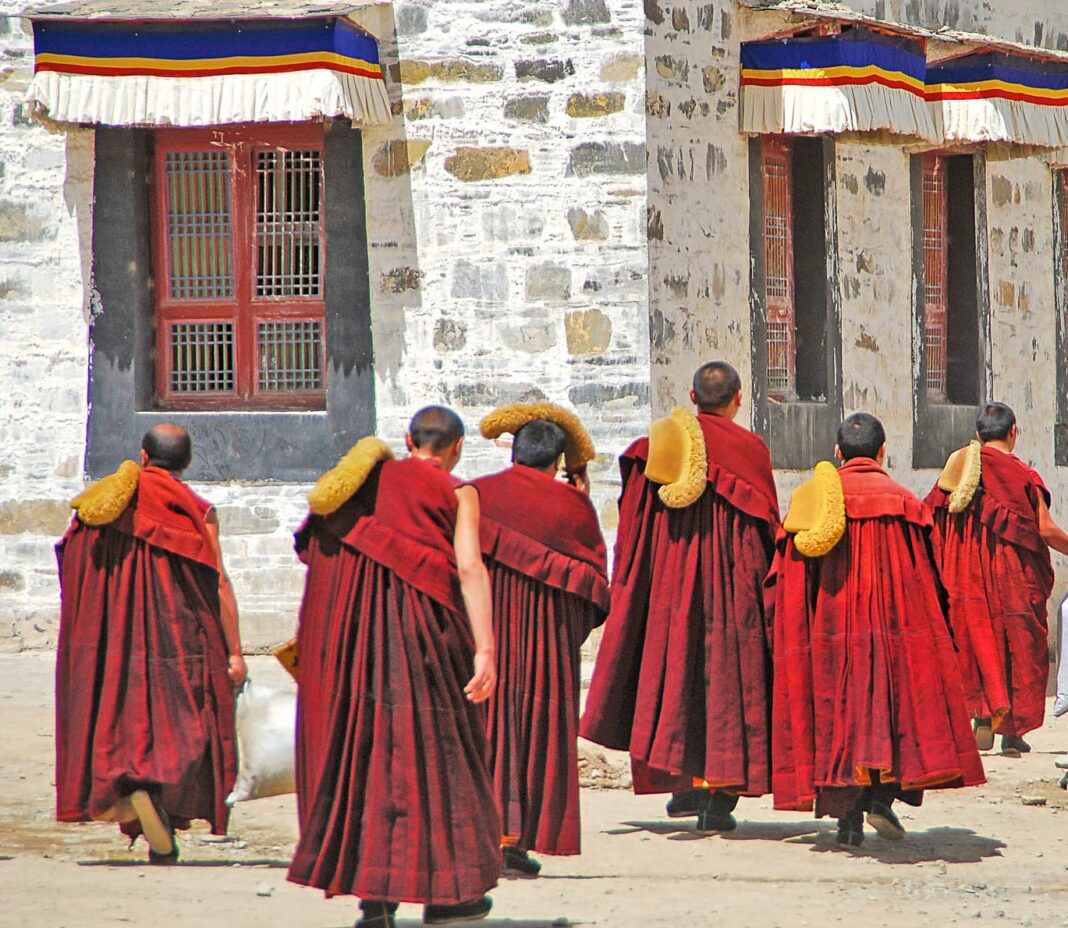
Tibetan culture and religion are deeply intertwined, making them hard to separate. Tibetan Buddhism’s traditions play a crucial role in the culture, not just in religious practices but also in spreading education and preserving Tibet’s rich cultural heritage and language. Historically, Tibetan monasteries have been central to learning and development, even before an established education system existed in Tibet. The curriculum across most monastic centers is largely uniform, with only slight variations according to specific traditions.
Tibet boasts a literary heritage that spans over 1,300 years, making it one of Asia’s most extensive and influential traditions. Central to Tibetan Buddhism are essential religious philosophies, often passed down orally from master to disciple rather than through written texts. This philosophical tradition has bolstered the religious and political authority of those overseeing educational institutions, equipping them to provide rigorous training in logic and philosophy. As a result, Tibetan monasteries have a profound impact on national identity, language, religion, and cultural traditions.
The CCP has heavily suppressed Tibetan Buddhism, demolishing monasteries and drastically limiting monks and nuns. Sera Monastery, once home to 8,000-10,000 monks, was the world’s second-largest monastery. However, during the 1959 seizure of Lhasa, Chinese forces bombed it, destroying monastic living quarters. Today, Sera Monastery has only about 500 monks due to restrictions by Chinese authorities. Barbara Demick’s book, “Eat the Buddha: Life and Death in a Tibetan Town,” highlights that in Chinese-occupied Tibet, no one can become a monk before the age of eighteen, and all monks are required to attend CCP propaganda lectures. This directly contravenes ancient Tibetan traditions.
These ongoing changes aim to erase religious and cultural identities among Tibetans through harassment and torture. Efforts to control monastery activities are intensifying across Tibet. These drastic policy shifts against various religions, including Tibetan Buddhism and Islam in Xinjiang, illustrate Xi Jinping’s escalating repression and disregard for the religious sentiments of millions in Tibet and across China.
In a paper titled “China: First CCP National Conference on Religion Held Since 2016,” dissident scholar Hu Zimo (pseudonym) described President Xi Jinping’s announcement of a more severe crackdown on religion on August 12, 2021. The conference, attended by all top CCP leaders, highlighted the scale of the planned oppressions. In his speech, Xi Jinping identified ‘problems’ in religious propagation and called for increased Marxism, internet surveillance, and sinicization. He also demanded the prevention of what he termed ‘religious propaganda’ on social media.
An illustrative case of these plans in action involves Blued, a major social network launched in 2012 that’s popular within China’s gay community. On April 12, 2021, Chen Tao’s article “Chinese LGBT Social Media App Banned Users from Posting Religious Content” reported that individuals in China are strictly forbidden from expressing religious opinions on this platform. While some religious posts still appear, accounts are blocked by Chinese Authorities if the authors are discovered.
On January 3, 2021, The Global Times revealed that the CCP aims to control the reincarnation of Tibetan Living Buddhas to manage succession within Tibetan Buddhism. In 2016, the State Administration of Religious Affairs mandated CCP approval for all reincarnated Lamas, including ‘living Buddhas.’ Even the 14th Dalai Lama, in exile, was included. The CCP’s objective is to dominate all aspects of Buddhism, allowing only those spiritual figures with its endorsement.
In a paper titled “Chinese Authorities Double Down on Tibetan Reincarnation,” published on December 14, 2021, Sophie Richardson highlighted the Communist Party’s aim to take complete control over the selection of the next Dalai Lama. Thubten Samphel, the former Director of the Tibet Policy Institute, noted that if Beijing successfully appoints the next Dalai Lama, it would bring the entire Buddhist Himalayan region under its influence without any conflict.
Tibetan monasteries play a crucial role in education and national identity in Tibet. The scholarly training they provide has preserved the region’s culture, religion, and language. By offering education, monasteries instill faith in tradition and equip individuals with the means to protect their endangered nationality. This stands in stark contrast to Communist ideology. Consequently, most self-immolations in Tibet, protesting Chinese oppression, are carried out by monks. This is why Xi Jinping opposes traditional Buddhism in Tibet and why his forces are demolishing revered Buddha statues.