
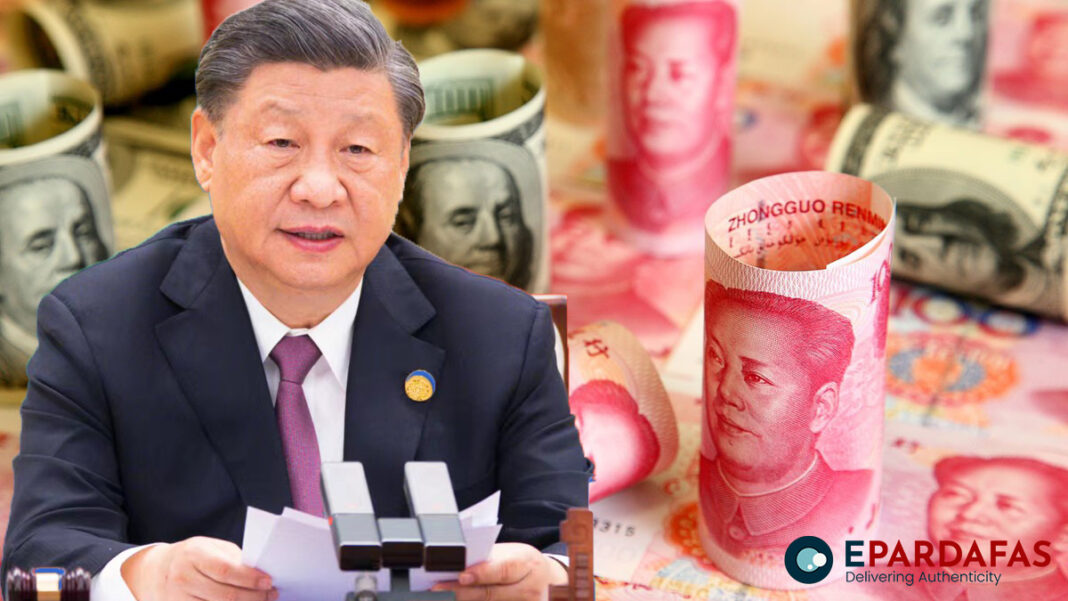

China, once propelled by an economic model marked by rapid infrastructure development and robust growth, finds itself grappling with signs of distress and uncertainty. The approach that lifted China out of poverty and catapulted it to global prominence is showing cracks, leaving many to ponder the nation’s future trajectory.
This economic model that thrived as China played catch-up with developed economies now appears less viable in a landscape marked by excessive debt and a dearth of new infrastructure projects. Parts of China are grappling with underutilized bridges, unoccupied apartments, and diminishing returns on investment.
Despite China’s impressive economic data, these distress signals extend to far-flung provinces, such as Yunnan in the southwest, where significant investments continue to be made in seemingly unnecessary projects, even as China has moved past its “zero-Covid” policy.
Experts believe that China is entering an era of slower growth, exacerbated by unfavorable demographics and growing tensions with the U.S. and its allies. This not only jeopardizes foreign investment and trade but also marks a potential turning point in China’s decades-long economic ascent.
The International Monetary Fund predicts that China’s GDP growth will remain below 4% in the coming years, a marked decline from the nearly double-digit growth of the past. Capital Economics, a London-based research firm, suggests that China’s growth rate has slowed from 5% in 2019 to around 2% by 2030.
Such a scenario would hinder China’s goal, set by President Xi Jinping in 2020, of doubling the economy’s size by 2035. This has implications for China’s aspiration to surpass the U.S. as the world’s largest economy.
Though China’s history is replete with predictions of economic downfall that failed to materialize, there’s a consensus that the country is confronting a new reality where its old methods of growth are yielding diminishing returns. The once-successful strategy of heavy investment in infrastructure now faces challenges of overcapacity and declining returns.
While China’s emergence as a global economic powerhouse was underscored by impressive growth rates and increased investment in hard assets like factories and transportation networks, these investments have led to diminishing returns over time. China’s current investment-to-GDP ratio has climbed, but the returns are declining.
China’s labor force is shrinking, and productivity growth is tapering off. In the past decade, productivity gains have contributed less to GDP growth. The country’s heavy debt load, much of which is shouldered by local governments and state-owned enterprises, has reached unsustainable levels.
China’s future path may necessitate a shift towards consumer spending and the service sector, mirroring more developed economies. Yet, there’s skepticism about this approach among some leaders, who view such a transition as risky. The government may need to encourage people to spend more by enhancing social safety nets and benefits.
China’s leadership remains focused on state intervention, strengthening industries like semiconductors, electric vehicles, and AI. While these industries may contribute to growth, experts warn they might not be sufficient to sustain the entire economy.
China’s economic evolution marks a pivotal point in its journey. The nation must grapple with shifting dynamics, diminishing returns, and the need for innovation and adaptation. As China seeks to navigate these challenges, it faces the task of balancing economic development with social stability and political control.
english.pardafas.com